This post is older than 2 years and might not be relevant anymore
More Info: Consider searching for newer posts

Configuration UARTE with nrf52805 for ESB - Part 2


My previous ticket is closed. I would need, but still help with the configuration of the pins. I report my last post.

Hello,
I did some tests with the oscilloscope directly connected to pins 21 and 18 of the nrf52805.
The transmission on pin 18 by the Stm8l works perfectly. The problem I encounter now is that nrf52805 I have the pull up instruction on this pin

 nrf_gpio_cfg_input(PIN_RXD,GPIO_PIN_CNF_PULL_Pullup);

but nothing happens when oscilloscopes.
It could be that I get the pin definition wrong initially

 #define UARTE_BASE           0x40002000
  #define PORTA_UARTE          ((NRF_UARTE_Type *) UARTE_BASE )
  #define PIN_TXD            21
  #define PIN_RXD            18


or the pull up configuration of pin 18, set as input and pin 21 as output?

 nrf_gpio_cfg_input(PIN_RXD,GPIO_PIN_CNF_PULL_Pullup);
     nrf_gpio_cfg_output(PIN_TXD);
  • perfect now I share the Tx project of the nrf52805, as it is the project that receives from my stm8 (being the master) the data, stm8 transmits them to the nrf52805 via Uarte and then from here the data are transmitted via ESB protocol to another nrf52805. The mistakes I had are in this link.esb_ptx - 01_10.rar
  • Good morning,

    Do you have news for me? Have you tested my project sent to you two weeks ago?
  • Hi,

    Sorry for the delay. I took a look at the code.

    Since you have APP_UART_FLOW_CONTROL_ENABLED, you also want to set the CTS and RTS pin:

            .cts_pin_no   = CTS_PIN;
            .rts_pin_no   = RTS_PIN;

    Instead of calling nrf_esb_write_payload() all the time in the main()-while-loop, you can instead call it in the UART handler.

    Something like this:

    /**
     * Copyright (c) 2014 - 2020, Nordic Semiconductor ASA
     *
     * All rights reserved.
     *
     * Redistribution and use in source and binary forms, with or without modification,
     * are permitted provided that the following conditions are met:
     *
     * 1. Redistributions of source code must retain the above copyright notice, this
     *    list of conditions and the following disclaimer.
     *
     * 2. Redistributions in binary form, except as embedded into a Nordic
     *    Semiconductor ASA integrated circuit in a product or a software update for
     *    such product, must reproduce the above copyright notice, this list of
     *    conditions and the following disclaimer in the documentation and/or other
     *    materials provided with the distribution.
     *
     * 3. Neither the name of Nordic Semiconductor ASA nor the names of its
     *    contributors may be used to endorse or promote products derived from this
     *    software without specific prior written permission.
     *
     * 4. This software, with or without modification, must only be used with a
     *    Nordic Semiconductor ASA integrated circuit.
     *
     * 5. Any software provided in binary form under this license must not be reverse
     *    engineered, decompiled, modified and/or disassembled.
     *
     * THIS SOFTWARE IS PROVIDED BY NORDIC SEMICONDUCTOR ASA "AS IS" AND ANY EXPRESS
     * OR IMPLIED WARRANTIES, INCLUDING, BUT NOT LIMITED TO, THE IMPLIED WARRANTIES
     * OF MERCHANTABILITY, NONINFRINGEMENT, AND FITNESS FOR A PARTICULAR PURPOSE ARE
     * DISCLAIMED. IN NO EVENT SHALL NORDIC SEMICONDUCTOR ASA OR CONTRIBUTORS BE
     * LIABLE FOR ANY DIRECT, INDIRECT, INCIDENTAL, SPECIAL, EXEMPLARY, OR
     * CONSEQUENTIAL DAMAGES (INCLUDING, BUT NOT LIMITED TO, PROCUREMENT OF SUBSTITUTE
     * GOODS OR SERVICES; LOSS OF USE, DATA, OR PROFITS; OR BUSINESS INTERRUPTION)
     * HOWEVER CAUSED AND ON ANY THEORY OF LIABILITY, WHETHER IN CONTRACT, STRICT
     * LIABILITY, OR TORT (INCLUDING NEGLIGENCE OR OTHERWISE) ARISING IN ANY WAY OUT
     * OF THE USE OF THIS SOFTWARE, EVEN IF ADVISED OF THE POSSIBILITY OF SUCH DAMAGE.
     *
     */
    #include <stdbool.h>
    #include <stdint.h>
    #include <string.h>
    
    #include "nrf.h"
    #include "nrf_esb.h"
    #include "nrf_error.h"
    #include "nrf_esb_error_codes.h"
    #include "nrf_delay.h"
    #include "nrf_gpio.h"
    #include "app_uart.h"
    
    #include "nrf_uarte.h"
    
    #include "boards.h" //rimane per i led 
    
    #include "nrf_delay.h"
    #include "app_util.h"
    #include "nrf_log.h"
    #include "nrf_log_ctrl.h"
    #include "nrf_log_default_backends.h"
    #include "sdk_common.h"


      #define UARTE_BASE           0x40002000
      #define PORTA_UARTE          ((NRF_UARTE_Type *) UARTE_BASE )
      #define PORTA_TXD            6
      #define PORTA_RXD            8
      #define PORTA_RTS            5
      #define PORTA_CTS            7
      
      #define UART_TX_BUF_SIZE                256                                         /**< UART TX buffer size. */
      #define UART_RX_BUF_SIZE                256                                         /**< UART RX buffer size. */
    
    static nrf_esb_payload_t        tx_payload = NRF_ESB_CREATE_PAYLOAD(0, 0x01, 0x00, 0x00, 0x00, 0x11, 0x00, 0x00, 0x00);
    static nrf_esb_payload_t        rx_payload;
    
    /**@brief   Function for handling app_uart events.
     *
     * @details This function will receive a single character from the app_uart module and append it to
     *          a string. The string will be be sent over BLE when the last character received was a
     *          'new line' '\n' (hex 0x0A) or if the string has reached the maximum data length.
     */
    /**@snippet [Handling the data received over UART] */
    void uart_event_handle(app_uart_evt_t * p_event)
    {
       
        static uint8_t index = 0;
        uint32_t       err_code;
    
        switch (p_event->evt_type)
        {
            case APP_UART_DATA_READY:
                UNUSED_VARIABLE(app_uart_get(&tx_payload.data[index]));
                index++;
    
                if ((tx_payload.data[index - 1] == '\n') ||
                    (tx_payload.data[index - 1] == '\r') ||
                    (index >= 20))// valore massimo da poter invare su uart suggerimento preso dall'esempio del ble_uart
                {
                    if (index > 1)
                    {
                        nrf_esb_write_payload(&tx_payload);
                        NRF_LOG_DEBUG("Ready to send data over ESB");
                        NRF_LOG_HEXDUMP_DEBUG(tx_payload.data, index);
                    }
    
                    index = 0;
                }
                break;
    
            case APP_UART_COMMUNICATION_ERROR:
                APP_ERROR_HANDLER(p_event->data.error_communication);
                break;
    
            case APP_UART_FIFO_ERROR:
                APP_ERROR_HANDLER(p_event->data.error_code);
                break;
    
            default:
                break;
        }
    }
    /**@snippet [Handling the data received over UART] */
    
    
    static void uart_init(void)
    {
        uint32_t                     err_code;
        app_uart_comm_params_t const comm_params =
        {
            .rx_pin_no    = PORTA_RXD,
            .tx_pin_no    = PORTA_TXD,
            .cts_pin_no   = PORTA_CTS,
            .rts_pin_no   = PORTA_RTS,
            .flow_control = APP_UART_FLOW_CONTROL_ENABLED,
            .use_parity   = false,
    #if defined (UART_PRESENT)
            .baud_rate    = NRF_UARTE_BAUDRATE_2400
    #else
            .baud_rate    = NRF_UARTE_BAUDRATE_115200
    #endif
        };
    
        APP_UART_FIFO_INIT(&comm_params,
                           UART_RX_BUF_SIZE,
                           UART_TX_BUF_SIZE,
                           uart_event_handle,
                           APP_IRQ_PRIORITY_LOWEST,
                           err_code);
        APP_ERROR_CHECK(err_code);
    }
    
    void nrf_esb_event_handler(nrf_esb_evt_t const * p_event)
    {
    
        switch (p_event->evt_id)
        {
            case NRF_ESB_EVENT_TX_SUCCESS:
             //   NRF_LOG_DEBUG("TX SUCCESS EVENT");
                break;
            case NRF_ESB_EVENT_TX_FAILED:
             //   NRF_LOG_DEBUG("TX FAILED EVENT");
                (void) nrf_esb_flush_tx();
                (void) nrf_esb_start_tx();
                break;
            case NRF_ESB_EVENT_RX_RECEIVED:
            //    NRF_LOG_DEBUG("RX RECEIVED EVENT");
                while (nrf_esb_read_rx_payload(&rx_payload) == NRF_SUCCESS)
                {
                    if (rx_payload.length > 0)
                    {
                //        NRF_LOG_DEBUG("RX RECEIVED PAYLOAD");
                    }
                }
                break;
        }
    }
    
    
    void clocks_start( void )
    {
        NRF_CLOCK->EVENTS_HFCLKSTARTED = 0;
        NRF_CLOCK->TASKS_HFCLKSTART = 1;
    
        while (NRF_CLOCK->EVENTS_HFCLKSTARTED == 0);
    }
    
    
    void gpio_init( void )
    {
        nrf_gpio_range_cfg_output(8, 15);
        bsp_board_init(BSP_INIT_LEDS);
    }
    
    
    uint32_t esb_init( void )
    {
        uint32_t err_code;
        uint8_t base_addr_0[4] = {0xE7, 0xE7, 0xE7, 0xE7};
        uint8_t base_addr_1[4] = {0xC2, 0xC2, 0xC2, 0xC2};
        uint8_t addr_prefix[8] = {0xE7, 0xC2, 0xC3, 0xC4, 0xC5, 0xC6, 0xC7, 0xC8 };
    
        nrf_esb_config_t nrf_esb_config         = NRF_ESB_DEFAULT_CONFIG;
        nrf_esb_config.protocol                 = NRF_ESB_PROTOCOL_ESB_DPL;
        nrf_esb_config.retransmit_delay         = 600;
        nrf_esb_config.bitrate                  = NRF_ESB_BITRATE_2MBPS;
        nrf_esb_config.event_handler            = nrf_esb_event_handler;
        nrf_esb_config.mode                     = NRF_ESB_MODE_PTX;
        nrf_esb_config.selective_auto_ack       = false;
    
        err_code = nrf_esb_init(&nrf_esb_config);
    
        VERIFY_SUCCESS(err_code);
    
        err_code = nrf_esb_set_base_address_0(base_addr_0);
        VERIFY_SUCCESS(err_code);
    
        err_code = nrf_esb_set_base_address_1(base_addr_1);
        VERIFY_SUCCESS(err_code);
    
        err_code = nrf_esb_set_prefixes(addr_prefix, NRF_ESB_PIPE_COUNT);
        VERIFY_SUCCESS(err_code);
    
        return err_code;
    }
    
    
    int main(void)
    {
         ret_code_t err_code;
         
         gpio_init();
         uart_init();
         
         
         err_code = NRF_LOG_INIT(NULL);
         APP_ERROR_CHECK(err_code);
         
         NRF_LOG_DEFAULT_BACKENDS_INIT();
    
         clocks_start();
    
         err_code = esb_init();
         APP_ERROR_CHECK(err_code);
        
         NRF_LOG_INFO("Enhanced ShockBurst Transmitter Example started.");
        
         while (true)
         {
            __SEV();
            __WFE();
            __WFE();
        
         }
       
    }
    

    PS: I also set NRFX_PRS_BOX_2_ENABLED to 1 in sdk_config.h to in order to get it to compile.

    Here is the SES project I used to run it "emulated" on a nRF52832-DK:

    esb_ptx_modified.zip

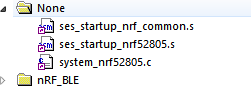
    If you run it on a real nRF52805, you want to use these startup-files instead:

      , and remove the DEVELOP_IN_NRF52832 preprocessor define.

    BR,

    Sigurd

  • thanks, now I will try your changes and let you know how the test went
  • Good morning I looked at the code you sent me and the comments you put me on the previous post: the CTS and RTS pins I did not configure them because we did not provide them. as for the function esb_write_payload() I have not yet moved it from the main as the problem I have is still in the phase of receiving data on uart by the nrf52... from the stm8, however when this part will work I will certainly move the function from the main loop. One question alone is not clear to me: NRFX_PRS_BOX_2_ENABLED you had to set it to 1 to make it compile but I without touching the file sdk_config compiled quietly is due then, to the speech that you had a nrf52832_DK so I have to bring it back to 0 to compile?
Related