

Hardware: nRF5340DK
Software: SDK version v2.5.1
Description:
We are using the nrfx_spis driver and are debugging interrupt latency as we have tight timings to reload the SPIS DMA buffers. (<12.5us)
We are using CONFIG_ZERO_LATENCY_IRQS in an effort to keep the interrupt latency as short as possible.
Running our SPIS driver code with no other code running on the device, we see a ~4.5us interrupt latency from when the CS line goes HIGH and when our debug toggle IO.
Here is an example of this: I have a IO toggle in my own spis_handler as well as the irq_handler in nrfx_spis.c. Here the timing makes sense, <2us to enter the nrfx_spis handler, and another ~2us to get to our user handler.
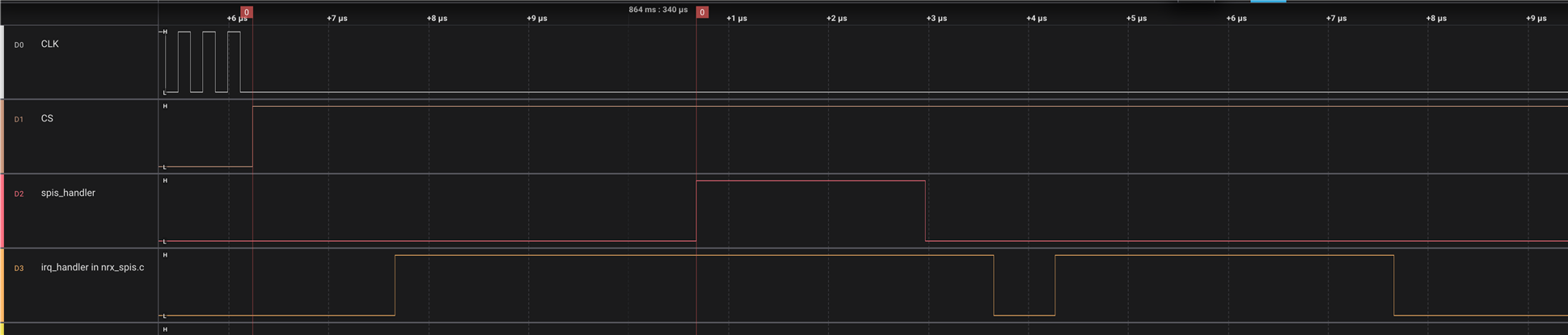
Here is the relavant code:
#define BUFFER_SIZE (768)
#define BUFFER_COUNT 2UL  // Double Buffer
static uint16_t dma_buf[BUFFER_COUNT][BUFFER_SIZE];
static uint16_t dummy_buf[BUFFER_SIZE] = {0};

  /////***** SPIS Setup *****/////
  nrfx_spis_config_t spis_config = {
      .miso_pin = MISO_PIN,                       //
      .mosi_pin = MOSI_PIN,                       //
      .sck_pin = SCK_PIN,                         //
      .csn_pin = CSN_PIN,                         //
      .mode = NRF_SPIS_MODE_0,                    //
      .bit_order = NRF_SPIS_BIT_ORDER_MSB_FIRST,  //
      .csn_pullup = NRF_GPIO_PIN_NOPULL,          //
      .miso_drive = NRF_GPIO_PIN_S0S1,            //
      .def = 0xFF,                                //
      .orc = 0xFE,                                //
      .irq_priority = 0,                          //
      .skip_gpio_cfg = false,                     //
      .skip_psel_cfg = false,                     //
  };

  err = nrfx_spis_init(&spis_inst, &spis_config, spis_handler, &spis_inst);
  if (err != NRFX_SUCCESS) {
    LOG_ERR("nrfx_spis_init");
  }

  IRQ_DIRECT_CONNECT(NRFX_IRQ_NUMBER_GET(NRF_SPIS_INST_GET(SPIS_INST_IDX)), 0,
                     NRFX_SPIS_INST_HANDLER_GET(SPIS_INST_IDX),
                     IRQ_ZERO_LATENCY);

  /////***** Start first transaction *****/////
  status =
      nrfx_spis_buffers_set(&spis_inst, (uint8_t*)dummy_buf, sizeof(dummy_buf),
                            (uint8_t*)&dma_buf[0], sizeof(dma_buf[0]));
  if (status != NRFX_SUCCESS) {
    LOG_ERR("nrfx_spis_buffers_set");
  }

static void spis_handler(nrfx_spis_evt_t const* p_event, void* p_context) {
  nrfx_err_t status;

  if (p_event->evt_type == NRFX_SPIS_XFER_DONE) {
    gpio_pin_set_dt(&debug_pin, 1);
    static uint32_t buffer_inx = 0;

    if (buffer_inx == 0) {
      buffer_inx = 1;
      buf0_ready = true;

    } else {
      buffer_inx = 0;
      buf1_ready = true;
    }

    // Queue next
    status = nrfx_spis_buffers_set(
        &spis_inst, (uint8_t*)dummy_buf, sizeof(dummy_buf),
        (uint8_t*)&dma_buf[buffer_inx], sizeof(dma_buf[buffer_inx]));
    if (status != NRFX_SUCCESS) {
      LOG_ERR("nrfx_spis_buffers_set");
    }
    gpio_pin_set_dt(&debug_pin, 0);
  }
}
Issue:
However, we are encountering a ~12.5us increase in latency when a background task is running.
Here is the additional relevant code:
#define TASK_STACKSIZE 1024
#define TASK_PRIORITY 4
#define TASK_NAME "fpga"

void FPGA_Init(void)
{
  k_tid_t fpga_task_tid =
      k_thread_create(&fpga_task_thread, fpga_task_stack,
                      K_THREAD_STACK_SIZEOF(fpga_task_stack), fpga_task, NULL,
                      NULL, NULL, TASK_PRIORITY, 0, K_NO_WAIT);
  k_thread_name_set(fpga_task_tid, TASK_NAME);
}


void fpga_task(void* arg1, void* arg2, void* arg3) {
  while (1) {
    gpio_pin_set_dt(&fpga_reset_pin, 1);
    k_msleep(5);
    gpio_pin_set_dt(&fpga_reset_pin, 0);
    k_msleep(5);
  }
}
Here is the logic capture:

The time-in-interrupt looks the same. There is simply a large shift in when the interrupt is serviced.
My hunch is that there is some kernel-call happening within the SPIS library irq_handler that is causing this delay sometimes, and this is related to a task running?
Any help is appreciated.

