

This is a continuation of the following ticket: Softdevice Controller: TX with 100% duty cycle scanning in v2.3
The resolution was logged as DRGN-19197, which was part of v2.4.0, but did not resolved the issue.
I have created a minimal reproduction based on the `zephyr/samples/bluetooth/scan_adv with the nRF52840DK.
The only additional Kconfig required is `CONFIG_BT_EXT_ADV=y`.
This reproduction starts scanning with 100% uptime and once a second attempts to create an Advertising set.
/* main.c - Application main entry point */

/*
 * Copyright (c) 2015-2016 Intel Corporation
 *
 * SPDX-License-Identifier: Apache-2.0
 */

#include <zephyr/types.h>
#include <stddef.h>
#include <zephyr/sys/printk.h>
#include <zephyr/sys/util.h>

#include <zephyr/bluetooth/bluetooth.h>

static uint8_t mfg_data[] = { 0xff, 0xff, 0x00 };

static const struct bt_data ad[] = {
	BT_DATA_BYTES(BT_DATA_FLAGS, (BT_LE_AD_GENERAL | BT_LE_AD_NO_BREDR)),
	BT_DATA(BT_DATA_MANUFACTURER_DATA, mfg_data, 3),
};

static void scan_cb(const bt_addr_le_t *addr, int8_t rssi, uint8_t adv_type,
		    struct net_buf_simple *buf)
{
	mfg_data[2]++;
}


static void adv_set_complete(struct bt_le_ext_adv *adv, struct bt_le_ext_adv_sent_info *info)
{
	printk("Advertising set complete after %d events\n", info->num_sent);
	(void)bt_le_ext_adv_delete(adv);
}

static const struct bt_le_ext_adv_cb adv_cb = {
	.sent = adv_set_complete,
};
static struct bt_le_ext_adv_start_param adv_start_param = {
	.timeout = 0,
	.num_events = 1,
};

int main(void)
{
	struct bt_le_scan_param scan_param = {
		.type       = BT_LE_SCAN_TYPE_PASSIVE,
		.options    = BT_LE_SCAN_OPT_NONE,
		.interval   = 0x0010,
		.window     = 0x0010,
	};
	struct bt_le_adv_param adv_param = {
		.id = BT_ID_DEFAULT,
		.sid = 0U,
		.secondary_max_skip = 0U,
		.options = BT_LE_ADV_OPT_USE_IDENTITY | BT_LE_ADV_OPT_EXT_ADV,
		.interval_min = BT_GAP_ADV_FAST_INT_MIN_1,
		.interval_max = BT_GAP_ADV_FAST_INT_MAX_1,
		.peer = NULL,
	};
	struct bt_le_ext_adv *adv;
	int err;


	printk("Starting Scanner/Advertiser Demo\n");

	/* Initialize the Bluetooth Subsystem */
	err = bt_enable(NULL);
	if (err) {
		printk("Bluetooth init failed (err %d)\n", err);
		return 0;
	}

	printk("Bluetooth initialized\n");

	err = bt_le_scan_start(&scan_param, scan_cb);
	if (err) {
		printk("Starting scanning failed (err %d)\n", err);
		return 0;
	}

	do {
		k_sleep(K_MSEC(1000));

		/* Create advertising set */
		err = bt_le_ext_adv_create(&adv_param, &adv_cb, &adv);
		if (err < 0) {
			printk("Failed to create advertising set (%d)\n", err);
			continue;
		}

		/* Set extended advertising data */
		err = bt_le_ext_adv_set_data(adv, ad, ARRAY_SIZE(ad), NULL, 0);
		if (err != 0) {
			printk("Failed to set advertising data (%d)\n", err);
			(void)bt_le_ext_adv_delete(adv);
			continue;
		}

		err = bt_le_ext_adv_start(adv, &adv_start_param);
		if (err != 0) {
			printk("Failed to start advertising set (%d)\n", err);
			(void)bt_le_ext_adv_delete(adv);
			continue;
		}
		printk("Advertising started...\n");
	} while (1);
	return 0;
}
When compiled as provided, the Bluetooth stack reports everything operating correctly, but Wireshark with the nRF Sniffer displays no packets.
*** Booting nRF Connect SDK v2.7.0-rc3-d5cd2f445522 ***
*** Using Zephyr OS v3.6.99-3e80418dd59f ***
Starting Scanner/Advertiser Demo
[00:00:00.000,488] <inf> bt_sdc_hci_driver: SoftDevice Controller build revision:
                                            d6 da c7 ae 08 db 72 6f  2a a3 26 49 2a 4d a8 b3 |......ro *.&I*M..
                                            98 0e 07 7f                                      |....
[00:00:00.002,410] <inf> bt_hci_core: HW Platform: Nordic Semiconductor (0x0002)
[00:00:00.002,441] <inf> bt_hci_core: HW Variant: nRF52x (0x0002)
[00:00:00.002,471] <inf> bt_hci_core: Firmware: Standard Bluetooth controller (0x00) Version 214.51162 Build 1926957230
[00:00:00.003,234] <inf> bt_hci_core: Identity: D9:0F:0E:72:66:EA (random)
[00:00:00.003,265] <inf> bt_hci_core: HCI: version 5.4 (0x0d) revision 0x11fb, manufacturer 0x0059
[00:00:00.003,295] <inf> bt_hci_core: LMP: version 5.4 (0x0d) subver 0x11fb
Bluetooth initialized
Advertising started...
Advertising set complete after 1 events
Advertising started...
Advertising set complete after 1 events
Advertising started...
Advertising set complete after 1 events
Changing the scan interval to be `0x0F` instead of `0x10` (95% scan duty cycle) restores the expected functionality and TX packets can be observed with Wireshark.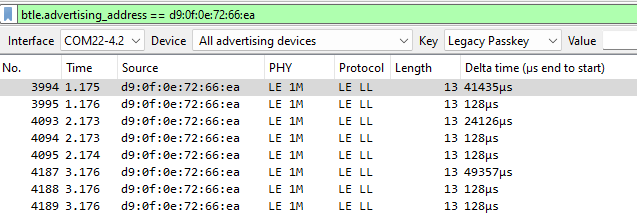
I am therefore confident that while the softdevice is reporting success under the 100% duty cycle case, no packets are actually being transmitted.
This appears to be a different failure mode to DRGN-19197 as the data payload is never changing length.
nRF Connect SDK: v2.7.0-rc3-d5cd2f445522
Softdevice: Version 214.51162 Build 1926957230

