

I tested on nrf5_sdk_17.1.0_ddde560,Tested on nrf5_sdk_17.1.0_ddde560\examples\ble_peripheral\ble_app_hrs_freertos project。Call the testfun function to test the test。
The location where I called the function execution is shown in the image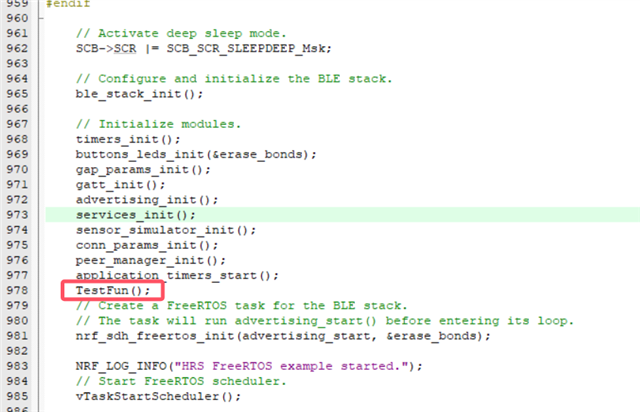
#include "nrf_fstorage.h"
#include "nrf_sdh.h"
#include "nrf_sdh_ble.h"
#include "nrf_fstorage_sd.h"
#include "nrf_soc.h"
#include "app_error.h"


#define EE_DEVICE_ADDR			(0xE0000)
#define EE_DEVICE_ADDR_BP		(0xE1000)


void wait_for_flash_ready(nrf_fstorage_t const * p_fstorage);
static void fstorage_evt_handler(nrf_fstorage_evt_t * p_evt);

static void print_flash_info(nrf_fstorage_t * p_fstorage);

void WritetoFlash(uint32_t Address, uint8_t *pdata, uint16_t Len);

NRF_FSTORAGE_DEF(nrf_fstorage_t fstorage) =
{
    /* Set a handler for fstorage events. */
    .evt_handler = fstorage_evt_handler,

    /* These below are the boundaries of the flash space assigned to this instance of fstorage.
     * You must set these manually, even at runtime, before nrf_fstorage_init() is called.
     * The function nrf5_flash_end_addr_get() can be used to retrieve the last address on the
     * last page of flash available to write data. */
    .start_addr = 0xE0000,
    .end_addr   = 0xE3000,
};

void NordicFlashInit(void)
{
	ret_code_t rc;
	nrf_fstorage_api_t * p_fs_api;

	p_fs_api = &nrf_fstorage_sd;

	rc = nrf_fstorage_init(&fstorage, p_fs_api, NULL);
	APP_ERROR_CHECK(rc);

	print_flash_info(&fstorage);
}

void DeinitFlash(void)
{
	nrf_fstorage_uninit(&fstorage, NULL);
}

void EraseflashStorage(void)
{
	ret_code_t ret_code;

	ret_code = nrf_fstorage_erase(&fstorage, 0xE0000, 1, NULL);
	APP_ERROR_CHECK(ret_code);
}

void EraseflashStorageBk(void)
{
	ret_code_t ret_code;

	ret_code = nrf_fstorage_erase(&fstorage, 0xE1000, 1, NULL);
	APP_ERROR_CHECK(ret_code);
}

uint8_t	TestFun(void)
{
	uint8_t buffer[] = {1,2,3,4};

	NordicFlashInit();
	EraseflashStorage();
	EraseflashStorageBk();
	WritetoFlash(EE_DEVICE_ADDR, (uint8_t*)&buffer, 4);
	WritetoFlash(EE_DEVICE_ADDR_BP, (uint8_t*)&buffer, 4);

	return 0;

}

static void print_flash_info(nrf_fstorage_t * p_fstorage)
{
#if ENABLE_PRINTF_DEUBG
    printf("\r========| flash info |========\n");
    printf("\rerase unit: \t%d bytes\n",      p_fstorage->p_flash_info->erase_unit);
    printf("\rprogram unit: \t%d bytes\n",    p_fstorage->p_flash_info->program_unit);
    printf("\r==============================\n");
#endif
}


static void fstorage_evt_handler(nrf_fstorage_evt_t * p_evt)
{
    if (p_evt->result != NRF_SUCCESS)
    {
#if ENABLE_PRINTF_DEUBG
        printf("--> Event received: ERROR while executing an fstorage operation.");
#endif
        return;
    }

    switch (p_evt->id)
    {
        case NRF_FSTORAGE_EVT_WRITE_RESULT:
        {
#if ENABLE_PRINTF_DEUBG
            printf("--> Event received: wrote %d bytes at address 0x%x.",
                         p_evt->len, p_evt->addr);
#endif
        } break;

        case NRF_FSTORAGE_EVT_ERASE_RESULT:
        {
#if ENABLE_PRINTF_DEUBG
            printf("--> Event received: erased %d page from address 0x%x.",
                         p_evt->len, p_evt->addr);
#endif
        } break;

        default:
            break;
    }
}


void wait_for_flash_ready(nrf_fstorage_t const * p_fstorage)
{
    /* While fstorage is busy, sleep and wait for an event. */
    while (nrf_fstorage_is_busy(p_fstorage))
    {
    }
}


void WritetoFlash(uint32_t Address, uint8_t *pdata, uint16_t Len)
{
	ret_code_t rc;

	rc = nrf_fstorage_write(&fstorage, Address, pdata, Len, NULL);
	APP_ERROR_CHECK(rc);

	wait_for_flash_ready(&fstorage);
}

