Increased current consumption. The nRF9151 negotiates a TAU value of 10,800 seconds for PSM, but PSM is not working.

Hi,

I’m using the function lte_lc_psm_param_set(rptau, rat). After connecting to LTE, I call lte_lc_psm_get(&psm_cfg.tau, &psm_cfg.active_time) and receive the following response:

PSM is ACTIVE: TAU=10800 s, Active Time=-1 s

It looks like the TAU value is being set correctly. However, Active_Time is returned as -1. Does this response mean that the device is ready to enter PSM?

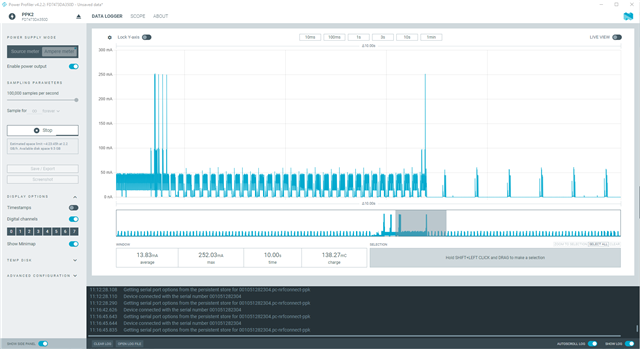
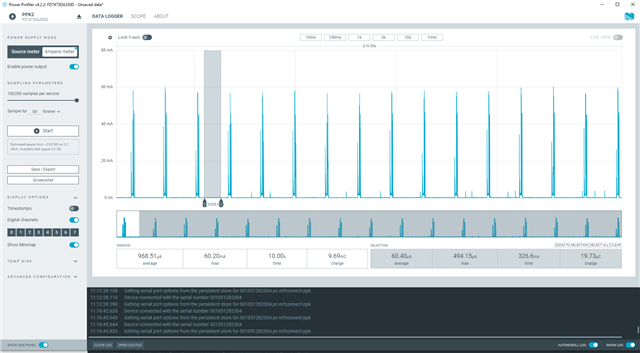
I'm using the Power Profiler, and it seems that the nRF9151 is waking up approximately every second regardless. I've also added eDRX configuration after establishing the LTE connection, but this doesn't make any difference either. Whether I enable PSM or eDRX, the current consumption profile remains the same. I’ve attached power trace screenshots below.

What can I do to ensure the device actually enters PSM mode? Despite the response I’m receiving, could it be that the device never enters PSM? Also, why isn’t eDRX working either?

Additionally, I disable logging before the device goes to sleep and re-enable it after waking up. I can see a difference in current consumption when doing this - but unfortunately, only in that part.
  • Both PSM and eDRX requires to be supported by your mobile network operator (MNO) and maybe also needs to be supported by your MVNO (SIM card). Looks, like your operator doesn't.

  • The SIM card I'm using for testing is from Onomondo. It came with the DK. From what I’ve read, Onomondo supports both PSM and eDRX. The network I’m connecting through is Orange, and according to the operator, PSM is also supported there.
    Is there anything else I should be aware of that might be preventing the nRF9151 from entering PSM mode?

    Going a step further — what should be the next action to reduce the device’s current consumption, even if it’s operating in RRC mode?
    As seen in the current trace, the nRF9151 wakes up approximately every 580ms in RRC mode.
    Is it possible to adjust the wake-up frequency in RRC mode to reduce the device’s average current consumption?

  • Orange, in which country? 

    Anyway: if you know, how to create a modem trace, that may help someone from Nordic to see, what's the cause of the PSM and eDRX issue. 

  • I’d like to provide an update on the topic and possibly shift its direction a bit.
    I replaced the Onomondo SIM card with a Conexa one, and now the device is negotiating PSM and even successfully entering that mode. The current consumption is around 4 µA.
    However, any attempt to modify the PSM parameters doesn't seem to have any effect — despite changing the rptau and rat values, the values received from the base station remain the same.

    Furthermore, even after removing the functions lte_lc_psm_param_set() and lte_lc_psm_req(true), the modem still negotiates entry into PSM. I assume that PSM is enabled by default.
    However, once the LTE connection is established, I don’t receive an IP address.

    I’ve written a small test program and I'm trying to send a message over CoAP, but I’m not making any progress. The events defined below are not being triggered at all:

    #define IP_EVENT_MASK (NET_EVENT_IPV4_ADDR_ADD | NET_EVENT_IPV6_ADDR_ADD)
    #define L4_EVENT_MASK (NET_EVENT_L4_CONNECTED | NET_EVENT_L4_DISCONNECTED)
    net_mgmt_init_event_callback(&l4_cb, l4_event_handler, L4_EVENT_MASK); net_mgmt_add_event_callback(&l4_cb); net_mgmt_init_event_callback(&conn_cb, connectivity_event_handler, CONN_LAYER_EVENT_MASK); net_mgmt_add_event_callback(&conn_cb);

    Does this actually work in NCS version 3.0.2? Where could the issue lie? Would it make more sense to test this kind of functionality on an earlier version of NCS?

  • Sounds strange.

    Some of the modem settings may have been stored in the modem's nvram, what may explain, that psm is still on even without calling lte_lc_psm_req(true).

    Anyway, without knowing, in which country use Orange, it's hard to say too much about your experience.

Related