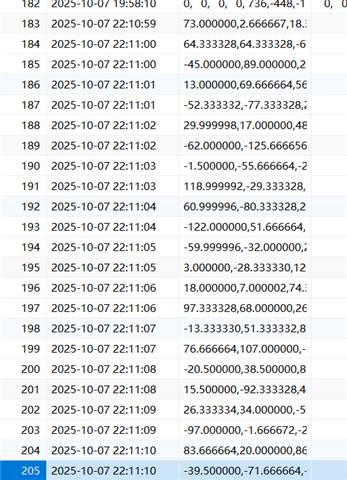
When running the channel sounding example on the nrf54l15, how can one obtain the IQ values of the ranging signal?

When running the channel sounding example on the nrf54l15, how can one obtain the IQ values of the ranging signal?I want to obtain the IQ value and then use my own algorithm to calculate the distance.

  • Hello,

    Please see this ticket, where a user has done something similar:

     Regarding I and Q measurements on the nRF54L15 development kits 

    Best regards,

    Edvin

  • I can now obtain my IQ score. May I ask how to increase the speed of obtaining this score?

  • Hello,

    I don't know how you already changed your sample, but looking at the default sample, that doesn't print the values, but prints the ranges, if you remove the k_sleep() in the main loop, and replace it with a semaphore:

    	while (true) {
    		//k_sleep(K_MSEC(100));
    		k_sem_take(&sem_new_distance_measurement, K_FOREVER);
    		if (buffer_num_valid != 0) {
    			for (uint8_t ap = 0; ap < MAX_AP; ap++) {
    				cs_de_dist_estimates_t distance_on_ap = get_distance(ap);
    
    				LOG_INF("Distance estimates on antenna path %u: ifft: %f, "
    					"phase_slope: %f, rtt: %f",
    					ap, (double)distance_on_ap.ifft,
    					(double)distance_on_ap.phase_slope,
    					(double)distance_on_ap.rtt);
    			}
    		}
    		else {
    			LOG_INF("No valid distance estimates available yet.");
    		}
    
    		//LOG_INF("Sleeping for a few seconds...");
    	}

    And then, near the top, declare the semaphore, and give it in the store_distance_estimates() (or alternatively in the ranging_data_cb())

    static K_SEM_DEFINE(sem_new_distance_measurement, 0, 1);
    static void store_distance_estimates(cs_de_report_t *p_report)
    {
    	int lock_state = k_mutex_lock(&distance_estimate_buffer_mutex, K_FOREVER);
    
    	__ASSERT_NO_MSG(lock_state == 0);
    
    	for (uint8_t ap = 0; ap < p_report->n_ap; ap++) {
    		memcpy(&distance_estimate_buffer[ap][buffer_index],
    		       &p_report->distance_estimates[ap], sizeof(cs_de_dist_estimates_t));
    	}
    
    	buffer_index = (buffer_index + 1) % DE_SLIDING_WINDOW_SIZE;
    
    	if (buffer_num_valid < DE_SLIDING_WINDOW_SIZE) {
    		buffer_num_valid++;
    	}
    	k_mutex_unlock(&distance_estimate_buffer_mutex);
    	k_sem_give(&sem_new_distance_measurement);
    }

    Then it should wake up and print the new data only when it has new data.

    Note that in the unmodified sample, this will sometimes print the same data as the previous round, but that is because of some median filtering done in median_inplace().

    Best regards,

    Edvin

  • I have modified the code according to your suggestion. Now the IQ data can be captured twice within one second. May I ask if it is possible to further increase the capture speed? What parameters need to be adjusted if we want to further improve?

  • Hello,,Can we continue to increase the speed of distance measurement?

Related