Assistance in understanding algorithms nPM2100

Hello.
Please excuse these potentially silly questions, but I've been given the task of monitoring battery charge while also achieving maximum energy savings.

A wearable device is being designed based on an nRF54L15  and an three-axis, all powered by a battery 2032.

The algorithm is as follows: if there is no acceleration, the device goes to sleep and wakes up when motion is detected. The device also has a functional button that can also wake it up.

1. We are considering the option of using the shipped mode.
If the nPM2100 allows using the input only for exiting the shipped mode and even if an active level is applied to this input will not react to it in any way after exiting shipped mode, In other words, is it possible to configure this input ONLY for exiting shipped mode?

2. If I use the low power mode, is the VOUT output active and what current can it supply?

3. Is it possible to wake up the nPM2100  from hibernation mode using an external signal?

  • Hi Vladimir,

    1. To confirm, you are asking if the nPM2100’s SHPHLD pin be configured so it’s only used to exit ship mode, and ignored after that?
    2. I'll need to ask internally. I'll come back to you with an answer.
    3. Yes, this is possible. In addition to automatic exit through the wakeup timer, you can do a SHPHLD pin wakeup.

    Best regards,
    Benjamin

  • 1. To confirm, you are asking if the nPM2100’s SHPHLD pin be configured so it’s only used to exit ship mode, and ignored after that?

    Yes, that's exactly it.

    2. I'll need to ask internally. I'll come back to you with an answer.

    Thanks.
    I couldn't figure out from the documentation which outputs are active and how much current they can provide in low and ultra-low power modes.
    I just realized that the module itself consumes significantly less energy in these modes than in high power mode.

  • Hi Vladimir,

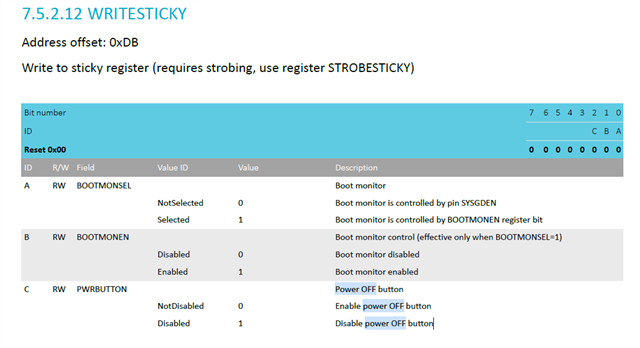
    To address your first question, yes, it’s possible to configure the SHPHLD pin to be used only for exiting ship mode and to disable the power-off button functionality. This is controlled by the “sticky” bit PWRBUTTON. After setting this bit, you must use STROBESTICKY. Note that this is still volatile memory even though these bits are named “sticky.” This means the values are retained as long as the battery voltage is present, and they don’t depend on the boost operation or VINT voltage as the normal registers.

    For the second question, the maximum current for LP mode really depends on the input to output conversion ratio. There is no strict limit for it, but depending on the battery voltage and output voltage at some load the HP mode will be more efficient and it is better to use that instead of ULP/LP mode. This is handled automatically when the boost is set to AUTO mode.

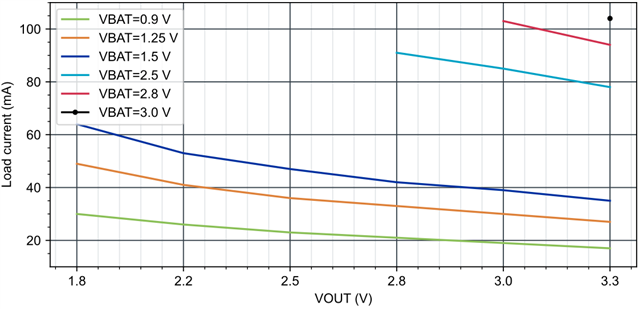
    Further, you can see this "Load current triggering mode change vs. VOUT" figure in the datasheet which shows the typical load current threshold in Auto mode where BOOST changes from Low Power to High Power mode. Same limits applies for LP mode also.


    Best regards,
    Benjamin

  • To address your first question, yes, it’s possible to configure the SHPHLD pin to be used only for exiting ship mode and to disable the power-off button functionality. This is controlled by the “sticky” bit PWRBUTTON. After setting this bit, you must use STROBESTICKY. Note that this is still volatile memory even though these bits are named “sticky.” This means the values are retained as long as the battery voltage is present, and they don’t depend on the boost operation or VINT voltage as the normal registers.

    Thanks for the answer)
    With this setting, a long active pulse will not put the device into ship mode ?)

    For the second question, the maximum current for LP mode really depends on the input to output conversion ratio. There is no strict limit for it, but depending on the battery voltage and output voltage at some load the HP mode will be more efficient and it is better to use that instead of ULP/LP mode. This is handled automatically when the boost is set to AUTO mode.

    Further, you can see this "Load current triggering mode change vs. VOUT" figure in the datasheet which shows the typical load current threshold in Auto mode where BOOST changes from Low Power to High Power mode. Same limits applies for LP mode also.

    I plan to power only the nRF54L15, it itself consumes very little and every additional µA is significant when powered by a battery (2032).
    In high power mode, the nPM2100 itself consumes (typ. 7.2mA) more than nRF54L15 In some cases..
    All hope lies in the low power or ultra-low mode, since I need to get no more than 10 mA

    Our goal is to get a real battery charge, as well as the ability to "squeeze" the maximum out of the battery, in this regard it nPM2100 us perfectly, but the question is about the consumption of the nPM2100 itself

Related