Hi there!
I am trying to set up external flash (w25q64) with my NRF52840 project over SPI. I have adapted the spi_flash sample in an attempt to set up this device, but I am having some issues that I think are related to the device tree. I can’t get the device to show as ready using device_is_ready(). Have I set something up incorrectly?
I’ve included my setup/wiring, prj.conf, overlay, and main.c.
NRF Connect SDK/Toolchain 2.5.1
Wiring:
| Module Pin | DK Pin |
| VCC | VCC |
| GND | GND |
| CS | P1.12 |
| MOSI/DI | P1.13 |
| MISO/DO | P1.14 |
| SCLK | P1.15 |
prj.conf
CONFIG_STDOUT_CONSOLE=y
CONFIG_FLASH=y
CONFIG_SPI=y
CONFIG_SPI_NOR=y
CONFIG_SPI_NOR_FLASH_LAYOUT_PAGE_SIZE=4096
nrf52840dk_nrf52840.overlay
&spi3_default {
    group1 {
        psels = <NRF_PSEL(SPIM_SCK, 1, 15)>,  /* P1.15, D13 */
                <NRF_PSEL(SPIM_MISO, 1, 14)>, /* P1.14, D12 */
                <NRF_PSEL(SPIM_MOSI, 1, 13)>; /* P1.13, D11 */
    };
};

&spi3_sleep {
    group1 {
        psels = <NRF_PSEL(SPIM_SCK, 1, 15)>,  /* P1.15, D13 */
                <NRF_PSEL(SPIM_MISO, 1, 14)>, /* P1.14, D12 */
                <NRF_PSEL(SPIM_MOSI, 1, 13)>; /* P1.13, D11 */
        low-power-enable;
    };
};


&spi3 {
	compatible = "nordic,nrf-spim";
	status = "okay";
	pinctrl-0 = <&spi3_default>;
	pinctrl-1 = <&spi3_sleep>;
	pinctrl-names = "default", "sleep";
	cs-gpios = <&gpio1 12 GPIO_ACTIVE_LOW>; /* P1.12, D10 */
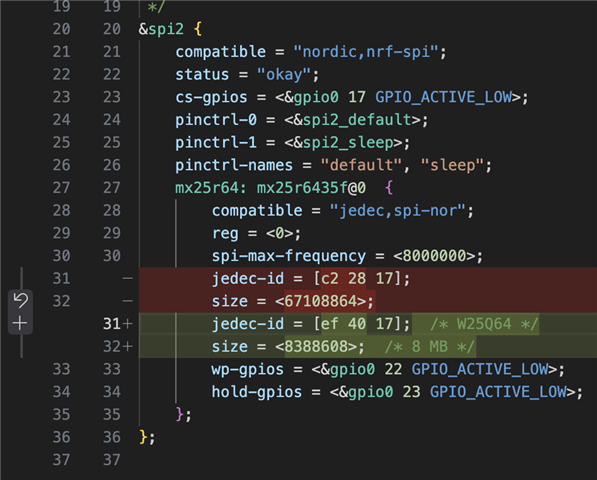
    w25q64: w25q64@0 {
        compatible = "jedec,spi-nor";
        reg = <0>;
        spi-max-frequency = <1000000>;
        jedec-id = [ef 40 17];
        size = <DT_SIZE_M(8)>;
    };
};

&nrf_radio_fem_spi {
    status = "disabled";
};
main.c
/*
 * Copyright (c) 2016 Intel Corporation.
 *
 * SPDX-License-Identifier: Apache-2.0
 */

#include <zephyr/kernel.h>
#include <zephyr/drivers/flash.h>
#include <zephyr/drivers/spi.h>
#include <zephyr/drivers/gpio.h>
#include <zephyr/device.h>
#include <zephyr/devicetree.h>
#include <stdio.h>
#include <string.h>

#define SPI_FLASH_TEST_REGION_OFFSET 0xff000
#define SPI_FLASH_SECTOR_SIZE        4096

void single_sector_test(const struct device *flash_dev)
{
	const uint8_t expected[] = { 0x55, 0xaa, 0x66, 0x99 };
	const size_t len = sizeof(expected);
	uint8_t buf[sizeof(expected)];
	int rc;

	printf("\nPerform test on single sector");
	/* Write protection needs to be disabled before each write or
	 * erase, since the flash component turns on write protection
	 * automatically after completion of write and erase
	 * operations.
	 */
	printf("\nTest 1: Flash erase\n");

	/* Full flash erase if SPI_FLASH_TEST_REGION_OFFSET = 0 and
	 * SPI_FLASH_SECTOR_SIZE = flash size
	 */
	rc = flash_erase(flash_dev, SPI_FLASH_TEST_REGION_OFFSET,
			 SPI_FLASH_SECTOR_SIZE);
	if (rc != 0) {
		printf("Flash erase failed! %d\n", rc);
	} else {
		printf("Flash erase succeeded!\n");
	}

	printf("\nTest 2: Flash write\n");

	printf("Attempting to write %zu bytes\n", len);
	rc = flash_write(flash_dev, SPI_FLASH_TEST_REGION_OFFSET, expected, len);
	if (rc != 0) {
		printf("Flash write failed! %d\n", rc);
		return;
	}

	memset(buf, 0, len);
	rc = flash_read(flash_dev, SPI_FLASH_TEST_REGION_OFFSET, buf, len);
	if (rc != 0) {
		printf("Flash read failed! %d\n", rc);
		return;
	}

	if (memcmp(expected, buf, len) == 0) {
		printf("Data read matches data written. Good!!\n");
	} else {
		const uint8_t *wp = expected;
		const uint8_t *rp = buf;
		const uint8_t *rpe = rp + len;

		printf("Data read does not match data written!!\n");
		while (rp < rpe) {
			printf("%08x wrote %02x read %02x %s\n",
			       (uint32_t)(SPI_FLASH_TEST_REGION_OFFSET + (rp - buf)),
			       *wp, *rp, (*rp == *wp) ? "match" : "MISMATCH");
			++rp;
			++wp;
		}
	}
}

int main(void)
{
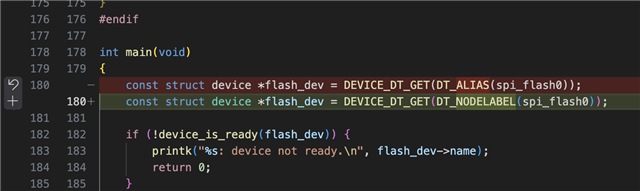
	const struct device *flash_dev = DEVICE_DT_GET(DT_NODELABEL(w25q64));

	for(int i = 0; i < 10; i++) {
		if (!device_is_ready(flash_dev)) {
			printk("Attempt %u: %s: device not ready.\n", i + 1, flash_dev->name);
		}
		k_sleep(K_SECONDS(1));
	}

	if (!device_is_ready(flash_dev)) {
		printk("Ending, %s: device not ready.\n", flash_dev->name);
		return 0;
	}

	printf("\n%s SPI flash testing\n", flash_dev->name);
	printf("==========================\n");

	single_sector_test(flash_dev);
	return 0;
}