[CIS][SDK3.2.1] nRF5340 with SDK 3.2.1 periodically misses CIS events from Pixel 10 Phone - clicks in audio

I have a nRF5340 module with an application built using SDK 3.2.1.

The nRF5340 is acting as a CIS Peripheral.

It has an ACL connection and a CIS connection with a Pixel 10 Phone acting as a Central and sending audio over the CIS.

CIS configuration:

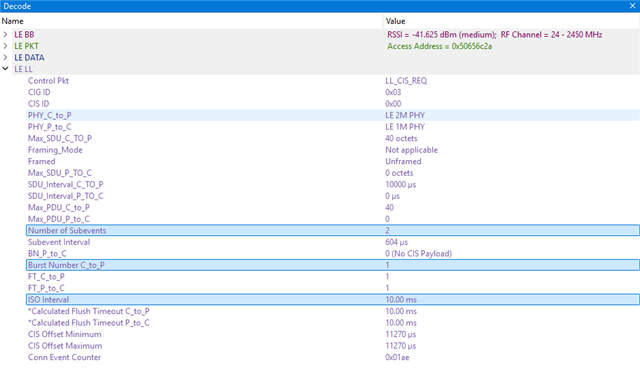
  • ISO Interval = 10 ms
  • NSE = 2
  • BN C to P = 1
  • BN P to C = 0
  • MAX PDU C to P = 40
  • PHY C to P = 2M
  • PHY P to C = 1M

Sniffer capture of the CIS_REQ packet:
The Audio received on the nRF5340 has some clicks in it.

These are some captures from the sniffer (Teledyne LeCroy Sodera) which showed that the nRF5340 periodically misses some CIS events form the Pixel 10 phone.

The nRF53 also acts as Central for a Peripheral device, on an ACL connection, with a very high Peripheral Latency, around 80.
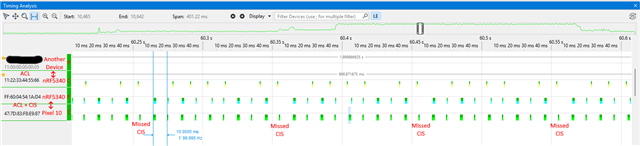
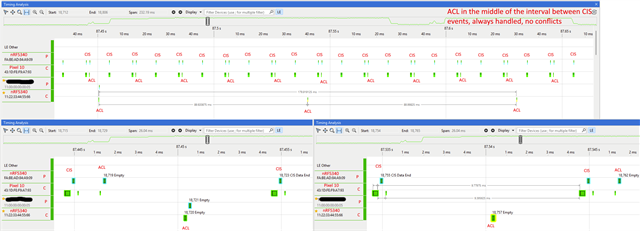
Please see below and example of the nRF5340 not responding to a CIS event from the PIxel 10, and the Pixel 10 repeating the payload in both subevents of the CIS.
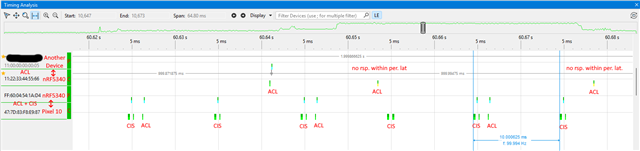
I noticed that the missed CIS events seem to happen immediately after an ACL event with the other device.

Is it possible tat the nRF5340 prioritizes the ACL over the CIS and that is why it is missing the CIS event?

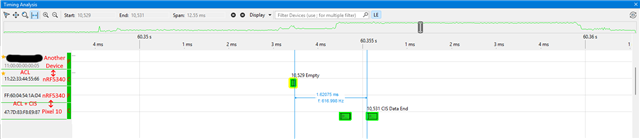
Technically, it has enough time to figure out that the Peripheral did not answer and catch at least the retransmission from the second CIS subevent which is ~1.6 ms from the end of the ACL packet.
The clicks were not audible in the previous SDK we used, 3.1.1. Has the behavior changed since then?

If this is the cause of the missed CIS is it possible to configure the device to always prioritize the CIS over ACL (maybe with the exception of special situations like connection update instants)?

  • Thanks for the clarifications,  !

    I will implement the continuous scan suggestion you made next week. This will surely solve some of the audio issues we have (gaps in audio when the device is scanning).

    Also, thanks for the link about the priorities. This clarifies some behaviours.

    You said the Central always does a Connection Update. Is this coming from the Controller or the Host? I have not dug into the Host yet. But, off the top of my head, I remember that the Controller is allowed to independently start a Connection Update.

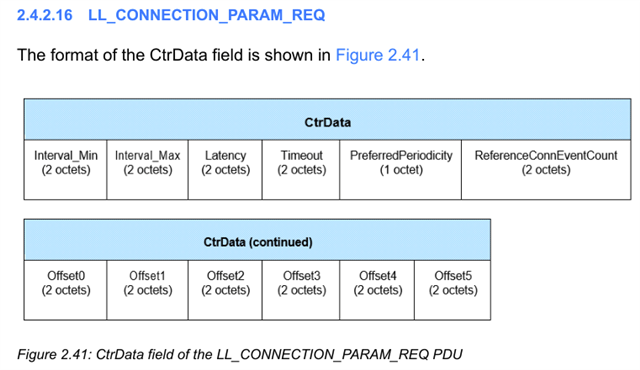
    I don't think increasing the Supervision Timeout or decreasing the Peripheral Latency will solve the second audio issue (clicks in audio when the device misses CIS events). In my opinion, the only way to solve this is to make sure the ACL events fall between the CIS events. This can be done by controlling the timing (Offset) and the Interval of the ACL.This is kind of hard to do because we are acting as a Peripheral for the ACL connection. One way we could do this form the  Peripheral is by using the LL_CONNECTION_PARAM_REQ PDU, which can be sent during a Connection Update procedure started form the Peripheral. Is there way to make the nRF5340 Controller send a LL_CONNECTION_PARAM_REQ PDU which suggests some good offsets to the Central (see Offset0 to Offset5 in the PDU CtrData field)? Will the bt_conn_le_param_update() function do this?

  • Hi Alex, 

    The peripheral can request the Connection update procedure, but it is only the central which will update the connection parameters. The controller only executes this procedure when initiated by the host. The SoftDevice Controller does not support the Connection Parameter Request procedure. So the customer will be unable to suggest specific anchor point offsets as a peripheral through bt_conn_le_param_update().

    If the CIS conflicts with the ACL connection with the pixel 10 phone, then as a mitigation it should be possible to increase the Flush Timeout, which will prevent the central from flushing the SDU and allow it to retransmit the SDU in the next ISO interval. However, this does come at the cost of increased transport latency. The Flush timeout is controlled by the central. At the application level this is often referred to as Retransmission Number (RTN).

    On the secondary low bandwidth ACL, where nRF5340 is the central, scheduling conflicts will occur and so setting the connection interval to a multiple of 7.5 ms and 10 ms is reasonable to try to minimize these conflicts.

    -Amanda H.

  • Thanks for these new details, .

    I will play with the CONFIG_BT_AUDIO_MAX_TRANSPORT_LATENCY_MS setting, which directy impacts the chosen Flush Timeout, to try to make the audio more resilient to occasional missed CIS events.

    I'll see what I can do about the ACL where the nRF5340 is Central.

  • Hi  .

    I have implemented your suggestion to use continuous scanning, using the BT_LE_SCAN_PASSIVE_CONTINUOUS option and now the nRF5340 scans for the low latency Peripheral between CIS events. We nolonger hear gaps in the audio. Thanks for the suggestion!

    I have also found that the connection interval was changed to 12.5 ms on the ACL by the nRF5340 because the Peripheral sent L2CAP_CONNECTION_PARAMETER_UPDATE_REQ to which the nRF5340 sent an affirmative response.
    I solved this by assigning a function which always returns false to the .le_param_req connection structure member. In this way, the nRF5340 rejects any connection parameter updates requested by the Peripheral and keeps the interval a multiple of 10 ms and 7.5 ms.

    A third mechanism I implemented to solve the audio issue was to disconnect the Peripheral whenever the Pixel 10 starts the audio stream on the CIS. I did this to force the nRF5340 and the low latency Peripheral to re-connect so the nRF5340 can choose a timing for the ACL which does not conflict with the CIS.

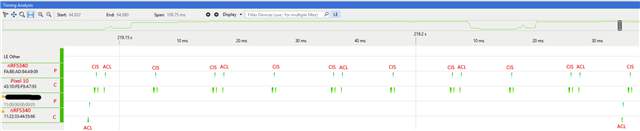
    This mechanism mostly works. Most of the time the nRF5340 schedules the Peripheral ACL, on re-connection, in the middle of the interval between CIS events. And in this situation, the audio is fine. See the screenshot.

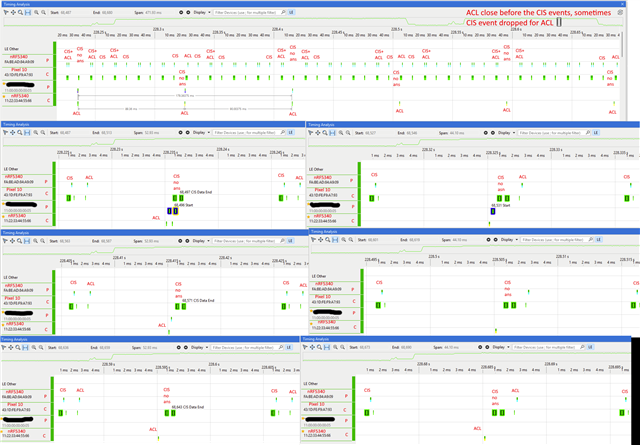
    But other times it schedules the RC ACL very close before the CIS event. Initially this works fine, but suddenly the nRF5340 starts missing CIS events again from the Pixel 10.
    Apparently, it starts missing CIS events after and ACL with the Peripheral where the Peripheral does not respond.
    The Peripheral eventually responds but the nRF5340 keeps missing CIS events from the Pixel 10.
    I suspect this is an Window Widening issue and the Window Widening is not reset correctly once the Peripheral responds.

    Please ask the Controller team what they think about this.

    See the following screenshots for this issue.

    Initially no CIS events are missed:

    But later all CIS events following the ACL with the Peripheral are missed.

    The issue starts here where the nRF5340 does not send an ACL event to the Peripheral for some reason:

  • It doesn't seem like window widening is the cause here; it seems like this is still a scheduling conflict. Regarding the secondary ACL where the 5340 is the central, unfortunately, the application is unable to control the anchor point of the first connection event (whereby all other connection event timings are based off), and the controller does not take into account the CIS peripheral activity when setting up the secondary ACL. This aligns with what you are seeing, and if the initial connection anchor point lands in a good position after reconnection, it should remain conflict free (with the 90ms connection interval). But if not then scheduling conflicts will occur. Unfortunately, the controller does not support any mechanism that can mitigate this. If possible, you can try to keep disconnecting until the secondary ACL initial anchor point falls in a better location.

Related