Failure in ble_stack_init during startup

We are trying to bring up a new run of an existing PCB design. No changes in the area of the processor, but a different assembly house. The first call inside ble_stack_init, a call to nrf_sdh_enable_request(), fails and returns an error code of 8. No reference anywhere gives a usable explanation.

Strangely, if started by "copying" the hex file onto the Jlink "drive" (the nRF52832 DevKit), it succeeds.

What should we be looking for?

  • Confirming again, even with your added "run once" reset code: If started from a drag&drop, it runs exactly as expected. If started from F5 (default is Build&Run in SES, which is how I left it), or from a power cycle, it gets to the call to sd_softdevice_enable() in the CRITICAL_REGION in nrf_sdh_enable_request() and resets somewhere before it returns from that call. I know this can't be, but somewhere in this house of cards hides a joker....

  • I have tried to start up the LF clock with the following routines, before any calls into the softdevice. It does not start up on either board, but after a correct startup (any method on the old rev, or via drag&drop on the new boards), it always shows running. I speculate that there's some problem in the softdevice starting the clock, but how to find it?

    void CheckLfClock (void)
    {
    char Str [80];
    sprintf (Str, "LFCLKSTAT %08X", NRF_CLOCK -> LFCLKSTAT);
    LogToJournal (Str);
    }

    void StartLfClock (void)
    {
    LogToJournal ("Starting LF Clock");
    NRF_CLOCK -> TASKS_LFCLKSTOP;
    NRF_CLOCK -> LFCLKSRC = 1;
    NRF_CLOCK -> TASKS_LFCLKSTART;
    }

    void AwaitLfClock (void)
    {
    int i;
    char Str [80];
    for (i = 1000000; i; --i) if (NRF_CLOCK -> LFCLKSTAT) break;
    sprintf (Str, "%d tries remaining", i);
    LogToJournal (Str);
    }

    I also tried clearing SOFTDEVICE_RESET_HANDLER_EXECUTED after recording its value and before the call to the softdevice, thinking I could at least trap any reset occurring there. No joy.

  • Further info. On speculation that the 32 KHz clock could be a problem, I tried the other selections for LFCLK.

    Set to 2 (synthesized from the 64 MHz clock) the behavior is identical. If started via drag&drop, it runs fine; started via F5 or power cycle it gets stuck in a reset loop in sd_softdevice_enable().

    Set to 0 (RC clock) it fails to start up under any conditions, presumably because the required external components are not present.

    So, if the 32 KHz oscillator is off the hook, what other minor ("trivial") difference could cause the behavior I'm seeing?

    Is there a way to send you screenshots of the relevant schematic and layout areas?

  • I just discovered that the working boards were built with the nRF52832QFAAE0, while the boards that fail have the E1 variant. Extensive searching online did not reveal any relevant differences. Can this be the whole problem?

  • The observations you have described do not indicate an LF clock issue. If I have understood you correctly, these are the three problems you have observed:

    1. Failure in advertising_init() with NRF_ERROR_NO_MEM.
    2. NRF_ERROR_INVALID_STATE returned from sd_softdevice_enable() (again, this is expected on the first run when using Build & Run, unless you still have my run_reset_handler_once() test function at the start of main()).
    3. A sudden reset with an unconfirmed reset source occurring somewhere in ble_stack_init().

    However, it is unclear to me under which conditions these issues occur and when they do not. To find the root cause and narrow down the problem, we first need to understand exactly what the error is.

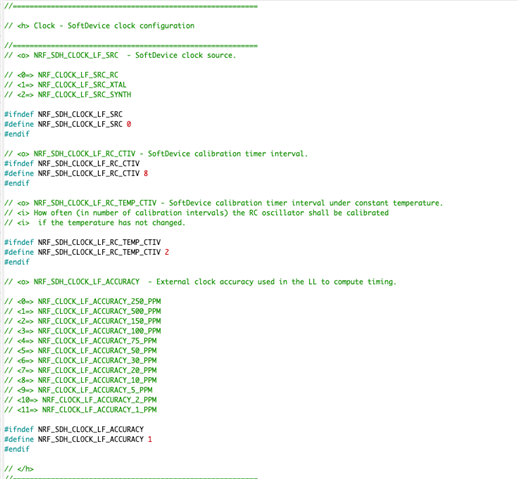
    If you still want to test with the LF RC oscillator, you can remove the test code you posted, and instead apply the following changes to the Softdevice clock configuration in sdk_config.h:

    SteveHx said:
    void StartLfClock (void)
    {
    LogToJournal ("Starting LF Clock");
    NRF_CLOCK -> TASKS_LFCLKSTOP;
    NRF_CLOCK -> LFCLKSRC = 1;
    NRF_CLOCK -> TASKS_LFCLKSTART;
    }

    Note that a task is triggered by writing 1 to the TASK register. The code above is not writing anything to the register.

Related