This post is older than 2 years and might not be relevant anymore
More Info: Consider searching for newer posts

PTX

Hello Nordic,

I try to establish communication between an ATmega328 based board an an Arduino Nano, so far without success. The goal is to improve a RF433 "Wire". 3 weeks ago, I started the project, but for 1 week, I do not make any progress. Please have a look to the attached pdf. Obviously I tried different settings, but probably not the right one! I spent time on internet, but didn't find how to fix.

Hope you can help, thank you anyway for your time.

JacquesNrf24L01+.pdf

  • In cases like these I always recommend to go for the minimum configuration to achieve communication, and then work from there (the below changes presume that you let all other registers use default value).

    - The minimum configuration on a PRX is to set the operation mode to RX and the rx payload width of pipe0 to specific length (e.g. 3), then write PWR_UP bit to 1 (wait ~2ms), and set CE to 1.

    - The minimum configuration on a PTX is write PWR_UP bit to 1 (wait ~2ms), then write the TX payload with a specific length (e.g. 3), and toggle CE to start transmission.

    Best regards,
    Kenneth

  • Hello Kenneth, thank you for your answer. I am stuck on the basic PTX config for a while now. It is why I decided the send this SOS.

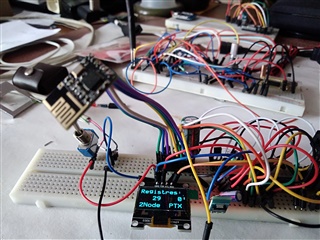
    Here is my pretty simple assembler code :

    PTXs:
    		cbi		PORTD, CE			; CE pin Low
    		sts		TXBuff, Centmilli	; change Payload 4th byte (4 byte long payload stored in TXBuff)
    		rcall	PwrUPTX				; clr bit 0 in CONFIG reg + interrupt masks + crc 16 ; ends with 2msec delay
    		rcall	AdrPipPTX			; write "2Node" in TX-ADDR ($10 reg) and RX_ADDR_P0 ($0A Reg) for ack  MSbit of LSByte first
    
    		ldi		Temp0, $7			; STATUS
    		rcall	AffReg				; oled display for monitoring
    		ldi		Temp0, $17			; FIFO_STATUS
    		rcall	AffReg				; oled display for monitoring
    
    		lds		Temp1, PayLong		; 4 bytes to transmit hold in variable PayLong
    		clr		Temp
    		ldi		ZL, Low(TXBuff)		; Buffer where 4 bytes of payload are stored
    		ldi		ZH, High(TXBuff)		
    		add		ZL, Temp1
    		adc		ZH, Temp			; update buffer index
    		rcall	WR_TXPayload		; load FIFO
    
    		rcall	clrStatus
    
    		ldi		Temp0, $7			; STATUS
    		rcall	AffReg				; oled display for monitoring
    		ldi		Temp0, $17			; FIFO_STATUS
    		rcall	AffReg				; oled display for monitoring		
    
    		sbi		PORTD, CE			; CE pin High
    		ldi		Temp, 15
    		rcall	Wait2uS				; 30 µsec delay
    		cbi		PORTD, CE			; CE pin Low
    		ldi		Temp, 1				; wait 1 msec
    		rcall	Wait				; délai transmit >130µs
    		ldi		Temp0, $7			; FIFO_STATUS
    		rcall	AffReg				; oled display for monitoring
    		ldi		Temp0, $17			; FIFO_STATUS
    		rcall	AffReg				; oled display for monitoring
    loop1:

    I think it fits well the recommandation, but nothing arrives at PRX 2Node address. I have also scoped the CE pin signal, which is in range too.

  • Sorry, I sent the message too early!

    Can you explain Why Max RT is asserted as soon as CE pulse returns
    low ?
    Is it normal to clear a flag by writing it1 ?  Usually it is 0.

    Best regards

    Jacques

  • Hi, 

    JacquesBrunet said:
    Can you explain Why Max RT is asserted as soon as CE pulse returns
    low ?

    No, I would expect there was a delay first yes. Are these genuine nRF24L01P chips bought from a Nordic distributor? 

    JacquesBrunet said:
    Is it normal to clear a flag by writing it1 ?  Usually it is 0.

    In this case yes.

    Best regards,
    Kenneth 

  • They come from an "heritage" when my father in law died! I have no idea where he bought them. It is not the chip itself, but a micro (nano?) module with 8 pins in single line.

    With the simplest program you advised me, no ack, no DPL, no ART I get now STATUS = 0b00101110 which means Data sent, RX fifi empty TX fifo full. But when I monitor RPD at PRX side, I get signal < -64dBm and unfortunatly still no byte received.

    I continue to pull my hairs and investigate now in how RF24 library works.

    With best regards

    Jacques

Related