This post is older than 2 years and might not be relevant anymore
More Info: Consider searching for newer posts

NRF52DK. NRF_BREAKPOINT_COND (ERROR 4 [NRF_ERROR_NO_MEM]).

Hello. 

I get an error NRF_BREAKPOINT_COND. I use nRF5_SDK_17.0.2, s132_nrf52_7.2.0_softdevice and my kit - nRF52-DK. 

An error occurs when trying to swap UART pins (Change  RX_PIN_NUMBER 3 (8) and  TX_PIN_NUMBER 4 (6) )  in example nRF5_SDK_17.0.2_d674dde \ examples \ ble_peripheral \ ble_app_uart:

#define PCA10040_H

#ifdef __cplusplus
extern "C" {
#endif

#include "nrf_gpio.h"

// LEDs definitions for PCA10040
#define LEDS_NUMBER 4

#define LED_START 17
#define LED_1 17
#define LED_2 18
#define LED_3 19
#define LED_4 20
#define LED_STOP 20

#define LEDS_ACTIVE_STATE 0

#define LEDS_INV_MASK LEDS_MASK

#define LEDS_LIST { LED_1, LED_2, LED_3, LED_4 }

#define BSP_LED_0 LED_1
#define BSP_LED_1 LED_2
#define BSP_LED_2 LED_3
#define BSP_LED_3 LED_4

#define BUTTONS_NUMBER 4

#define BUTTON_START 13
#define BUTTON_1 13
#define BUTTON_2 14
#define BUTTON_3 15
#define BUTTON_4 16
#define BUTTON_STOP 16
#define BUTTON_PULL NRF_GPIO_PIN_PULLUP

#define BUTTONS_ACTIVE_STATE 0

#define BUTTONS_LIST { BUTTON_1, BUTTON_2, BUTTON_3, BUTTON_4 }

#define BSP_BUTTON_0 BUTTON_1
#define BSP_BUTTON_1 BUTTON_2
#define BSP_BUTTON_2 BUTTON_3
#define BSP_BUTTON_3 BUTTON_4

#define RX_PIN_NUMBER 3
#define TX_PIN_NUMBER 4
#define CTS_PIN_NUMBER 7
#define RTS_PIN_NUMBER 5
#define HWFC true

//#define SPIS_MISO_PIN 28 // SPI MISO signal.
//#define SPIS_CSN_PIN 12 // SPI CSN signal.
//#define SPIS_MOSI_PIN 25 // SPI MOSI signal.
//#define SPIS_SCK_PIN 29 // SPI SCK signal.

//#define SPIM0_SCK_PIN 29 // SPI clock GPIO pin number.
//#define SPIM0_MOSI_PIN 25 // SPI Master Out Slave In GPIO pin number.
//#define SPIM0_MISO_PIN 28 // SPI Master In Slave Out GPIO pin number.
//#define SPIM0_SS_PIN 12 // SPI Slave Select GPIO pin number.

//#define SPIM1_SCK_PIN 2 // SPI clock GPIO pin number.
//#define SPIM1_MOSI_PIN 3 // SPI Master Out Slave In GPIO pin number.
//#define SPIM1_MISO_PIN 4 // SPI Master In Slave Out GPIO pin number.
//#define SPIM1_SS_PIN 5 // SPI Slave Select GPIO pin number.

//#define SPIM2_SCK_PIN 12 // SPI clock GPIO pin number.
//#define SPIM2_MOSI_PIN 13 // SPI Master Out Slave In GPIO pin number.
//#define SPIM2_MISO_PIN 14 // SPI Master In Slave Out GPIO pin number.
//#define SPIM2_SS_PIN 15 // SPI Slave Select GPIO pin number.

//// serialization APPLICATION board - temp. setup for running serialized MEMU tests
//#define SER_APP_RX_PIN 23 // UART RX pin number.
//#define SER_APP_TX_PIN 24 // UART TX pin number.
//#define SER_APP_CTS_PIN 2 // UART Clear To Send pin number.
//#define SER_APP_RTS_PIN 25 // UART Request To Send pin number.

//#define SER_APP_SPIM0_SCK_PIN 27 // SPI clock GPIO pin number.
//#define SER_APP_SPIM0_MOSI_PIN 2 // SPI Master Out Slave In GPIO pin number
//#define SER_APP_SPIM0_MISO_PIN 26 // SPI Master In Slave Out GPIO pin number
//#define SER_APP_SPIM0_SS_PIN 23 // SPI Slave Select GPIO pin number
//#define SER_APP_SPIM0_RDY_PIN 25 // SPI READY GPIO pin number
//#define SER_APP_SPIM0_REQ_PIN 24 // SPI REQUEST GPIO pin number

//// serialization CONNECTIVITY board
//#define SER_CON_RX_PIN 24 // UART RX pin number.
//#define SER_CON_TX_PIN 23 // UART TX pin number.
//#define SER_CON_CTS_PIN 25 // UART Clear To Send pin number. Not used if HWFC is set to false.
//#define SER_CON_RTS_PIN 2 // UART Request To Send pin number. Not used if HWFC is set to false.


//#define SER_CON_SPIS_SCK_PIN 27 // SPI SCK signal.
//#define SER_CON_SPIS_MOSI_PIN 2 // SPI MOSI signal.
//#define SER_CON_SPIS_MISO_PIN 26 // SPI MISO signal.
//#define SER_CON_SPIS_CSN_PIN 23 // SPI CSN signal.
//#define SER_CON_SPIS_RDY_PIN 25 // SPI READY GPIO pin number.
//#define SER_CON_SPIS_REQ_PIN 24 // SPI REQUEST GPIO pin number.

//#define SER_CONN_CHIP_RESET_PIN 11 // Pin used to reset connectivity chip


//// Arduino board mappings
//#define ARDUINO_SCL_PIN 27 // SCL signal pin
//#define ARDUINO_SDA_PIN 26 // SDA signal pin
//#define ARDUINO_AREF_PIN 2 // Aref pin
//#define ARDUINO_13_PIN 25 // Digital pin 13
//#define ARDUINO_12_PIN 24 // Digital pin 12
//#define ARDUINO_11_PIN 23 // Digital pin 11
//#define ARDUINO_10_PIN 22 // Digital pin 10
//#define ARDUINO_9_PIN 20 // Digital pin 9
//#define ARDUINO_8_PIN 19 // Digital pin 8

//#define ARDUINO_7_PIN 18 // Digital pin 7
//#define ARDUINO_6_PIN 17 // Digital pin 6
//#define ARDUINO_5_PIN 16 // Digital pin 5
//#define ARDUINO_4_PIN 15 // Digital pin 4
//#define ARDUINO_3_PIN 14 // Digital pin 3
//#define ARDUINO_2_PIN 13 // Digital pin 2
//#define ARDUINO_1_PIN 12 // Digital pin 1
//#define ARDUINO_0_PIN 11 // Digital pin 0

//#define ARDUINO_A0_PIN 3 // Analog channel 0
//#define ARDUINO_A1_PIN 4 // Analog channel 1
//#define ARDUINO_A2_PIN 28 // Analog channel 2
//#define ARDUINO_A3_PIN 29 // Analog channel 3
//#define ARDUINO_A4_PIN 30 // Analog channel 4
//#define ARDUINO_A5_PIN 31 // Analog channel 5


#ifdef __cplusplus
}
#endif

#endif // PCA10040_H

Project memory setting:
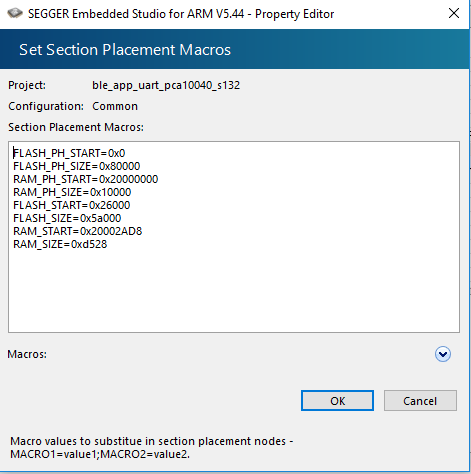
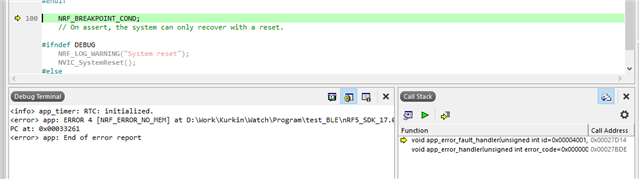
What needs to be changed in the project so that the error does not occur?
Thanks.

  • Can you provide the entire text in the debug terminal window?

    Wild guess: When changing RX pin, make sure it's pulled high externally (e.g pull-up or that an external device pull it logic high).

    Kenneth

  • Hello Kenneth.

    <info> app_timer: RTC: initialized.
    <error> app: ERROR 4 [NRF_ERROR_NO_MEM] at D:\Work\Kurkin\Watch\Program\test_BLE\nRF5_SDK_17.0.2_d674dde\examples\ble_peripheral\ble_app_uart\main.c:560
    PC at: 0x00033261
    <error> app: End of error report

    /**
     * Copyright (c) 2014 - 2020, Nordic Semiconductor ASA
     *
     * All rights reserved.
     *
     * Redistribution and use in source and binary forms, with or without modification,
     * are permitted provided that the following conditions are met:
     *
     * 1. Redistributions of source code must retain the above copyright notice, this
     *    list of conditions and the following disclaimer.
     *
     * 2. Redistributions in binary form, except as embedded into a Nordic
     *    Semiconductor ASA integrated circuit in a product or a software update for
     *    such product, must reproduce the above copyright notice, this list of
     *    conditions and the following disclaimer in the documentation and/or other
     *    materials provided with the distribution.
     *
     * 3. Neither the name of Nordic Semiconductor ASA nor the names of its
     *    contributors may be used to endorse or promote products derived from this
     *    software without specific prior written permission.
     *
     * 4. This software, with or without modification, must only be used with a
     *    Nordic Semiconductor ASA integrated circuit.
     *
     * 5. Any software provided in binary form under this license must not be reverse
     *    engineered, decompiled, modified and/or disassembled.
     *
     * THIS SOFTWARE IS PROVIDED BY NORDIC SEMICONDUCTOR ASA "AS IS" AND ANY EXPRESS
     * OR IMPLIED WARRANTIES, INCLUDING, BUT NOT LIMITED TO, THE IMPLIED WARRANTIES
     * OF MERCHANTABILITY, NONINFRINGEMENT, AND FITNESS FOR A PARTICULAR PURPOSE ARE
     * DISCLAIMED. IN NO EVENT SHALL NORDIC SEMICONDUCTOR ASA OR CONTRIBUTORS BE
     * LIABLE FOR ANY DIRECT, INDIRECT, INCIDENTAL, SPECIAL, EXEMPLARY, OR
     * CONSEQUENTIAL DAMAGES (INCLUDING, BUT NOT LIMITED TO, PROCUREMENT OF SUBSTITUTE
     * GOODS OR SERVICES; LOSS OF USE, DATA, OR PROFITS; OR BUSINESS INTERRUPTION)
     * HOWEVER CAUSED AND ON ANY THEORY OF LIABILITY, WHETHER IN CONTRACT, STRICT
     * LIABILITY, OR TORT (INCLUDING NEGLIGENCE OR OTHERWISE) ARISING IN ANY WAY OUT
     * OF THE USE OF THIS SOFTWARE, EVEN IF ADVISED OF THE POSSIBILITY OF SUCH DAMAGE.
     *
     */
    /** @file
     *
     * @defgroup ble_sdk_uart_over_ble_main main.c
     * @{
     * @ingroup  ble_sdk_app_nus_eval
     * @brief    UART over BLE application main file.
     *
     * This file contains the source code for a sample application that uses the Nordic UART service.
     * This application uses the @ref srvlib_conn_params module.
     */
    
    
    #include <stdint.h>
    #include <string.h>
    #include "nordic_common.h"
    #include "nrf.h"
    #include "ble_hci.h"
    #include "ble_advdata.h"
    #include "ble_advertising.h"
    #include "ble_conn_params.h"
    #include "nrf_sdh.h"
    #include "nrf_sdh_soc.h"
    #include "nrf_sdh_ble.h"
    #include "nrf_ble_gatt.h"
    #include "nrf_ble_qwr.h"
    #include "app_timer.h"
    #include "ble_nus.h"
    #include "app_uart.h"
    #include "app_util_platform.h"
    #include "bsp_btn_ble.h"
    #include "nrf_pwr_mgmt.h"
    
    #if defined (UART_PRESENT)
    #include "nrf_uart.h"
    #endif
    #if defined (UARTE_PRESENT)
    #include "nrf_uarte.h"
    #endif
    
    #include "nrf_log.h"
    #include "nrf_log_ctrl.h"
    #include "nrf_log_default_backends.h"
    
    #define APP_BLE_CONN_CFG_TAG            1                                           /**< A tag identifying the SoftDevice BLE configuration. */
    
    #define DEVICE_NAME                     "BLUE_ID_UART"                               /**< Name of device. Will be included in the advertising data. */
    #define NUS_SERVICE_UUID_TYPE           BLE_UUID_TYPE_VENDOR_BEGIN                  /**< UUID type for the Nordic UART Service (vendor specific). */
    
    #define APP_BLE_OBSERVER_PRIO           3                                           /**< Application's BLE observer priority. You shouldn't need to modify this value. */
    
    #define APP_ADV_INTERVAL                64                                          /**< The advertising interval (in units of 0.625 ms. This value corresponds to 40 ms). */
    
    #define APP_ADV_DURATION                0                                       /**< The advertising duration (180 seconds) in units of 10 milliseconds. */
    
    #define MIN_CONN_INTERVAL               MSEC_TO_UNITS(20, UNIT_1_25_MS)             /**< Minimum acceptable connection interval (20 ms), Connection interval uses 1.25 ms units. */
    #define MAX_CONN_INTERVAL               MSEC_TO_UNITS(75, UNIT_1_25_MS)             /**< Maximum acceptable connection interval (75 ms), Connection interval uses 1.25 ms units. */
    #define SLAVE_LATENCY                   0                                           /**< Slave latency. */
    #define CONN_SUP_TIMEOUT                MSEC_TO_UNITS(4000, UNIT_10_MS)             /**< Connection supervisory timeout (4 seconds), Supervision Timeout uses 10 ms units. */
    #define FIRST_CONN_PARAMS_UPDATE_DELAY  APP_TIMER_TICKS(5000)                       /**< Time from initiating event (connect or start of notification) to first time sd_ble_gap_conn_param_update is called (5 seconds). */
    #define NEXT_CONN_PARAMS_UPDATE_DELAY   APP_TIMER_TICKS(30000)                      /**< Time between each call to sd_ble_gap_conn_param_update after the first call (30 seconds). */
    #define MAX_CONN_PARAMS_UPDATE_COUNT    3                                           /**< Number of attempts before giving up the connection parameter negotiation. */
    
    #define DEAD_BEEF                       0xDEADBEEF                                  /**< Value used as error code on stack dump, can be used to identify stack location on stack unwind. */
    
    #define UART_TX_BUF_SIZE                256                                         /**< UART TX buffer size. */
    #define UART_RX_BUF_SIZE                256                                         /**< UART RX buffer size. */
    
    
    BLE_NUS_DEF(m_nus, NRF_SDH_BLE_TOTAL_LINK_COUNT);                                   /**< BLE NUS service instance. */
    NRF_BLE_GATT_DEF(m_gatt);                                                           /**< GATT module instance. */
    NRF_BLE_QWR_DEF(m_qwr);                                                             /**< Context for the Queued Write module.*/
    BLE_ADVERTISING_DEF(m_advertising);                                                 /**< Advertising module instance. */
    
    static uint16_t   m_conn_handle          = BLE_CONN_HANDLE_INVALID;                 /**< Handle of the current connection. */
    static uint16_t   m_ble_nus_max_data_len = BLE_GATT_ATT_MTU_DEFAULT - 3;            /**< Maximum length of data (in bytes) that can be transmitted to the peer by the Nordic UART service module. */
    static ble_uuid_t m_adv_uuids[]          =                                          /**< Universally unique service identifier. */
    {
        {BLE_UUID_NUS_SERVICE, NUS_SERVICE_UUID_TYPE}
    };
    
    
    /**@brief Function for assert macro callback.
     *
     * @details This function will be called in case of an assert in the SoftDevice.
     *
     * @warning This handler is an example only and does not fit a final product. You need to analyse
     *          how your product is supposed to react in case of Assert.
     * @warning On assert from the SoftDevice, the system can only recover on reset.
     *
     * @param[in] line_num    Line number of the failing ASSERT call.
     * @param[in] p_file_name File name of the failing ASSERT call.
     */
    void assert_nrf_callback(uint16_t line_num, const uint8_t * p_file_name)
    {
        app_error_handler(DEAD_BEEF, line_num, p_file_name);
    }
    
    /**@brief Function for initializing the timer module.
     */
    static void timers_init(void)
    {
        ret_code_t err_code = app_timer_init();
        APP_ERROR_CHECK(err_code);
    }
    
    /**@brief Function for the GAP initialization.
     *
     * @details This function will set up all the necessary GAP (Generic Access Profile) parameters of
     *          the device. It also sets the permissions and appearance.
     */
    static void gap_params_init(void)
    {
        uint32_t                err_code;
        ble_gap_conn_params_t   gap_conn_params;
        ble_gap_conn_sec_mode_t sec_mode;
    
        BLE_GAP_CONN_SEC_MODE_SET_OPEN(&sec_mode);
    
        err_code = sd_ble_gap_device_name_set(&sec_mode,
                                              (const uint8_t *) DEVICE_NAME,
                                              strlen(DEVICE_NAME));
        APP_ERROR_CHECK(err_code);
    
        memset(&gap_conn_params, 0, sizeof(gap_conn_params));
    
        gap_conn_params.min_conn_interval = MIN_CONN_INTERVAL;
        gap_conn_params.max_conn_interval = MAX_CONN_INTERVAL;
        gap_conn_params.slave_latency     = SLAVE_LATENCY;
        gap_conn_params.conn_sup_timeout  = CONN_SUP_TIMEOUT;
    
        err_code = sd_ble_gap_ppcp_set(&gap_conn_params);
        APP_ERROR_CHECK(err_code);
    }
    
    
    /**@brief Function for handling Queued Write Module errors.
     *
     * @details A pointer to this function will be passed to each service which may need to inform the
     *          application about an error.
     *
     * @param[in]   nrf_error   Error code containing information about what went wrong.
     */
    static void nrf_qwr_error_handler(uint32_t nrf_error)
    {
        APP_ERROR_HANDLER(nrf_error);
    }
    
    
    /**@brief Function for handling the data from the Nordic UART Service.
     *
     * @details This function will process the data received from the Nordic UART BLE Service and send
     *          it to the UART module.
     *
     * @param[in] p_evt       Nordic UART Service event.
     */
    /**@snippet [Handling the data received over BLE] */
    static void nus_data_handler(ble_nus_evt_t * p_evt)
    {
    
        if (p_evt->type == BLE_NUS_EVT_RX_DATA)
        {
            uint32_t err_code;
    
            NRF_LOG_DEBUG("Received data from BLE NUS. Writing data on UART.");
            NRF_LOG_HEXDUMP_DEBUG(p_evt->params.rx_data.p_data, p_evt->params.rx_data.length);
    
            for (uint32_t i = 0; i < p_evt->params.rx_data.length; i++)
            {
                do
                {
                    err_code = app_uart_put(p_evt->params.rx_data.p_data[i]);
                    if ((err_code != NRF_SUCCESS) && (err_code != NRF_ERROR_BUSY))
                    {
                        NRF_LOG_ERROR("Failed receiving NUS message. Error 0x%x. ", err_code);
                        APP_ERROR_CHECK(err_code);
                    }
                } while (err_code == NRF_ERROR_BUSY);
            }
            if (p_evt->params.rx_data.p_data[p_evt->params.rx_data.length - 1] == '\r')
            {
                while (app_uart_put('\n') == NRF_ERROR_BUSY);
            }
        }
    
    }
    /**@snippet [Handling the data received over BLE] */
    
    
    /**@brief Function for initializing services that will be used by the application.
     */
    static void services_init(void)
    {
        uint32_t           err_code;
        ble_nus_init_t     nus_init;
        nrf_ble_qwr_init_t qwr_init = {0};
    
        // Initialize Queued Write Module.
        qwr_init.error_handler = nrf_qwr_error_handler;
    
        err_code = nrf_ble_qwr_init(&m_qwr, &qwr_init);
        APP_ERROR_CHECK(err_code);
    
        // Initialize NUS.
        memset(&nus_init, 0, sizeof(nus_init));
    
        nus_init.data_handler = nus_data_handler;
    
        err_code = ble_nus_init(&m_nus, &nus_init);
        APP_ERROR_CHECK(err_code);
    }
    
    
    /**@brief Function for handling an event from the Connection Parameters Module.
     *
     * @details This function will be called for all events in the Connection Parameters Module
     *          which are passed to the application.
     *
     * @note All this function does is to disconnect. This could have been done by simply setting
     *       the disconnect_on_fail config parameter, but instead we use the event handler
     *       mechanism to demonstrate its use.
     *
     * @param[in] p_evt  Event received from the Connection Parameters Module.
     */
    static void on_conn_params_evt(ble_conn_params_evt_t * p_evt)
    {
        uint32_t err_code;
    
        if (p_evt->evt_type == BLE_CONN_PARAMS_EVT_FAILED)
        {
            err_code = sd_ble_gap_disconnect(m_conn_handle, BLE_HCI_CONN_INTERVAL_UNACCEPTABLE);
            APP_ERROR_CHECK(err_code);
        }
    }
    
    
    /**@brief Function for handling errors from the Connection Parameters module.
     *
     * @param[in] nrf_error  Error code containing information about what went wrong.
     */
    static void conn_params_error_handler(uint32_t nrf_error)
    {
        APP_ERROR_HANDLER(nrf_error);
    }
    
    
    /**@brief Function for initializing the Connection Parameters module.
     */
    static void conn_params_init(void)
    {
        uint32_t               err_code;
        ble_conn_params_init_t cp_init;
    
        memset(&cp_init, 0, sizeof(cp_init));
    
        cp_init.p_conn_params                  = NULL;
        cp_init.first_conn_params_update_delay = FIRST_CONN_PARAMS_UPDATE_DELAY;
        cp_init.next_conn_params_update_delay  = NEXT_CONN_PARAMS_UPDATE_DELAY;
        cp_init.max_conn_params_update_count   = MAX_CONN_PARAMS_UPDATE_COUNT;
        cp_init.start_on_notify_cccd_handle    = BLE_GATT_HANDLE_INVALID;
        cp_init.disconnect_on_fail             = false;
        cp_init.evt_handler                    = on_conn_params_evt;
        cp_init.error_handler                  = conn_params_error_handler;
    
        err_code = ble_conn_params_init(&cp_init);
        APP_ERROR_CHECK(err_code);
    }
    
    
    /**@brief Function for putting the chip into sleep mode.
     *
     * @note This function will not return.
     */
    static void sleep_mode_enter(void)
    {
        uint32_t err_code = bsp_indication_set(BSP_INDICATE_IDLE);
        APP_ERROR_CHECK(err_code);
    
        // Prepare wakeup buttons.
        err_code = bsp_btn_ble_sleep_mode_prepare();
        APP_ERROR_CHECK(err_code);
    
        // Go to system-off mode (this function will not return; wakeup will cause a reset).
        err_code = sd_power_system_off();
        APP_ERROR_CHECK(err_code);
    }
    
    
    /**@brief Function for handling advertising events.
     *
     * @details This function will be called for advertising events which are passed to the application.
     *
     * @param[in] ble_adv_evt  Advertising event.
     */
    static void on_adv_evt(ble_adv_evt_t ble_adv_evt)
    {
        uint32_t err_code;
    
        switch (ble_adv_evt)
        {
            case BLE_ADV_EVT_FAST:
                err_code = bsp_indication_set(BSP_INDICATE_ADVERTISING);
                APP_ERROR_CHECK(err_code);
                break;
            case BLE_ADV_EVT_IDLE:
                sleep_mode_enter();
                break;
            default:
                break;
        }
    }
    
    
    /**@brief Function for handling BLE events.
     *
     * @param[in]   p_ble_evt   Bluetooth stack event.
     * @param[in]   p_context   Unused.
     */
    static void ble_evt_handler(ble_evt_t const * p_ble_evt, void * p_context)
    {
        uint32_t err_code;
    
        switch (p_ble_evt->header.evt_id)
        {
            case BLE_GAP_EVT_CONNECTED:
                NRF_LOG_INFO("Connected");
                err_code = bsp_indication_set(BSP_INDICATE_CONNECTED);
                APP_ERROR_CHECK(err_code);
                m_conn_handle = p_ble_evt->evt.gap_evt.conn_handle;
                err_code = nrf_ble_qwr_conn_handle_assign(&m_qwr, m_conn_handle);
                APP_ERROR_CHECK(err_code);
                break;
    
            case BLE_GAP_EVT_DISCONNECTED:
                NRF_LOG_INFO("Disconnected");
                // LED indication will be changed when advertising starts.
                m_conn_handle = BLE_CONN_HANDLE_INVALID;
                break;
    
            case BLE_GAP_EVT_PHY_UPDATE_REQUEST:
            {
                NRF_LOG_DEBUG("PHY update request.");
                ble_gap_phys_t const phys =
                {
                    .rx_phys = BLE_GAP_PHY_AUTO,
                    .tx_phys = BLE_GAP_PHY_AUTO,
                };
                err_code = sd_ble_gap_phy_update(p_ble_evt->evt.gap_evt.conn_handle, &phys);
                APP_ERROR_CHECK(err_code);
            } break;
    
            case BLE_GAP_EVT_SEC_PARAMS_REQUEST:
                // Pairing not supported
                err_code = sd_ble_gap_sec_params_reply(m_conn_handle, BLE_GAP_SEC_STATUS_PAIRING_NOT_SUPP, NULL, NULL);
                APP_ERROR_CHECK(err_code);
                break;
    
            case BLE_GATTS_EVT_SYS_ATTR_MISSING:
                // No system attributes have been stored.
                err_code = sd_ble_gatts_sys_attr_set(m_conn_handle, NULL, 0, 0);
                APP_ERROR_CHECK(err_code);
                break;
    
            case BLE_GATTC_EVT_TIMEOUT:
                // Disconnect on GATT Client timeout event.
                err_code = sd_ble_gap_disconnect(p_ble_evt->evt.gattc_evt.conn_handle,
                                                 BLE_HCI_REMOTE_USER_TERMINATED_CONNECTION);
                APP_ERROR_CHECK(err_code);
                break;
    
            case BLE_GATTS_EVT_TIMEOUT:
                // Disconnect on GATT Server timeout event.
                err_code = sd_ble_gap_disconnect(p_ble_evt->evt.gatts_evt.conn_handle,
                                                 BLE_HCI_REMOTE_USER_TERMINATED_CONNECTION);
                APP_ERROR_CHECK(err_code);
                break;
    
            default:
                // No implementation needed.
                break;
        }
    }
    
    
    /**@brief Function for the SoftDevice initialization.
     *
     * @details This function initializes the SoftDevice and the BLE event interrupt.
     */
    static void ble_stack_init(void)
    {
        ret_code_t err_code;
    
        err_code = nrf_sdh_enable_request();
        APP_ERROR_CHECK(err_code);
    
        // Configure the BLE stack using the default settings.
        // Fetch the start address of the application RAM.
        uint32_t ram_start = 0;
        err_code = nrf_sdh_ble_default_cfg_set(APP_BLE_CONN_CFG_TAG, &ram_start);
        APP_ERROR_CHECK(err_code);
    
        // Enable BLE stack.
        err_code = nrf_sdh_ble_enable(&ram_start);
        APP_ERROR_CHECK(err_code);
    
        // Register a handler for BLE events.
        NRF_SDH_BLE_OBSERVER(m_ble_observer, APP_BLE_OBSERVER_PRIO, ble_evt_handler, NULL);
    }
    
    
    /**@brief Function for handling events from the GATT library. */
    void gatt_evt_handler(nrf_ble_gatt_t * p_gatt, nrf_ble_gatt_evt_t const * p_evt)
    {
        if ((m_conn_handle == p_evt->conn_handle) && (p_evt->evt_id == NRF_BLE_GATT_EVT_ATT_MTU_UPDATED))
        {
            m_ble_nus_max_data_len = p_evt->params.att_mtu_effective - OPCODE_LENGTH - HANDLE_LENGTH;
            NRF_LOG_INFO("Data len is set to 0x%X(%d)", m_ble_nus_max_data_len, m_ble_nus_max_data_len);
        }
        NRF_LOG_DEBUG("ATT MTU exchange completed. central 0x%x peripheral 0x%x",
                      p_gatt->att_mtu_desired_central,
                      p_gatt->att_mtu_desired_periph);
    }
    
    
    /**@brief Function for initializing the GATT library. */
    void gatt_init(void)
    {
        ret_code_t err_code;
    
        err_code = nrf_ble_gatt_init(&m_gatt, gatt_evt_handler);
        APP_ERROR_CHECK(err_code);
    
        err_code = nrf_ble_gatt_att_mtu_periph_set(&m_gatt, NRF_SDH_BLE_GATT_MAX_MTU_SIZE);
        APP_ERROR_CHECK(err_code);
    }
    
    
    /**@brief Function for handling events from the BSP module.
     *
     * @param[in]   event   Event generated by button press.
     */
    void bsp_event_handler(bsp_event_t event)
    {
        uint32_t err_code;
        switch (event)
        {
            case BSP_EVENT_SLEEP:
                sleep_mode_enter();
                break;
    
            case BSP_EVENT_DISCONNECT:
                err_code = sd_ble_gap_disconnect(m_conn_handle, BLE_HCI_REMOTE_USER_TERMINATED_CONNECTION);
                if (err_code != NRF_ERROR_INVALID_STATE)
                {
                    APP_ERROR_CHECK(err_code);
                }
                break;
    
            case BSP_EVENT_WHITELIST_OFF:
                if (m_conn_handle == BLE_CONN_HANDLE_INVALID)
                {
                    err_code = ble_advertising_restart_without_whitelist(&m_advertising);
                    if (err_code != NRF_ERROR_INVALID_STATE)
                    {
                        APP_ERROR_CHECK(err_code);
                    }
                }
                break;
    
            default:
                break;
        }
    }
    
    
    /**@brief   Function for handling app_uart events.
     *
     * @details This function will receive a single character from the app_uart module and append it to
     *          a string. The string will be be sent over BLE when the last character received was a
     *          'new line' '\n' (hex 0x0A) or if the string has reached the maximum data length.
     */
    /**@snippet [Handling the data received over UART] */
    void uart_event_handle(app_uart_evt_t * p_event)
    {
        static uint8_t data_array[BLE_NUS_MAX_DATA_LEN];
        static uint8_t index = 0;
        uint32_t       err_code;
    
        switch (p_event->evt_type)
        {
            case APP_UART_DATA_READY:
                UNUSED_VARIABLE(app_uart_get(&data_array[index]));
                index++;
    
                if ((data_array[index - 1] == '\n') ||
                    (data_array[index - 1] == '\r') ||
                    (index >= m_ble_nus_max_data_len))
                {
                    if (index > 1)
                    {
                        NRF_LOG_DEBUG("Ready to send data over BLE NUS");
                        NRF_LOG_HEXDUMP_DEBUG(data_array, index);
    
                        do
                        {
                            uint16_t length = (uint16_t)index;
                            err_code = ble_nus_data_send(&m_nus, data_array, &length, m_conn_handle);
                            if ((err_code != NRF_ERROR_INVALID_STATE) &&
                                (err_code != NRF_ERROR_RESOURCES) &&
                                (err_code != NRF_ERROR_NOT_FOUND))
                            {
                                APP_ERROR_CHECK(err_code);
                            }
                        } while (err_code == NRF_ERROR_RESOURCES);
                    }
    
                    index = 0;
                }
                break;
    
            case APP_UART_COMMUNICATION_ERROR:
                APP_ERROR_HANDLER(p_event->data.error_communication);
                break;
    
            case APP_UART_FIFO_ERROR:
                APP_ERROR_HANDLER(p_event->data.error_code);
                break;
    
            default:
                break;
        }
    }
    /**@snippet [Handling the data received over UART] */
    
    
    /**@brief  Function for initializing the UART module.
     */
    /**@snippet [UART Initialization] */
    static void uart_init(void)
    {
        uint32_t                     err_code;
        app_uart_comm_params_t const comm_params =
        {
            .rx_pin_no    = RX_PIN_NUMBER,
            .tx_pin_no    = TX_PIN_NUMBER,
            .rts_pin_no   = RTS_PIN_NUMBER,
            .cts_pin_no   = CTS_PIN_NUMBER,
            .flow_control = APP_UART_FLOW_CONTROL_DISABLED,
            .use_parity   = false,
    #if defined (UART_PRESENT)
            .baud_rate    = NRF_UART_BAUDRATE_115200
    #else
            .baud_rate    = NRF_UARTE_BAUDRATE_115200
    #endif
        };
    
        APP_UART_FIFO_INIT(&comm_params,
                           UART_RX_BUF_SIZE,
                           UART_TX_BUF_SIZE,
                           uart_event_handle,
                           APP_IRQ_PRIORITY_LOWEST,
                           err_code);
        APP_ERROR_CHECK(err_code);
    }
    /**@snippet [UART Initialization] */
    
    
    /**@brief Function for initializing the Advertising functionality.
     */
    static void advertising_init(void)
    {
        uint32_t               err_code;
        ble_advertising_init_t init;
    
        memset(&init, 0, sizeof(init));
    
        init.advdata.name_type          = BLE_ADVDATA_FULL_NAME;
        init.advdata.include_appearance = false;
        init.advdata.flags              = BLE_GAP_ADV_FLAGS_LE_ONLY_GENERAL_DISC_MODE;
    
        init.srdata.uuids_complete.uuid_cnt = sizeof(m_adv_uuids) / sizeof(m_adv_uuids[0]);
        init.srdata.uuids_complete.p_uuids  = m_adv_uuids;
    
        init.config.ble_adv_fast_enabled  = true;
        init.config.ble_adv_fast_interval = APP_ADV_INTERVAL;
        init.config.ble_adv_fast_timeout  = APP_ADV_DURATION;
        init.evt_handler = on_adv_evt;
    
        err_code = ble_advertising_init(&m_advertising, &init);
        APP_ERROR_CHECK(err_code);
    
        ble_advertising_conn_cfg_tag_set(&m_advertising, APP_BLE_CONN_CFG_TAG);
    }
    
    
    /**@brief Function for initializing buttons and leds.
     *
     * @param[out] p_erase_bonds  Will be true if the clear bonding button was pressed to wake the application up.
     */
    static void buttons_leds_init(bool * p_erase_bonds)
    {
        bsp_event_t startup_event;
    
        uint32_t err_code = bsp_init(BSP_INIT_LEDS | BSP_INIT_BUTTONS, bsp_event_handler);
        APP_ERROR_CHECK(err_code);
    
        err_code = bsp_btn_ble_init(NULL, &startup_event);
        APP_ERROR_CHECK(err_code);
    
        *p_erase_bonds = (startup_event == BSP_EVENT_CLEAR_BONDING_DATA);
    }
    
    
    /**@brief Function for initializing the nrf log module.
     */
    static void log_init(void)
    {
        ret_code_t err_code = NRF_LOG_INIT(NULL);
        APP_ERROR_CHECK(err_code);
    
        NRF_LOG_DEFAULT_BACKENDS_INIT();
    }
    
    
    /**@brief Function for initializing power management.
     */
    static void power_management_init(void)
    {
        ret_code_t err_code;
        err_code = nrf_pwr_mgmt_init();
        APP_ERROR_CHECK(err_code);
    }
    
    
    /**@brief Function for handling the idle state (main loop).
     *
     * @details If there is no pending log operation, then sleep until next the next event occurs.
     */
    static void idle_state_handle(void)
    {
        if (NRF_LOG_PROCESS() == false)
        {
            nrf_pwr_mgmt_run();
        }
    }
    
    
    /**@brief Function for starting advertising.
     */
    static void advertising_start(void)
    {
        uint32_t err_code = ble_advertising_start(&m_advertising, BLE_ADV_MODE_FAST);
        APP_ERROR_CHECK(err_code);
    }
    
    
    /**@brief Application main function.
     */
    int main(void)
    {
        bool erase_bonds;
    
        // Initialize.
        uart_init();
        log_init();
        timers_init();
        buttons_leds_init(&erase_bonds);
        power_management_init();
        ble_stack_init();
        gap_params_init();
        gatt_init();
        services_init();
        advertising_init();
        conn_params_init();
    
        // Start execution.
        printf("\r\nUART started.\r\n");
        NRF_LOG_INFO("Debug logging for UART over RTT started.");
        advertising_start();
    
        // Enter main loop.
        for (;;)
        {
            idle_state_handle();
        }
    }
    
    
    /**
     * @}
     */

    RX and TX pin not pull-up external.  By default, RX and TX pin (8 and 6) are not pulled up.

  • The error is APP_UART_COMMUNICATION_ERROR I can see from line 559 (line before 560 in main.c).

    This is caused by RX pin is not pulled high externally, typically the SEGGER chip will do this, but if you change pins you need to do this yourself.

    Kenneth

  • Does it neede to be done hardwearly, or specifyed it in the program?

  • To reduce leakage through the pull-up when there is serial data I suggest to use a large pull-up resistor, such as >100kohm pull-up.

    Kenneth

Related