Device reset happening and i can't able to upload the code

Hello,

In my project i am using  nrf52840 with my custom board and to upload the code through NRF_CONNECT application with soft device its uploading properly but with  segger emmbedded its giving some error like this .please have look and let me know what is the problem.
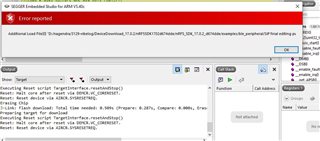
after this i have add DEBUG in preprocessor definition and i got this
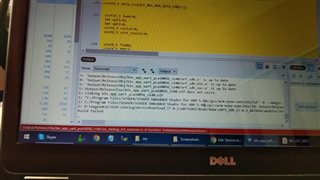
thank you.

  • Hello,

    NO, still same problem i have checked with LOG function configurations also, when comment out the uart_init then it advertising properly and when i uncomment it its not working. so i think in the uart_init() declaration for two UART is not correct so can you please have a look once on uart_init() and let me know any issue with declaration.

    static void uart_init(void)
    {
        uint32_t                     err_code1;
        app_uart_comm_params_t const comm_params1 =
        {
            .rx_pin_no    = RX_PIN_NUMBER,
            .tx_pin_no    = TX_PIN_NUMBER,
            .rts_pin_no   = RTS_PIN_NUMBER,
            .cts_pin_no   = CTS_PIN_NUMBER,
            .flow_control = APP_UART_FLOW_CONTROL_DISABLED,
            .use_parity   = false,
    #if defined (UART_PRESENT)
            .baud_rate    = NRF_UART_BAUDRATE_115200
    #else
            .baud_rate    = NRF_UARTE_BAUDRATE_115200
    #endif
        };
    
         uint32_t                     err_code2;
       app_uart_comm_params_t const comm_params2 =
        {
            .rx_pin_no    = RX_PIN1,
            .tx_pin_no    = TX_PIN1,
            .rts_pin_no   = RTS_PIN_NUMBER,
            .cts_pin_no   = CTS_PIN_NUMBER,
            .flow_control = APP_UART_FLOW_CONTROL_DISABLED,
            .use_parity   = false,
    #if defined (UART_PRESENT)
            .baud_rate    = NRF_UART_BAUDRATE_115200
    #else
            .baud_rate    = NRF_UARTE_BAUDRATE_115200
    #endif
        };
    
        APP_UART_FIFO_INIT(&comm_params1,
                           UART_RX_BUF_SIZE,
                           UART_TX_BUF_SIZE,
                           uart_event_handle,
                           APP_IRQ_PRIORITY_LOWEST,
                           err_code1);
        APP_ERROR_CHECK(err_code1);
    
         APP_UART_FIFO_INIT(&comm_params2,
                           UART_RX_BUF_SIZE,
                           UART_TX_BUF_SIZE,
                           uart_event_handle,
                           APP_IRQ_PRIORITY_LOWEST,
                           err_code2);
        APP_ERROR_CHECK(err_code2);
    }

    thank you.

  • Hi

    Okay, I think you have to use the nrf_drv_uart_init() function to initialize the UART1 instance, as the app_uart does not support two UARTs, and the UART1 is recommended to access through the HW driver, while the UART0 can be accessed through app_uart (or the driver).

    Best regards,

    Simon

  • Hello ,

    sorry for the late reply,

    I think you have to use the nrf_drv_uart_init() function to initialize the UART1 instance, as the app_uart does not support two UARTs,

    As before i mentioned i have declared two nrf_drv_uart_init() in fifo.c but it gives me error so that's why i asked how to declare two UART's i think i am repeating the same thing again and again . please let me know how to declare two UART's and use it.

    thank you.

  • Hi

    Sorry, but you can check out the Serial Power Library example with two UARTEs that is in the nRF5 SDK v16.0.0. It was removed for later versions for some reason, but should show how to set up two UART instances. Here's the source code:

    /**
     * Copyright (c) 2018 - 2019, Nordic Semiconductor ASA
     *
     * All rights reserved.
     *
     * Redistribution and use in source and binary forms, with or without modification,
     * are permitted provided that the following conditions are met:
     *
     * 1. Redistributions of source code must retain the above copyright notice, this
     *    list of conditions and the following disclaimer.
     *
     * 2. Redistributions in binary form, except as embedded into a Nordic
     *    Semiconductor ASA integrated circuit in a product or a software update for
     *    such product, must reproduce the above copyright notice, this list of
     *    conditions and the following disclaimer in the documentation and/or other
     *    materials provided with the distribution.
     *
     * 3. Neither the name of Nordic Semiconductor ASA nor the names of its
     *    contributors may be used to endorse or promote products derived from this
     *    software without specific prior written permission.
     *
     * 4. This software, with or without modification, must only be used with a
     *    Nordic Semiconductor ASA integrated circuit.
     *
     * 5. Any software provided in binary form under this license must not be reverse
     *    engineered, decompiled, modified and/or disassembled.
     *
     * THIS SOFTWARE IS PROVIDED BY NORDIC SEMICONDUCTOR ASA "AS IS" AND ANY EXPRESS
     * OR IMPLIED WARRANTIES, INCLUDING, BUT NOT LIMITED TO, THE IMPLIED WARRANTIES
     * OF MERCHANTABILITY, NONINFRINGEMENT, AND FITNESS FOR A PARTICULAR PURPOSE ARE
     * DISCLAIMED. IN NO EVENT SHALL NORDIC SEMICONDUCTOR ASA OR CONTRIBUTORS BE
     * LIABLE FOR ANY DIRECT, INDIRECT, INCIDENTAL, SPECIAL, EXEMPLARY, OR
     * CONSEQUENTIAL DAMAGES (INCLUDING, BUT NOT LIMITED TO, PROCUREMENT OF SUBSTITUTE
     * GOODS OR SERVICES; LOSS OF USE, DATA, OR PROFITS; OR BUSINESS INTERRUPTION)
     * HOWEVER CAUSED AND ON ANY THEORY OF LIABILITY, WHETHER IN CONTRACT, STRICT
     * LIABILITY, OR TORT (INCLUDING NEGLIGENCE OR OTHERWISE) ARISING IN ANY WAY OUT
     * OF THE USE OF THIS SOFTWARE, EVEN IF ADVISED OF THE POSSIBILITY OF SUCH DAMAGE.
     *
     */
    #include <stdint.h>
    #include <stdbool.h>
    #include <stddef.h>
    
    #include "nrf.h"
    #include "nrf_drv_clock.h"
    #include "nrf_gpio.h"
    #include "nrf_delay.h"
    #include "nrf_log.h"
    #include "nrf_log_ctrl.h"
    #include "nrf_drv_power.h"
    #include "nrf_serial.h"
    #include "app_timer.h"
    
    
    #include "app_error.h"
    #include "app_util.h"
    #include "boards.h"
    
    /** @file
     * @defgroup nrf_serial_uartes_example main.c
     * @{
     * @ingroup nrf_serial_uartes_example
     * @brief Example of @ref nrf_serial usage. Loopback example using two UARTE peripherals.
     *        Please short Arduino SCL and SDA GPIOs to start transmission.
     *
     */
    
    #define OP_QUEUES_SIZE          3
    #define APP_TIMER_PRESCALER     NRF_SERIAL_APP_TIMER_PRESCALER
    
    static void sleep_handler(void)
    {
        __WFE();
        __SEV();
        __WFE();
    }
    
    NRF_SERIAL_DRV_UART_CONFIG_DEF(m_uarte0_drv_config,
                          RX_PIN_NUMBER, ARDUINO_SCL_PIN,
                          RTS_PIN_NUMBER, CTS_PIN_NUMBER,
                          NRF_UART_HWFC_DISABLED, NRF_UART_PARITY_EXCLUDED,
                          NRF_UART_BAUDRATE_115200,
                          UART_DEFAULT_CONFIG_IRQ_PRIORITY);
    
    NRF_SERIAL_DRV_UART_CONFIG_DEF(m_uarte1_drv_config,
                          ARDUINO_SDA_PIN, TX_PIN_NUMBER,
                          RTS_PIN_NUMBER, CTS_PIN_NUMBER,
                          NRF_UART_HWFC_DISABLED, NRF_UART_PARITY_EXCLUDED,
                          NRF_UART_BAUDRATE_115200,
                          UART_DEFAULT_CONFIG_IRQ_PRIORITY);
    
    
    #define SERIAL_FIFO_TX_SIZE 32
    #define SERIAL_FIFO_RX_SIZE 32
    
    NRF_SERIAL_QUEUES_DEF(serial0_queues, SERIAL_FIFO_TX_SIZE, SERIAL_FIFO_RX_SIZE);
    NRF_SERIAL_QUEUES_DEF(serial1_queues, SERIAL_FIFO_TX_SIZE, SERIAL_FIFO_RX_SIZE);
    
    
    #define SERIAL_BUFF_TX_SIZE 1
    #define SERIAL_BUFF_RX_SIZE 1
    
    NRF_SERIAL_BUFFERS_DEF(serial0_buffs, SERIAL_BUFF_TX_SIZE, SERIAL_BUFF_RX_SIZE);
    NRF_SERIAL_BUFFERS_DEF(serial1_buffs, SERIAL_BUFF_TX_SIZE, SERIAL_BUFF_RX_SIZE);
    
    
    NRF_SERIAL_CONFIG_DEF(serial0_config, NRF_SERIAL_MODE_DMA,
                          &serial0_queues, &serial0_buffs, NULL, sleep_handler);
    NRF_SERIAL_CONFIG_DEF(serial1_config, NRF_SERIAL_MODE_DMA,
                          &serial1_queues, &serial1_buffs, NULL, sleep_handler);
    
    
    NRF_SERIAL_UART_DEF(serial0_uarte, 0);
    NRF_SERIAL_UART_DEF(serial1_uarte, 1);
    
    
    int main(void)
    {
        ret_code_t ret;
    
        ret = nrf_drv_clock_init();
        APP_ERROR_CHECK(ret);
        ret = nrf_drv_power_init(NULL);
        APP_ERROR_CHECK(ret);
    
        nrf_drv_clock_lfclk_request(NULL);
        ret = app_timer_init();
        APP_ERROR_CHECK(ret);
    
        // Initialize LEDs and buttons.
        bsp_board_init(BSP_INIT_LEDS | BSP_INIT_BUTTONS);
    
        ret = nrf_serial_init(&serial0_uarte, &m_uarte0_drv_config, &serial0_config);
        APP_ERROR_CHECK(ret);
    
        ret = nrf_serial_init(&serial1_uarte, &m_uarte1_drv_config, &serial1_config);
        APP_ERROR_CHECK(ret);
    
        static char tx_message[] = "Hello nrf_serial!\n\r";
    
        ret = nrf_serial_write(&serial1_uarte,
                               tx_message,
                               strlen(tx_message),
                               NULL,
                               NRF_SERIAL_MAX_TIMEOUT);
        (void)nrf_serial_flush(&serial1_uarte, 0);
    
        while (true)
        {
            char c;
            ret = nrf_serial_read(&serial0_uarte, &c, sizeof(c), NULL, 1000);
            if (ret != NRF_SUCCESS)
            {
                continue;
            }
            (void)nrf_serial_write(&serial0_uarte, &c, sizeof(c), NULL, 0);
            (void)nrf_serial_flush(&serial0_uarte, 0);
    
            ret = nrf_serial_read(&serial1_uarte, &c, sizeof(c), NULL, 1000);
            if (ret != NRF_SUCCESS)
            {
                continue;
            }
            (void)nrf_serial_write(&serial1_uarte, &c, sizeof(c), NULL, 0);
            (void)nrf_serial_flush(&serial1_uarte, 0);
        }
    }
    
    /** @} */
    

    Best regards,

    Simon

Related