Beware that this post is related to an SDK in maintenance mode
More Info: Consider nRF Connect SDK for new designs

Mesh LPN application timing out and/or terminating

Hi,

I have a custom application that is very much based on the LPN example as well as friend nodes that have custom applications based on the light switch server example. They are running on nrf52840dk rev2 with nrf sdk 17.0.2 and s140 7.2.0 softdevice. I provision with the nrf Mesh application for Android. All devices are within a meter of each other.

The friend nodes work just fine but the LPN goes into a cycle of terminating/timing out with reason 2 (NRF_MESH_EVT_FRIENDSHIP_TERMINATED_REASON_NO_REPLY). This is the log from RTT:

00> <t:      12872>, main.c,  302, THP Sensor Model Handle: 2
00> <t:      12877>, main.c,  305, Timestamp Model Handle: 3
00> <t:      17637>, mesh_app_utils.c,   66, Device UUID (raw): 4B842A956B654A04A05B04B3FDCF6F9C
00> <t:      17642>, mesh_app_utils.c,   67, Device UUID : 4B842A95-6B65-4A04-A05B-04B3FDCF6F9C
00> <t:    6479487>, ble_softdevice_support.c,  104, Successfully updated connection parameters
00> <t:    6567957>, ble_softdevice_support.c,  104, Successfully updated connection parameters
00> <t:    6815097>, main.c,  166, Successfully provisioned
00> <t:    6815106>, main.c,  160, Node Address: 0x001B 
00> <t:    6815109>, main.c,   98, Initiating the friendship establishment procedure.
00> <t:    6824388>, main.c,  226, Received friend offer from 0x0012
00> <t:    6827948>, main.c,  267, Friendship established with: 0x0012
00> <t:    7132221>, ble_softdevice_support.c,  104, Successfully updated connection parameters
00> <t:    7156143>, main.c,  279, Friendship with 0x0012 terminated. Reason: 2
00> <t:    7156150>, main.c,   98, Initiating the friendship establishment procedure.
00> <t:    7161669>, main.c,  226, Received friend offer from 0x0014
00> <t:    7182837>, main.c,  257, Friend Request timed out
00> <t:    7182842>, main.c,   98, Initiating the friendship establishment procedure.
00> <t:    7189079>, main.c,  226, Received friend offer from 0x0011
00> <t:    7192638>, main.c,  267, Friendship established with: 0x0011
00> <t:    7226343>, ble_softdevice_support.c,  104, Successfully updated connection parameters
00> <t:    7513799>, main.c,  253, Friend poll procedure complete
00> <t:    7841995>, main.c,  279, Friendship with 0x0011 terminated. Reason: 2
00> <t:    7842001>, main.c,   98, Initiating the friendship establishment procedure.
00> <t:    7871185>, main.c,  226, Received friend offer from 0x0011
00> <t:    7892358>, main.c,  257, Friend Request timed out

In addition, this happens exactly when I start the provisioning process and it fails at the "Getting composition data..." step.

My assumptions are that the provisioner is unable to communicate with the LPN because its not supposed to start initiating friendships too early. The LPN example uses a button handler to initiate friendship after provisioning, but I use the provisioning complete callback instead:

static void provisioning_complete_cb(void)
{
    __LOG(LOG_SRC_APP, LOG_LEVEL_INFO, "Successfully provisioned\n");

    /* Restores the application parameters after switching from the Provisioning
     * service to the Proxy  */
    gap_params_init();
    conn_params_init();

#if BLE_DFU_SUPPORT_ENABLED
    ble_dfu_support_service_init();
#endif

    unicast_address_print();

#ifdef  THP_SENSOR
    if (!mesh_lpn_is_in_friendship())
    {
        initiate_friendship();
    }
    else /* In a friendship */
    {
        terminate_friendship();
    }
#endif
}

Is calling initiate_friendship() here a wrong thing to do?

  • Update 2: 

    For now, my latest two replies there are where I'm at: with the friendship timing out maybe every 10-20mins. I've also set 

    MESH_FEATURE_LPN_ACT_AS_REGULAR_NODE_OUT_OF_FRIENDSHIP = 1
    so that the sensors don't skip a beat with the periodic publications.
    Now the LPN devices work fine, and friend nodes reliably deliver their message when they aren't timed out so we have an MVP there. My worry is the power consumption of the device now.
  • Hi,

    Since the MESH_FEATURE_LPN_ACT_AS_REGULAR_NODE_OUT_OF_FRIENDSHIP means the device will stay in RX when out of friendship, it should mean both that it receives messages and uses more power when not in friendship, yes. Power consumption would be low whenever in friendship, so the power consumption impact depends on how much time is spent outside of friendship. Figuring out and fixing the friendship loss issue could therefore improve power consumption by a lot if a significant time is spent outside of friendship, or if friendship is lost (and reinitiated) often.

    Regarding the MESH_LPN_POLL_RETRY_COUNT, this will work if the friend is often unavailable due to other operations on the friend blocking it from scanning, or if the LPN is prevented from executing polls. If the friend is actually offline, then a high retry count means there is a longer time period for which incoming messages are lost. The reason for the latter, is that during the time between the friend node goes offline and the friendship is terminated, the LPN considers itself still in friendship, so it does not scan for messages but rather depends on the friend to store messages for it. Therefore, high MESH_LPN_POLL_RETRY_TIMEOUT has the drawback of more messages lost at friendship termination. The same will happen for any friendship termination, as the friend will also discard the already received messages when it hasn't heard back from the LPN and the friendship times out.

    The observation regarding app scheduler is interesting. However I have no suggestions why this change should impact friendship in the way you describe. With app scheduler, less should happen in interrupt context, providing more control for the stack to operate, which should improve overall stack performance. May it be too small buffers related to app scheduler, leading to lost operations and/or lost data, impacting the performance of the device? Are you experiencing errors, asserts, etc, leading to LPN or Friend resetting? That could explain lost friendship.

    It is not quite clear to me if the difference was seen when app scheduler was disabled on LPN, or on Friend, or on both.

    Regards,
    Terje

    Regards,
    Terje

  • Hi Terje, 

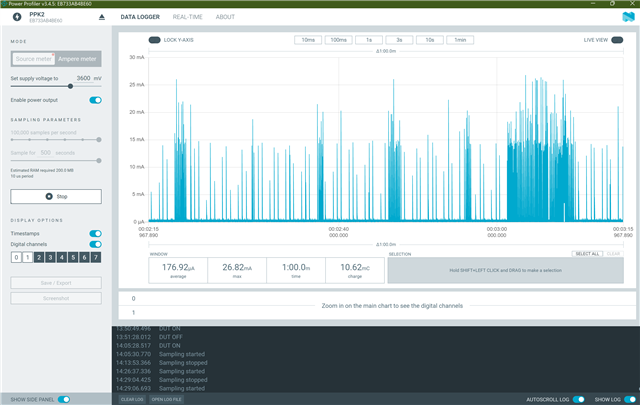
    Sorry to get back to you so late. I finally got my hands on a PPK2 and for some reason the REPLY buttons are not showing up properly on this forum. I'm measuring the current on my custom nRF52840 board and I'm only using the TWI and SAADC peripherals, which I only turn on and off every 5 minutes to read data from a sensor. This time I'm running with MESH_FEATURE_LPN_ACT_AS_REGULAR_NODE_OUT_OF_FRIENDSHIP=0. 

    Other definitions of note:

    /* The maximum duration to scan for incoming Friend Offers. */
    #define FRIEND_REQUEST_TIMEOUT_MS (MESH_LPN_FRIEND_REQUEST_TIMEOUT_MAX_MS) // 1000
    /* The upper limit for two subsequent Friend Polls. */
    #define POLL_TIMEOUT_MS (SEC_TO_MS(10))
    /* The time between LPN sending a request and listening for a response. */
    #define RECEIVE_DELAY_MS (100)
    
    mesh_lpn_friend_request_t freq;
    freq.friend_criteria.friend_queue_size_min_log = MESH_FRIENDSHIP_MIN_FRIEND_QUEUE_SIZE_16; // 4
    freq.friend_criteria.receive_window_factor = MESH_FRIENDSHIP_RECEIVE_WINDOW_FACTOR_1_0; // 0
    freq.friend_criteria.rssi_factor = MESH_FRIENDSHIP_RSSI_FACTOR_2_0; // 2
    freq.poll_timeout_ms = POLL_TIMEOUT_MS;
    freq.receive_delay_ms = RECEIVE_DELAY_MS;

    Here's what idle looks like:

    Temperature Sensor

    It runs much too high for a button cell so we're deploying them with bigger Li-ions. They've been running fine for more than two weeks but we're concerned about the longevity. Do you think moving to the nRF Connect SDK would see some improvements?

    Regards,

    Arif

  • Hi,

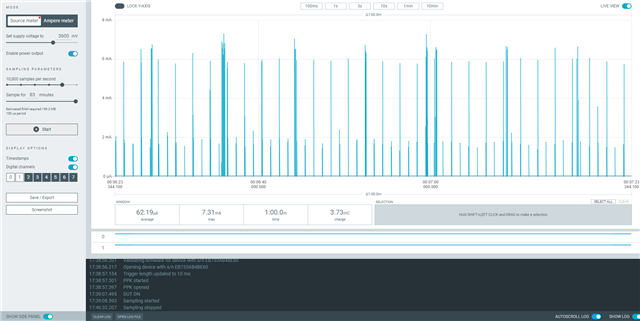
    If you zoom in on that current draw plot, I think you will find that the peaks are very narrow spikes of one or two data points. That should be easily mitigated using capacitors, giving less maximum power draw as seen from the batteries.

    The nature of the power draw would be very similar also in nRF Connect SDK, so this would not be a reason for switching. However, there are other reasons for switching, such as the fact the nRF5 SDK is in maintenance mode and new development will happen only in nRF Connect SDK, ref. the nRF Connect SDK and nRF5 SDK statement.

    Regards,
    Terje

  • We added a 10 uF cap and removed the resistor ladder for the SAADC and managed to get down to this. Very good! Thank you very much for the suggestion. Is there any way to get it down further? The peaks are caused by the friendship polling IIRC, so maybe I should play around with the timings? Right now it'll last 83~ days on a CR2032

Related