



Nordic Semiconductor just launched the nRF54LV10A, further expanding the next-generation nRF54L Series of ultra-low-power wireless SoCs with new capabilities. This device brings support for lower supply voltage of 1.2-1.7 V, a sub-50 nA system hibernation mode for shipping and storage, and an ultra-compact 1.9x2.3 mm CSP package, the smallest in the nRF54L Series to date.
These features make the nRF54LV10A ideal for connected health applications, including CGM (continuous glucose monitors) and other wearable biosensors, where support for low-voltage batteries such as silver oxide coin cells is key to reducing overall size, complexity, and cost.
In this blog post, we will examine the nRF54LV10A and what makes it stand out in the nRF54L Series.
Table of Contents
Expanding the nRF54L Series with nRF54LV10A
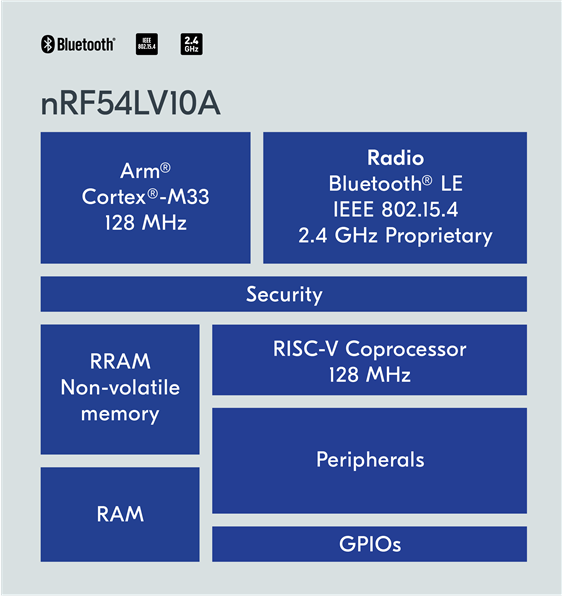
The nRF54LV10A expands the nRF54L Series with differentiating features that are fit-for-purpose, making it ideal for wearable biosensors, CGMs, and other connected healthcare applications. It features 1 MB NVM and 192 KB RAM, while maintaining the same MCU functionality with a 128 MHz Arm Cortex-M33 processor, RISC-V coprocessor, an essential set of peripherals and advanced security. It also integrates Nordic’s fourth-generation ultra-low-power 2.4 GHz radio, supporting Bluetooth® LE and Channel Sounding.
nRF54L Series takes the low power consumption of Bluetooth SoCs to the next level with the 22nm process node and multiple fine optimizations. All SoCs in the series, including nRF54LV10A, deliver roughly 30–50% lower power consumption for common Bluetooth LE use cases compared to the nRF52 Series.
The two features that make nRF54LV10A stand out are the low-voltage power supply and system hibernation mode, which combined with the ultra-low power consumption capabilities allow for the usage of smaller batteries, reducing BOM cost while still meeting battery life requirements. Let’s dig deeper to understand what this means for your end product.
Low-voltage power supply
All the existing devices in the nRF54L Series to date have a power supply voltage of 1.7-3.6 V, a relatively common range. This makes it compatible with batteries such as lithium coin cells, notably the widely used CR2032, which has a nominal output voltage of 3 V. So why did we make a device that brings this supply voltage range all the way down to 1.2-1.7 V? To understand this, we need to first look at the lifespan of CGMs and other wearable biosensors.
CGMs and similar devices typically insert a tiny filament under the skin to provide contact with the interstitial fluid, ensuring accurate sensor readings. The human body sees the filament as a foreign object and triggers an immune response that degrades the sensor’s ability to provide accurate readings. This limits their usable lifetime, which for CGMs is typically between 7 and 14 days, as an example. The short lifespan and long storage time of these devices, coupled with other technical requirements such as their small form factor and the need for watertightness, restrict the choice of batteries, essentially narrowing it down to silver oxide coin cell batteries.
This type of coin cell battery has properties that make it well-suited to wearable biosensors, such as a compact form factor, stable voltage output throughout most of its charge, low self-discharge, and a reputation for safety and reliability, which are essential in body-worn applications. Despite these advantages, a key challenge of integrating silver oxide cells is their low nominal output voltage of 1.5V, which is not typically supported as standard by wireless SoCs.
By introducing a low-voltage power supply with nRF54LV10A, it allows the wireless SoC to be powered directly from the output of the silver oxide battery, eliminating the need for an external boost converter, and enabling simpler, smaller, and more cost-optimized designs for wearable biosensor applications.
System hibernation mode
Wearable biosensors are typically fully enclosed, meaning that the battery is mounted during the device manufacturing process and must remain in good condition until it reaches the end user. While devices such as CGMs have a short lifespan of 7 to 14 days after initial use, they may remain inactive for 6 to 18 months. This is due to various reasons such as manufacturing lead times (the batteries may have been sitting on a shelf for several months before they are assembled into the device), regulatory approvals, global logistics related to distribution and storage, shipping, and inventory buffering.
Over this period of time, the battery will lose capacity due to two primary reasons: self-discharge and system power consumption. While there is nothing we can do about the self-discharge, which for silver oxide batteries is 2-10% per year, there is something we can do to minimize the power consumption of the system itself, and avoid significant battery drain, ensuring a healthy state when it reaches the end user.
For this purpose we borrowed a feature from Nordic’s Power Management ICs (PMICs) called ship/hibernate mode, and brought it over to the nRF54LV10A, which allows the wireless SoC to go under 50 nA of current consumption, minimizing battery drain. This feature is especially useful for devices such as CGMs that can spend months in shipping and storage, and must reach the end customer in a healthy state that ensures operation during their specified lifespan.
Availability of development kits and samples
The nRF54LV10A is ready for development and the preliminary datasheet is publicly available. We’ve opened the project-based early access program to enable access to the nRF54LV10A DK and samples. To apply for access, please fill-out the form here nordicsemi.com/nRF54LV10A or you can contact your Nordic sales representative or local Nordic distributor directly.
How to get started
The nRF54LV10A is supported by the nRF Connect SDK, offering a framework for developing low-power and secure IoT applications that can scale from simple use cases to feature-rich and sophisticated implementations. Support for nRF54LV10A in the nRF Connect SDK Bare Metal option will also be in place at a later stage, expected during Q1 2026.
The Nordic Developer Academy just released a new course, the nRF54L Series Express. Express courses are concise, self-contained learning modules with no prerequisites, designed to provide rapid onboarding on specific topics. The nRF54L Series Express only takes 2-3 hours to complete and requires no hardware or software. To get started with the nRF Connect SDK, we recommend using the broadly available nRF54L15 DK (which can also emulate the nRF54L10 and nRF54L05) and taking the nRF Connect SDK Fundamentals/Intermediate and Bluetooth LE Fundamentals courses.
For any questions or troubleshooting, Nordic’s technical support is available to all, including free hardware reviews and antenna tuning.
Closing
As we’ve explored the capabilities and features of the nRF54LV10A, it’s clear that the nRF54L Series is expanding in breadth and depth, offering both flexibility and a fit-for-purpose approach for specific application areas.
For more information and further links to the datasheet and nRF Connect SDK documentation, visit nordicsemi.com/nRF54LV10A.
