Before buying two nRF54LM20-DKs, I need to know which way is supported. Our own protocol uses RADIO directly: in each 20 ms period a SYNC goes out at 30 µs, started by a TIMER...
The Thingy:91 X board files allocate only 32 kB to the TF-M secure partition (slot0_s_partition). This is too small to support CONFIG_TFM_PROFILE_TYPE_MEDIUM, which is required...
Hi,
I am designing a PCB using the nRF54L15 (QFN, 3.3 V system) that must meet IEC 61000-4-2 Level 3 (±4 kV contact / ±8 kV air discharge). The on-chip ESD rating is only...
I am developing a proprietary 2.4 GHz distance measurement with two-way phase-based ranging and RTT on the nRF54L15.
I intend to control the RADIO peripheral directly, without...
Range testing of any RF scheme is inherently limited by the RF environment, antenna design, tuning and many other factors. The usefulness of range testing is to provide a basis for comparison while keeping…
This blog post describes how you can take advantage of the 4 MOSFET's on the Thingy:52.
DISCLAIMER: Please verify all information that is used/retrieved from this blog post. Some of the information…
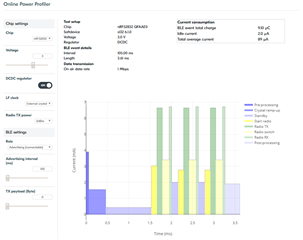
The Power Profiler Kit (PPK) is a flexible tool for measuring the real-time current draw of nRF5x designs. When used as an add-on board to measure the nRF5x current of an attached development kit (DK)…
This blog was last updated 17.01.2019.
The Bluetooth Special Interest Group (SIG) recently announced the deprecation and withdrawal of Bluetooth Core specifications v4.0 and v4.1. For products that are…
This blog describes how you can setup a Segger Embedded Studio example for PCA10040E (emulating nRF52810) from nRF5 SDK 14.2 to use S132 v5.1.0, instead of S112. The procedure should be similar for the…
A common thing to do is to use the Nordic UART Service for quick prototyping.
Often the example itself is used as a starting point (ble_app_uart). But sometimes we use other starting points, and want to…