How reliable is the Power Profiler II?

HI. I've been using the Power Profiler II to measure the power consumption of our new IoT device. I am relying on it to give me accurate information so I can formulate battery life estimates that we are then using in marketing materials. While I've been using the PPKII for a year now, I now have very low confidence in its accuracy. 

First off, about a month ago, after accepting a software update to the Power Profiler II (because I wasn't thinking right), it lost the ability to capture for periods of longer than 45 minutes +/-. Prior to that, I had captured time ranges up to and over 24 and 36 hours. This is on two different Macs, one that is Intel and the other is Apple Silicon. Nordic support knows about it and are working on it, but they've given me no estimate of when they will have this fixed.

I realize that Macs are usually an afterthought for most companies, and in their rush to use cross-platform dev tools they end up with something not quite perfect -- therefore, I went out and both a Windows PC to get what I need done.

And there seems to be no way to downgrade the software. There are too many components that were updated, including the firmware of the PPKII.

Secondly, I am currently running some measurements, and I am seeing some very odd anomalies. And I have alternatively placed two different Fluke 289s in series with it to double check the current:

        a. While the Flukes tell me that I am using about 8µA, the Power Profiler shows 4.1µA. Even at higher values in the 50µA range, the Fluke and the PPK disagree. For example the Flukes will tell me that I am using 55mA, and the PPKII is telling me that I'm using 48mA.

        b. Then I use another device that has an adjustable LED on it. As I increase the brightness of the LED, the fluke shows the current increase from 12mA to 15mA. The Power Profiler does not - and isn't even merely off by some constant amount. Instead, what it shows is a ramp that repeats every ten seconds or so, spiking instantaneously to 50mA and then ramping down slowly to mA at which point it spikes to 50 again and the whole thing repeats itself. The delay is 10 seconds or less, but it seems to reset to the spike when the value hits 5ma. The device I am testing has no reason to be using power in that pattern. It is merely an ESP32 that is setting the RGB values of an LED. The Fluke's do not show any fluctuation that goes over 16mA - i have it displaying min, max and average and I don't see any ramping.
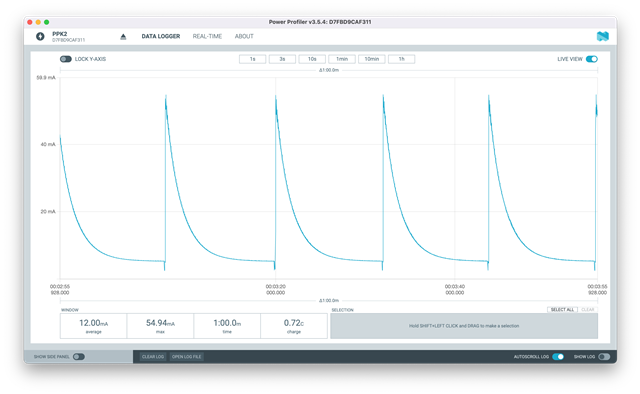

I wasn't seeing this ramp in my other IoT device, because that IoT device typically uses 4-8µA (not sure who to believe), and when the device is on, it uses about 40-50mA for about 3 seconds. I then placed my IoT device in a mode where it stays on and uses about 20mA consistently. At that point I started seeing that rating. It seems to me that there is a bug that makes the PPKII show completely incorrect numbers if the current is within a range of 10-20mA. Or something.

Can anyone shed some light onto this?
Do I have a bad unit? 
Should I not be expecting much accuracy?
 

Parents
  • Hi again, Mahboud!

    Some suggestions and questions for further investigation:

    • Try to perform measurements separately, as placing measurement equipment in series tend to have undesired side effects.
    • What settings are you using?
      • SMU or AMP mode?
      • Sampling speed (may cause averaging, which again may give wrong calculations)?
      • Voltage level of measurements?
    • What are you using as voltage source? And what is the voltage level of this?
    • What is the current measured in the lower spikes of the curve (use 100 kS/s when measuring this)?
    • Could you also try measuring a component that you're 100 % sure is static (e.g., a resistor)? As the ESP32 is an MCU, it might be running PWM or other things causing an unexpected pattern in the current consumption.

    Best regards,
    Mathias

Reply
  • Hi again, Mahboud!

    Some suggestions and questions for further investigation:

    • Try to perform measurements separately, as placing measurement equipment in series tend to have undesired side effects.
    • What settings are you using?
      • SMU or AMP mode?
      • Sampling speed (may cause averaging, which again may give wrong calculations)?
      • Voltage level of measurements?
    • What are you using as voltage source? And what is the voltage level of this?
    • What is the current measured in the lower spikes of the curve (use 100 kS/s when measuring this)?
    • Could you also try measuring a component that you're 100 % sure is static (e.g., a resistor)? As the ESP32 is an MCU, it might be running PWM or other things causing an unexpected pattern in the current consumption.

    Best regards,
    Mathias

Children
  • 1. The reason I was measuring in series is because of the numbers I was seeing when measuring just using the PPK. I had to verify the numbers, and also to see if that strange pattern was visible on the Fluke - it wasn't and it spanned 10 seconds so it should have been easy to see it on the Fluke.
    2. I am using AMP mode. I have tried sampling 1000 and 100 samples per second. I didn't see an improvement.
    3. The voltage is typically between 4V and 4.2V. I am using Lithium Polymer batteries that is pretty fully charged. I have been testing dozens of boards. They each have their own battery. I unplug the battery and place a little harness between the battery and the boards. That harness allows me to route the power to the PPK's Vin and Vout, with a ground from the battery negative to the PPK's GND.
    4. I was thinking that the issue could be with PWM, but a 10 second period is something else.
    I'll try sampling with some resistors.

    Keep in mind that I've been measuring currents on these devices for about a year now, and it seems like a lot of the problems I have with the PPK, cropped up after the last update (which I can not roll back).


  • I understand. Please give me an update when you have tried with the resistors.

    And as mentioned in my last reply, could you try to perform the measurements using 100 kS/s (especially to identify what's happening in the lower, downward spikes)? There is a suspicion that wrong calculations after the last update may be caused by averaging. Using 100 S/s or 1 kS/s wouldn't give a high enough speed to discover if this is the problem.

Related