

NCS 2.4.0
OS: Windows 10
We are preparing our system for regulatory testing (FCC) on our nRF52833-based device. So we want to use the "direct test mode" sample.
We wanted to start by running on the nRF52833 DK, but when we try to compile under NCS 2.4.0 we get the build error...
ir/src/dtm_hw.c.obj -MF CMakeFiles\app.dir\src\dtm_hw.c.obj.d -o CMakeFiles/app.dir/src/dtm_hw.c.obj -c ../src/dtm_hw.c
In file included from C:\Users\Bryan\ncs\v2.4.2\zephyr\include\zephyr\toolchain.h:50,
from C:\Users\Bryan\ncs\v2.4.2\zephyr\include\zephyr\sys\time_units.h:10,
from C:\Users\Bryan\ncs\v2.4.2\zephyr\include\zephyr\sys\util.h:582,
from C:\Users\Bryan\ncs\v2.4.2\zephyr\include\zephyr\devicetree.h:21,
from c:\users\bryan\ncs\v2.4.2\zephyr\modules\hal_nordic\nrfx\nrfx_config.h:10,
from C:\Users\Bryan\ncs\v2.4.2\modules\hal\nordic\nrfx\nrfx.h:37,
from C:\Users\Bryan\ncs\v2.4.2\modules\hal\nordic\nrfx\hal\nrf_radio.h:37,
from c:\Virtuix\nordic\myapps\direct_test_mode\src\dtm_hw.h:13,
from c:\Virtuix\nordic\myapps\direct_test_mode\src\dtm_hw.c:9:
C:\Users\Bryan\ncs\v2.4.2\zephyr\include\zephyr\toolchain\gcc.h:81:36: error: static assertion failed: "You must set the dfe-antenna-num property in the radio node to enable antenna switching."
OK. So we deleted the nRF52833 DK build configuration, created an overlay file based on what was done for the nRF5340 that includes the dfe-antenna-num property, and created a new nRF52833 DK build configuration. This builds and is flashed into the nRF52833 DK successfully, but the Direct Test Mode app fails to connect.
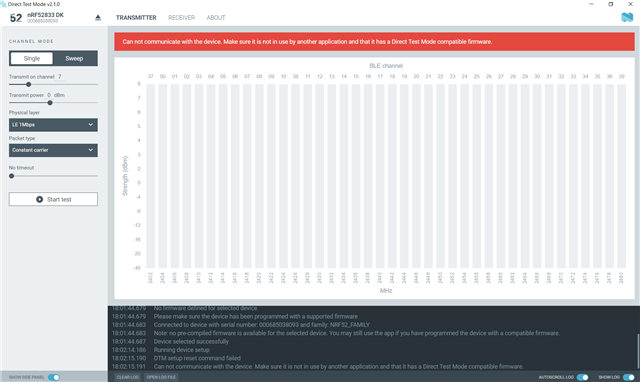
We do not know where to go from here. The DTM on the nRF52833 DK used to work way back on NCS 1.9.1 because we used it to do some initial antenna testing. Can someone explain what we are doing wrong? Thanks!
direct_test_mode_ncs_2.4.0.zip
