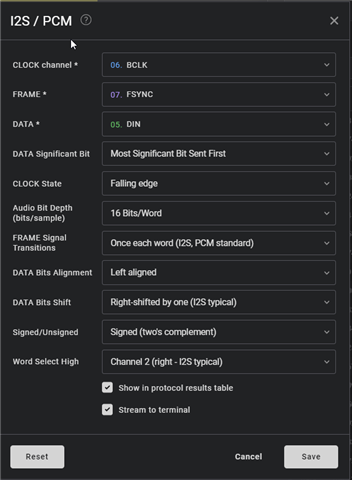
I am quite new to the nRF5340 Audio DK and used ace.johnny 's project on https://github.com/ace-johnny/nrfadk-hello_codec to get me started.
The overall project goal is to process audio data coming via line-in on the nRF5340 to add filters, effects, etc. and output again via the headphone.
In order to achieve this I transmit the data from the codec via i2s to the MCU, process it there and send it back. However, something in this chain is introducting a lot of noise/clipping and I can't find the reason for this. Right now my processing of the received data is just copying it 1:1 to the transmit buffer - no change whatsoever.
When I directly route the line-in input to the output and not going via i2s to the MCU and back everything is crystal clear.
This is the code I use:
/**
 * @file        main.c
 *
 * @brief       Audio DK HW_CODEC test using I2S loop and tone/noise generators.
 */

#include <zephyr/kernel.h>
#include <nrf.h>
#include <nrfx_clock.h>

#include "cs47l63_comm.h"

////////////////////////////////////////////////////////////////////////////////
// NRFX_CLOCKS

#define HFCLKAUDIO_12_288_MHZ 0x9BA6
#define ENABLE_LINEIN
#undef ENABLE_MIC


/**
 * @brief       Initialize the high-frequency clocks and wait for each to start.
 *
 * @details     HFCLK =         128,000,000 Hz
 *              HFCLKAUDIO =     12,288,000 Hz
 */
static int nrfadk_hfclocks_init(void)
{
	nrfx_err_t err;


	// HFCLK
	err = nrfx_clock_divider_set(NRF_CLOCK_DOMAIN_HFCLK, NRF_CLOCK_HFCLK_DIV_1);
	if (err != NRFX_SUCCESS) return (err - NRFX_ERROR_BASE_NUM);

	nrfx_clock_start(NRF_CLOCK_DOMAIN_HFCLK);
	while (!nrfx_clock_is_running(NRF_CLOCK_DOMAIN_HFCLK, NULL)) k_msleep(1);


	// HFCLKAUDIO
	nrfx_clock_hfclkaudio_config_set(HFCLKAUDIO_12_288_MHZ);

	nrfx_clock_start(NRF_CLOCK_DOMAIN_HFCLKAUDIO);
	while (!nrfx_clock_is_running(NRF_CLOCK_DOMAIN_HFCLKAUDIO, NULL)) k_msleep(1);


	return 0;
}


////////////////////////////////////////////////////////////////////////////////
// NRF_I2S

#define MCKFREQ_6_144_MHZ 0x66666000


#define I2S_BUFF_SIZE 256  // Define an appropriate buffer size

static int16_t rx_buffer[I2S_BUFF_SIZE];  // Buffer for received data
static int16_t tx_buffer[I2S_BUFF_SIZE];

void process_audio(int16_t *rx, int16_t *tx, size_t size)
{
    for (size_t i = 0; i < size; i++) {
		tx[i] = rx[i];  // Simple passthrough (modify as needed)
        	//tx[i] = (int16_t)(rx[i]*0.1);  // Volume control
		//tx[size-1-i] = rx[i];  // Reverse - doesn't work... -> only outputs silence...?
    }
}

/**
 * @brief       Initialize and start the I2S peripheral using NRF registers.
 *
 * @details     I2S master, 48kHz 16bit, Left mono, TX only.
 */
static int nrfadk_i2s_reg_init(void)
{
	// Configure and enable
	NRF_I2S0->CONFIG.CLKCONFIG =    I2S_CONFIG_CLKCONFIG_CLKSRC_ACLK;
	NRF_I2S0->CONFIG.MCKFREQ =      MCKFREQ_6_144_MHZ;
	NRF_I2S0->CONFIG.RATIO =        I2S_CONFIG_RATIO_RATIO_128X;
	NRF_I2S0->CONFIG.CHANNELS =     I2S_CONFIG_CHANNELS_CHANNELS_Left;
	NRF_I2S0->CONFIG.TXEN =         I2S_CONFIG_TXEN_TXEN_Enabled;  // Send audio samples to the nRF5340
	NRF_I2S0->CONFIG.RXEN = 	I2S_CONFIG_RXEN_RXEN_Enabled;  // Enable RX to receive the data from the nRF5340

	NRF_I2S0->ENABLE =              I2S_ENABLE_ENABLE_Enabled;

	// Start TX buffer
	NRF_I2S0->RXD.PTR = 		(uint32_t)rx_buffer;
	NRF_I2S0->TXD.PTR = 		(uint32_t)tx_buffer;
	NRF_I2S0->RXTXD.MAXCNT =        I2S_BUFF_SIZE / sizeof(uint32_t);

        // Clear pending events
    	NRF_I2S0->EVENTS_RXPTRUPD = 0;
	    NRF_I2S0->EVENTS_TXPTRUPD = 0;

	NRF_I2S0->TASKS_START =         I2S_TASKS_START_TASKS_START_Trigger;
	return 0;
}

void i2s_polling_loop(void)
{
    while (1)
    {
        // Wait for new RX data
        while (NRF_I2S0->EVENTS_RXPTRUPD == 0);

        // Clear RX event
        NRF_I2S0->EVENTS_RXPTRUPD = 0;

        // Process audio data
        process_audio(rx_buffer, tx_buffer, I2S_BUFF_SIZE); // For now, just set tx_buffer == rx_buffer

        // Ensure we restart I2S for continuous operation
        NRF_I2S0->TASKS_START = I2S_TASKS_START_TASKS_START_Trigger;
	while (NRF_I2S0->EVENTS_TXPTRUPD == 0);
    }
}

////////////////////////////////////////////////////////////////////////////////
// HW_CODEC

/** CS47L63 driver state handle. */
static cs47l63_t cs47l63_driver;


/** CS47L63 subsystems configuration. */
static const uint32_t cs47l63_cfg[][2] =
{

	// Audio Serial Port 1 (I2S slave, 48kHz 16bit, Left mono, RX and TX)
	{ CS47L63_ASP1_CONTROL2,
		(0x10  << CS47L63_ASP1_RX_WIDTH_SHIFT) |        // 16bit
		(0x10  << CS47L63_ASP1_TX_WIDTH_SHIFT) |        // 16bit
		(0b010 << CS47L63_ASP1_FMT_SHIFT)               // I2S
	},
	{ CS47L63_ASP1_CONTROL3,
		(0b00 << CS47L63_ASP1_DOUT_HIZ_CTRL_SHIFT)      // Always 0
	},
	// Enable the various channels for RX and TX
	{ CS47L63_ASP1_ENABLES1,
		(0 << CS47L63_ASP1_RX2_EN_SHIFT) |              // Disabled
		(1 << CS47L63_ASP1_RX1_EN_SHIFT) |              // Enabled
		(0 << CS47L63_ASP1_TX2_EN_SHIFT) |              // Disabled
		//(0 << CS47L63_ASP1_TX1_EN_SHIFT)                // Disabled
		(1 << CS47L63_ASP1_TX1_EN_SHIFT)                // Enabled - we want to send something to the nRF5340
	},

#ifdef ENABLE_LINEIN
	// Enable line-in
	{ CS47L63_INPUT2_CONTROL1, 0x00050020 },/* MODE=analog */
	{ CS47L63_IN2L_CONTROL1, 0x10000000 },  /* SRC=IN2LP */
	{ CS47L63_IN2R_CONTROL1, 0x10000000 },  /* SRC=IN2RP */
	{ CS47L63_INPUT_CONTROL, 0x0000000C },  /* IN2_EN=1 */
	// Set volume for line-in
	{ CS47L63_IN2L_CONTROL2, 0x00800080 },  /* VOL=0dB, MUTE=0 */
	{ CS47L63_IN2R_CONTROL2, 0x00800080 },  /* VOL=0dB, MUTE=0 */
	{ CS47L63_INPUT_CONTROL3, 0x20000000 }, /* VU=1 */
	// Important
	/* Route IN2L and IN2R to I2S */
	{ CS47L63_ASP1TX1_INPUT1, 0x800012 },
	{ CS47L63_ASP1TX2_INPUT1, 0x800013 },
#endif

	// Output 1 Left (reduced MIX_VOLs to prevent clipping summed signals)
	// this here is only there so we hear also that i2s data is sent

	{ CS47L63_OUT1L_INPUT1,
		(0x2B  << CS47L63_OUT1LMIX_VOL1_SHIFT) |        // quite weak
		(0x020 << CS47L63_OUT1L_SRC1_SHIFT)             // ASP1_RX1 // from MCU (currently a sine wave only)
	},

	{ CS47L63_OUT1L_INPUT2,
		(0x2B  << CS47L63_OUT1LMIX_VOL2_SHIFT) |        //
		(0x021 << CS47L63_OUT1L_SRC2_SHIFT)             // ASP1_RX2
	},

#undef ENABLE_LINEIN
#ifdef ENABLE_LINEIN
	// We need both channels here, even if we only have one output channel
	// If we uncomment the next two {} we won´t get any line in pass-through, only i2s
	{
		CS47L63_OUT1L_INPUT3,
		(0x2B  << CS47L63_OUT1LMIX_VOL3_SHIFT) |
		(0x012 << CS47L63_OUT1L_SRC3_SHIFT)    // 0x12=IN2L
	},
	{
		CS47L63_OUT1L_INPUT4,
		(0x2B  << CS47L63_OUT1LMIX_VOL4_SHIFT) |
		(0x013 << CS47L63_OUT1L_SRC4_SHIFT)    // 0x13=IN2R
	},
#endif

	{ CS47L63_OUTPUT_ENABLE_1,
		(1 << CS47L63_OUT1L_EN_SHIFT)                   // Enabled
	},
};


/**
 * @brief       Write a configuration array to multiple CS47L63 registers.
 *
 * @param[in]   config: Array of address/data pairs.
 * @param[in]   length: Number of registers to write.
 *
 * @retval      `CS47L63_STATUS_OK`     The operation was successful.
 * @retval      `CS47L63_STATUS_FAIL`   Writing to the control port failed.
 */
static int nrfadk_hwcodec_config(const uint32_t config[][2], uint32_t length)
{
	int ret;
	uint32_t addr;
	uint32_t data;

	for (int i = 0; i < length; i++)
	{
		addr = config[i][0];
		data = config[i][1];

		ret = cs47l63_write_reg(&cs47l63_driver, addr, data);
		if (ret) return ret;
	}

	return CS47L63_STATUS_OK;
}


/**
 * @brief       Initialize the CS47L63, start clocks, and configure subsystems.
 *
 * @details     MCLK1 =   6,144,000 Hz  (I2S MCK = CONFIG.MCKFREQ)
 *              FSYNC =      48,000 Hz  (I2S LRCK = MCK / CONFIG.RATIO)
 *              BCLK =    1,536,000 Hz  (I2S SCK = LRCK * CONFIG.SWIDTH * 2)
 *              FLL1 =   49,152,000 Hz  (MCLK1 * 8)
 *              SYSCLK = 98,304,000 Hz  (FLL1 * 2)
 *
 * @retval      `CS47L63_STATUS_OK`     The operation was successful.
 * @retval      `CS47L63_STATUS_FAIL`   Initializing the CS47L63 failed.
 *
 * @note        I2S MCK must already be running before calling this function.
 */
static int nrfadk_hwcodec_init(void)
{
	int ret = CS47L63_STATUS_OK;


	// Initialize driver
	ret += cs47l63_comm_init(&cs47l63_driver);


	// Start FLL1 and SYSCLK
	ret += cs47l63_fll_config(&cs47l63_driver, CS47L63_FLL1,
	                          CS47L63_FLL_SRC_MCLK1, 6144000, 49152000);

	ret += cs47l63_fll_enable(&cs47l63_driver, CS47L63_FLL1);

	ret += cs47l63_fll_wait_for_lock(&cs47l63_driver, CS47L63_FLL1);

	ret += cs47l63_update_reg(&cs47l63_driver, CS47L63_SYSTEM_CLOCK1,
	                          CS47L63_SYSCLK_EN_MASK, CS47L63_SYSCLK_EN);


	// Configure subsystems
	ret += nrfadk_hwcodec_config(cs47l63_cfg, ARRAY_SIZE(cs47l63_cfg));


	return ret;
}


////////////////////////////////////////////////////////////////////////////////
// MAIN

int main(void)
{
	// Initialize Audio DK

	if (nrfadk_hfclocks_init() ||
	    nrfadk_i2s_reg_init()  ||
	    nrfadk_hwcodec_init())
	{
		printk("\nError initializing Audio DK\n");
		return -1;
	}

	printk("\nAudio DK initialized\n");
	k_msleep(1250);


	// Unmute OUT1L I2S playback and enable NOISE/TONE1 generators

	cs47l63_update_reg(&cs47l63_driver, CS47L63_OUT1L_VOLUME_1,
	                   CS47L63_OUT_VU_MASK | CS47L63_OUT1L_MUTE_MASK,
	                   CS47L63_OUT_VU | 0);

	printk("\nOUT1L unmuted for 5000ms\n");

	k_msleep(5000);
	i2s_polling_loop(); // We actually never return from here (testing)

	while(1);
	cs47l63_update_reg(&cs47l63_driver, CS47L63_OUT1L_VOLUME_1,
	                   CS47L63_OUT_VU_MASK | CS47L63_OUT1L_MUTE_MASK,
	                   CS47L63_OUT_VU | CS47L63_OUT1L_MUTE);

	printk("OUT1L muted\n");
	k_msleep(1250);


	// Shutdown Audio DK (reverse order initialized)

	cs47l63_update_reg(&cs47l63_driver, CS47L63_OUTPUT_ENABLE_1,
	                   CS47L63_OUT1L_EN_MASK, 0);
	printk("\nOUT1L disabled\n");
	k_msleep(250);

	cs47l63_update_reg(&cs47l63_driver, CS47L63_SYSTEM_CLOCK1,
	                   CS47L63_SYSCLK_EN_MASK, 0);
	printk("SYSCLK disabled\n");
	k_msleep(250);

	cs47l63_fll_disable(&cs47l63_driver, CS47L63_FLL1);
	printk("FLL1 disabled\n");
	k_msleep(250);

	NRF_I2S0->TASKS_STOP =  I2S_TASKS_STOP_TASKS_STOP_Trigger;
	NRF_I2S0->ENABLE =      I2S_ENABLE_ENABLE_Disabled;
	printk("I2S disabled\n");
	k_msleep(250);

	nrfx_clock_stop(NRF_CLOCK_DOMAIN_HFCLKAUDIO);
	while (nrfx_clock_is_running(NRF_CLOCK_DOMAIN_HFCLKAUDIO, NULL)) k_msleep(1);
	printk("HFCLKAUDIO stopped\n");
	k_msleep(250);

	nrfx_clock_stop(NRF_CLOCK_DOMAIN_HFCLK);
	while (nrfx_clock_is_running(NRF_CLOCK_DOMAIN_HFCLK, NULL)) k_msleep(1);
	printk("HFCLK stopped\n");
	k_msleep(250);


	printk("\nAudio DK shutdown\n\n");
	k_msleep(100);


	return 0;
}
process_audio() is the simple function which just sets the TX buffer to the RX buffer's values.
(Here I want eventually to add my processing)