Hello,
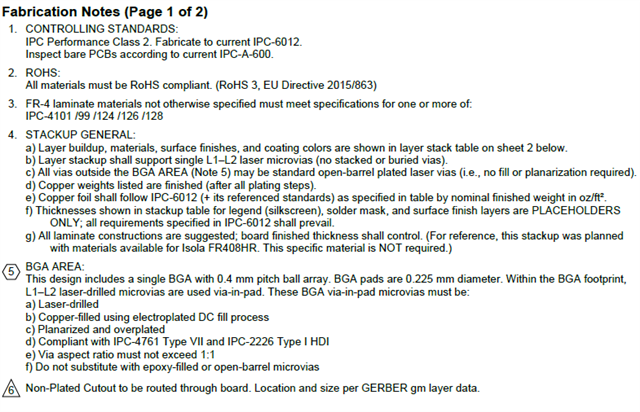
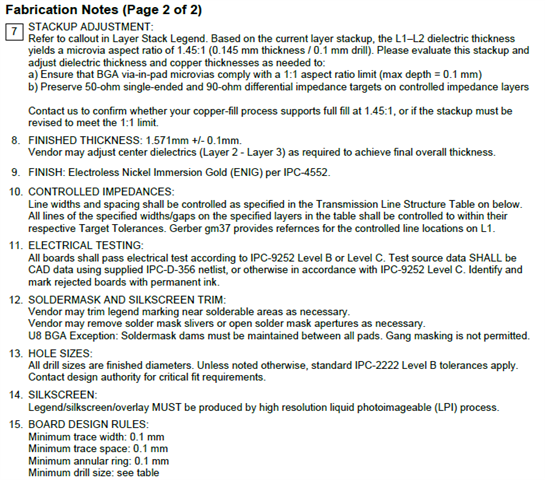
I am designing a custom PCBA based on the nRF7002DK PCBA and I really need the Fabrication Notes / Drawing that officially went to the fabricator to direct the build, if possible, please. I am getting push-back from my NPI prototype vendor regarding capabilities limitations for the nRF5340 via-in-pad construction.
At this point I've made only one change to the L1-L2 microvia spec to ease minimum soldermask sliver between BGA pads. I changed the via diameter from 0.3mm to 0.254mm. This continues to meet standard class 2 minimum annular ring for a 4 mil laser drill, so I think it's ok. Let me know if you disagree.
Also regarding the stack-up in the DK Altium files, and with respect to the microvias, there is an aspect ratio problem. For the stack-up in the Altium files, the effective aspect ratio is about 1.45:1. Max permitted aspect ratio for a 4 mil laser drilled microvia is 1:1. So, I don't know how Nordic managed to manufacture the DK with this stackup. Maybe the Altium stackup is not what's in the fab drawing. You can see what I'm getting at here now.
In addition to all of this, I want to be very clear about specifying the board is generally class 2 but requires special considerations for the nRF5340 only. Here's what I have in my draft fabrication notes as of right now specifically related to this:
General Construction Notes
-
Build to IPC-6012 Class 2 performance requirements unless otherwise specified.
-
Layer stackup shall support single L1–L2 laser microvias (no stacked or buried vias).
-
All vias outside of the BGA area may be standard open-barrel plated laser vias (i.e., no fill or planarization required).
BGA Area (HDI Exception Handling)
-
This design includes a single BGA with 0.4 mm pitch ball array. BGA pads are 8.858 mil diameter (circular).
-
Within the BGA footprint, L1–L2 laser-drilled microvias are used via-in-pad.
-
These BGA via-in-pad microvias must be:
-
Laser-drilled
-
Copper-filled using electroplated DC fill process
-
Planarized and overplated
-
Compliant with IPC-4761 Type VII and IPC-2226 Type I HDI
-
Via aspect ratio must not exceed 1:1
-
Do not substitute with epoxy-filled or open-barrel microvias
-
Stackup Adjustment Request
-
Based on the current layer stackup, the L1–L2 dielectric thickness yields a microvia aspect ratio of 1.45:1 (via drill = 3.937 mil, pad = 10 mil).
-
Please evaluate this stackup and adjust dielectric thickness and copper thicknesses as needed to:
-
Ensure that BGA via-in-pad microvias comply with a 1:1 aspect ratio limit (max depth = 3.937 mil)
-
Preserve 50-ohm single-ended and 90-ohm differential impedance targets on controlled impedance layers
-
-
Contact us to confirm whether your copper-fill process supports full fill at 1.45:1, or if the stackup must be revised to meet the 1:1 limit.
I ask that someone from Nordic engineering please review this and provide me with any additional instructions I need to ensure I accurately communicate Nordic's full fabrication intent to my NPI vendor.
Thank you in advance,
Chris