nRF91 RF front end, isolation between cellular and GPS antenna ports

Hi,

I'm considering the implementation options for nRF91 GPS front end. Having a shared antenna for LTE and GPS would be tempting, but I'm concerned about the filtering/isolation needs.

In the solution proposed in the nRF91 documentation the antenna connection is fed to the GPS input via the AUX pin. Hence apparently there's some kind of internal switch between the ANT and AUX pins of the nRF91.
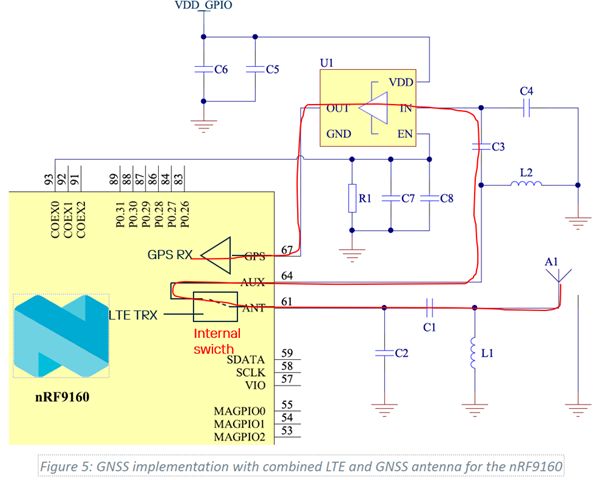
Now, I wonder what is the attenuation of this internal switch and if it's high enough to prevent the LTE TX leaking in the GPS receiver and causing harmful harmonics? For example, when operating in B13, the 2nd TX harmonic is falling in the middle of the GPS band for which there're very strict emission limits in US.

Possible problem could be mitigated by a band filter in front of the GPS LNA, but this is not recommended in the nRF91 documentation. Is it really not needed?

Regards,

Jyrki

Parents Reply Children
  • Hi again, Jyrki.

    The GPS is time multiplexed with the cellular modem so the risk of LTE TX leaking into the GPS receiver is non-existent. What though is possible, is that nearby UEs/interference is captured by the wide-band cellular antenna and fed into the nRF91 GPS receiver. To mitigate this, an external LNA with a BPF/band filter for the GPS path is recommended in the documentation. This is also mentioned in the GPS chapter of the PS:
      

  • Hi,

    That's sure sound thinking. However, my scenario was that in case the LTE TX leaks to the GPS receiver via the switch, the GPS receiver may cause harmonics even it's not turned on. This would not happen if the switch attenuation is high enough. And of course the switch would attenuate those generated harmonics too.

    But I hear you and agree - an external GPS LNA and GPS band filter is probably the preferred solution anyhow.

Related
