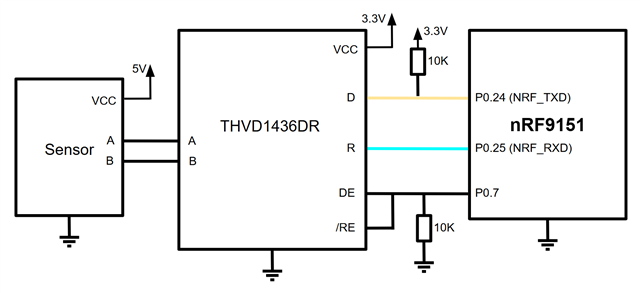
Hello,
I'm adding power management to a custom driver that talks to a sensor via uart2 of the nRF9151DK. But from my tests it seems that uart_irq_rx_enable() has no effect after the driver resumes the uart device with pm_device_runtime_get().
The driver has three functions:
- turn_on(): Runs pm_device_runtime_get() to resume uart operation and sets a gpio high to enable the sensor.
- turn_off(): Runs pm_device_runtime_put() to suspend uart operation and set a gpio low to disable the sensor.
- sample_fetch(): Sends a command to the sensor and waits for the rx buffer to have the expected response size in bytes, using a semaphore with a 1s timeout.
The pm_action callback function is:
static int sensor_pm_action(const struct device *dev,
                             enum pm_device_action action)
{
    const struct sensor_cfg *cfg = dev->config;
    struct gpio_dt_spec en_gpio = cfg->en_gpio;
    int ret = 0;

    switch (action)
    {
    case PM_DEVICE_ACTION_RESUME:
        LOG_INF("Resuming sensor");

        /* Re-initialize the sensor */
        ret = sensor_init(dev);
        break;

    case PM_DEVICE_ACTION_SUSPEND:
        LOG_INF("Suspending sensor");

        /* Disconnect GPIO */
        gpio_pin_configure((&en_gpio)->port, (&en_gpio)->pin, GPIO_INPUT | GPIO_DISCONNECTED);

        break;
    default:
        return -ENOTSUP;
    }

    return ret;
}
The driver init function sets up the uart paramenters:
static int sensor_init(const struct device *dev)
{
    const struct sensor_cfg *cfg = dev->config;
    struct sensor_data *data = dev->data;
    struct gpio_dt_spec en_gpio = cfg->en_gpio;
    int ret = 0;

    LOG_DBG("Initializing sensor driver");

    if (!gpio_is_ready_dt(&en_gpio))
    {
        LOG_ERR("Sensor EN pin not ready");
        return -ENOSYS;
    }

    gpio_pin_configure((&en_gpio)->port, (&en_gpio)->pin, GPIO_OUTPUT);
    gpio_pin_set_dt(&en_gpio, 0);

    if (!device_is_ready(cfg->uart_dev))
    {
        LOG_ERR("UART not ready");
        return -ENOSYS;
    }

    uart_irq_rx_disable(cfg->uart_dev);
    uart_irq_tx_disable(cfg->uart_dev);

    ret = uart_configure(cfg->uart_dev, &uart_cfg_sensor);

    if (ret == -ENOSYS)
    {
        LOG_ERR("Unable to configure UART port");
        return -ENOSYS;
    }

    ret = uart_irq_callback_user_data_set(cfg->uart_dev, cfg->cb, (void *)dev);

    if (ret < 0)
    {
        if (ret == -ENOTSUP)
        {
            LOG_ERR("Interrupt-driven UART API support not enabled");
        }
        else if (ret == -ENOSYS)
        {
            LOG_ERR("UART device does not support interrupt-driven API");
        }
        else
        {
            LOG_ERR("Error setting UART callback: %d", ret);
        }
        return ret;
    }

    if (ret == -ENOSYS)
    {
        LOG_ERR("Unable to configure UART");
        return -ENOSYS;
    }

    data->rx_index = 0;
    data->tx_index = 0;

    k_sem_init(&data->tx_sem, 1, 1);
    k_sem_init(&data->rx_sem, 0, 1);

    return ret;
}
App overlay file:
&uart2 {
    status = "okay";
    current-speed = <4800>;
    pinctrl-0 = <&uart2_default>;
    pinctrl-1 = <&uart2_sleep>;
    pinctrl-names = "default", "sleep";
    zephyr,pm-device-runtime-auto;

    sensor_test: sensor {
        compatible = "sensor";
        en-gpios = <&gpio0 7 GPIO_ACTIVE_HIGH>;
        status = "okay";
        zephyr,pm-device-runtime-auto;
    };
};

&pinctrl {
    uart2_default: uart2_default {
        group1 {
            psels = <NRF_PSEL(UART_TX, 0, 24)>,
                    <NRF_PSEL(UART_RTS, 0, 23)>;
        };
        group2 {
            psels = <NRF_PSEL(UART_RX, 0, 25)>,
                    <NRF_PSEL(UART_CTS, 0, 17)>;
            bias-pull-up;
        };
    };

    uart2_sleep: uart2_sleep {
        group1 {
            psels = <NRF_PSEL(UART_TX, 0, 24)>,
                    <NRF_PSEL(UART_RX, 0, 25)>,
                    <NRF_PSEL(UART_RTS, 0, 23)>,
                    <NRF_PSEL(UART_CTS, 0, 17)>;
            low-power-enable;
        };
    };
};
And prj.conf file:
CONFIG_GPIO=y
CONFIG_LOG=y
CONFIG_SERIAL=y
CONFIG_CONSOLE=y

CONFIG_UART_INTERRUPT_DRIVEN=y
CONFIG_SENSOR=y
CONFIG_CUSTOM_SENSOR_DRIVER=y
CONFIG_CUSTOM_SENSOR=y

CONFIG_PM_DEVICE=y
CONFIG_PM_DEVICE_RUNTIME=y

CONFIG_TFM_SECURE_UART=n
CONFIG_TFM_LOG_LEVEL_SILENCE=y
If the zephyr,pm-device-runtime-auto is removed from the uart node in devicetree, the driver gets the response form the sensor.
Any ideas of what is causing this? Thanks!
Best regards,
Lalo