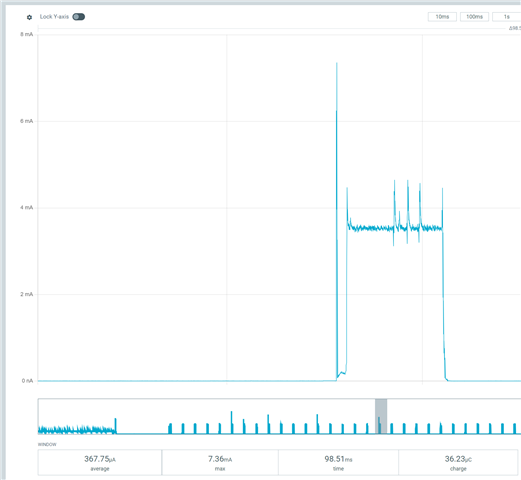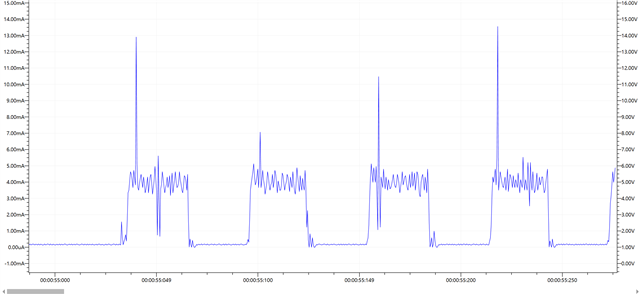
The current issue with using the bt_le_scan_start function

HI

I am using the periodic_sync_conn example on nRF54L15. I found that after calling bt_le_scan_start(BT_LE_SCAN_ACTIVE, NULL);, it should be interval scanning.

1、But why does the current sometimes show tens of milliamps? Is it sending some kind of data? 

2、Is it related to BT_LE_SCAN_ACTIVE? If I use BT_LE_SCAN_PASSIVE here, will this current spike not occur?

Thanks!

  • Hello,

    The sample rate in your plot looks a bit low, so I am not sure what the spikes actually do look like. Are the two in the middle as tall as the ones one the edges in reality? Just measured at a slightly different point in time?

    When you do BT_LE_SCAN_ACTIVE, yes, the radio will occationally send a packet on the radio, which may explain what you are seeing. Whenever it sees an advertisement with the scan response flag set, it will send a scan request, which will be picked up by the advertiser before it will send the scan response message. 

    So if these spikes are in fact these TX packets from the active scanner, then yes, BT_LE_SCAN_PASSIVE will not have these spikes.

    Best regards,

    Edvin

  • Thank you for your reply. The image I uploaded was scaled down, so the resolution isn't that high. However, I configured BT_LE_SCAN_PASSIVE and still sometimes observe current spikes. What else could be causing this?

  • Hello,

    I am not able to see those spikes running the NCS\zephyr\samples\bluetooth\scan_adv, where I disabled the advertising (it uses passive scanning by default).

    I do see some spikes, but they are not inside the scan events, they are directly before. These spikes are some internal capacitors being charged up before the radio events. 

    But these are always before the radio events, like this:

    The reason you are not seeing these are probably because it doesn't go into this low power mode (basically nothing but the RTC running). These spikes occur when exiting this state. I see that your plot has a base current of around 150-200µA, so you probably have something running. 

    Can you please upload the application that you are testing on, so that I can try to reproduce the spikes that you are seeing as well?

    Best regards,

    Edvin

Related