I am testing PAwR interoperability between:
-
TX side: third-party chipset acting as PAwR Advertiser/Transmitter
-
RX side: Nordic board running nRF Connect SDK (Zephyr) as PAwR Synchronizer/Receiver
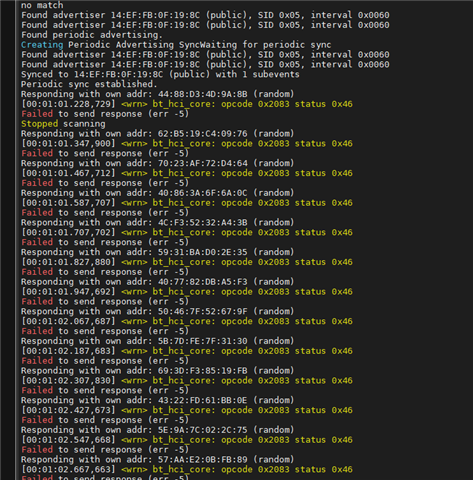
The RX successfully discovers and syncs to the third-party TX periodic advertising. The log shows:
Found advertiser 14:EF:FB:0F:19:8C (public), SID 0x05, interval 0x0060
Creating Periodic Advertising Sync
Synced to 14:EF:FB:0F:19:8C (public) with 1 subevents
Periodic sync established.
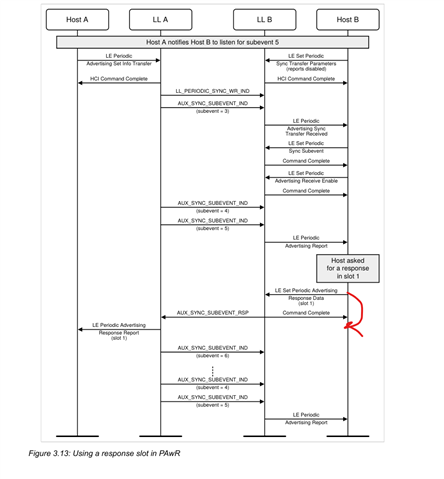
However, when the RX tries to send PAwR responses, the HCI command fails:
<wrn> bt_hci_core: opcode 0x2083 status 0x46
Failed to send response (err -5)
This repeats for every response attempt.
What I already checked
-
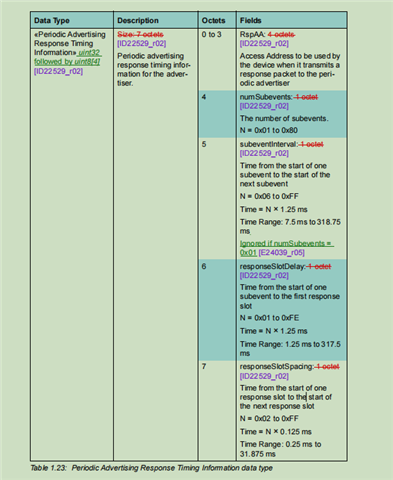
The third-party TX broadcasts PAwR Timing Info (AD Type 0x03) including:
-
Response AA
-
Number of SubEvents
-
SubEvent Interval
-
Response Slot Delay
-
Response Slot Spacing
-
-
Sniffer capture confirms these fields are present. According to Core Spec 5.4, there is no explicit “num_response_slots” field in the timing info.
My understanding is:
-
RX only knows interval/delay/spacing, but not the exact number of response slots.
-
Nordic’s RX Controller seems to require valid slot information in the link context; otherwise it returns
0x46 Unsupported Featurewhen Host tries to sendHCI_LE_Periodic_Adv_Subevent_Data_Response (0x2083).
My questions
-
Does Nordic’s RX implementation expect the Advertiser to explicitly include num_response_slots in ACAD (even though not defined in the spec)?
-
Is there any vendor-specific extension required in the Periodic Advertising Response Timing Info for RX to accept response data?
-
If the Advertiser only provides SubEvent Interval + Slot Delay + Slot Spacing (no slot count), should RX still allow Host to send responses (even if they may be dropped)?
-
Any advice on how to make Nordic RX accept responses from a non-Nordic PAwR TX implementation?