

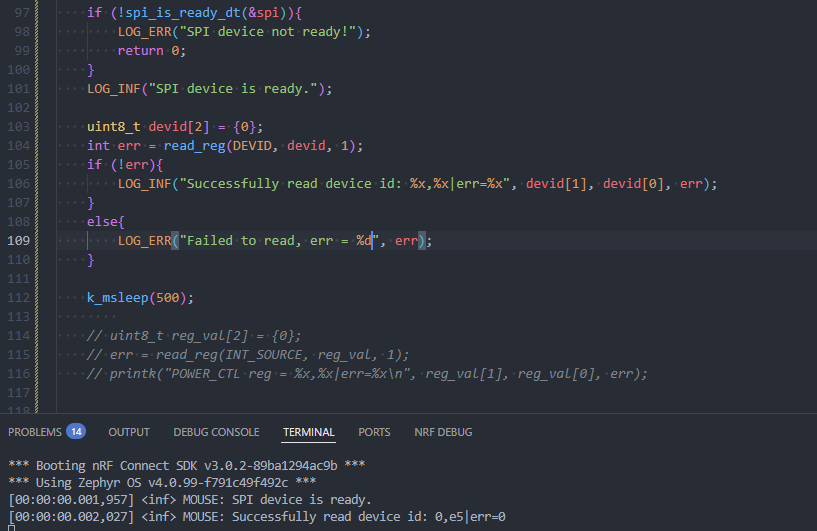
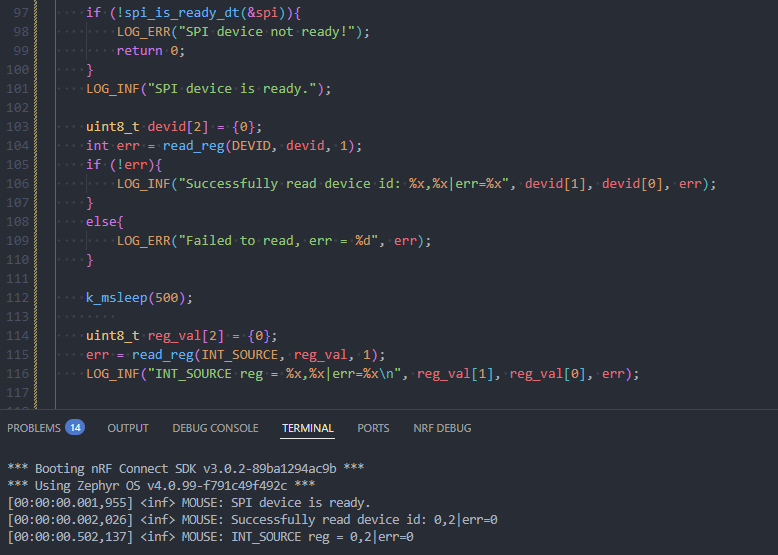
I'm working in Windows using nRF Connect for VSCode and I'm trying to read registers from an ADXL345 over SPI. I have no issues reading the device ID in reg 0x00 but when I go to read the interrupt source reg 0x2D and print out its value, it seems to overwrite the value of the device ID retrieved previously. DEVID 0x00 and INT_SOURCE 0x2D register at power up have default values of 0xE5 and 0x02 respectively. I've never seen the act of writing to a variable affect a wholly different variable like this before.
read_reg() implementation:
static int read_reg(uint8_t reg, uint8_t *data, uint8_t size)
{
	int err;

	/* STEP 4.1 - Set the transmit and receive buffers */
	uint8_t tx_buffer = reg;
	struct spi_buf tx_spi_buf			= {.buf = (void *)&tx_buffer, .len = 1};
	struct spi_buf_set tx_spi_buf_set 	= {.buffers = &tx_spi_buf, .count = 1};
	struct spi_buf rx_spi_bufs 			= {.buf = data, .len = size};
	struct spi_buf_set rx_spi_buf_set	= {.buffers = &rx_spi_bufs, .count = 1};

	/* STEP 4.2 - Call the transceive function */
	err = spi_transceive_dt(&spi, &tx_spi_buf_set, &rx_spi_buf_set);
	if (err < 0) {
		LOG_ERR("spi_transceive_dt() failed, err: %d", err);
		return err;
	}

	return 0;
}
Overlay:
&spi21 {
    compatible = "nordic,nrf-spim";
    status = "ok";
    pinctrl-0 = <&spi21_default>;
    pinctrl-1 = <&spi21_sleep>;
    pinctrl-names = "default", "sleep";
    cs-gpios = <&gpio1 8 GPIO_ACTIVE_LOW>;

    accelerometer_spi: adxl345@0 {
        compatible = "adi,adxl345";
        reg = <0>;
        spi-max-frequency = <DT_FREQ_M(2)>;
        spi-cpha;
        spi-cpol;
        //cs-gpios = <&gpio2 5 GPIO_ACTIVE_LOW>;
    };
};

&pinctrl {
    spi21_default: spi21_default {
        group1 {
            psels = <NRF_PSEL(SPIM_MISO, 1, 14)>, <NRF_PSEL(SPIM_MOSI, 1, 13)>;
        };
        group2 {
            psels = <NRF_PSEL(SPIM_SCK, 1, 11)>;
            bias-pull-up;
        };
    };

    spi21_sleep: spi21_sleep {
        group1 {
            psels = <NRF_PSEL(SPIM_SCK, 1, 11)>,
                    <NRF_PSEL(SPIM_MOSI, 1, 13)>,
                    <NRF_PSEL(SPIM_MISO, 1, 14)>;
            low-power-enable;
        };
    };
};

