NPM1304 PCM lockout

Hi,

We're looking to integrate the NPM1304 in a product with a very small battery. As per the NPM datasheet we've selected a battery with a PCM.

We've previously seen the PCM trip in a couple of prototypes; we are not sure why seems likely to be overcurrent.

Using the EK we triggered a trip with a momentary short; we see the battery output at 1.25V after this and we've measured 85uA still going into the NPM EK. This current seems too high for the PCM to reset; if we momentarily disconnect the battery it's back up to 4.1V on reconnection and everything works.

Problem is this voltage seems to be too low for any of the NPM1304 functions like button reset or shipping mode to function, so as far as we can tell there would be no way for the user to get the product out of this state.

Any suggestions? Seems like we need the NPM's UVLO current to drop below the battery PCM's reset threshold but no idea how to go about it.

Thanks,

Bill

Parents
  • Hi Bill,

    Could you get us the schematics of the board? Does it recover from this state by plugging in USB? Could we also get the datasheet of the PCM?

    I'll be happy to make the case private if you want me to.

    Regards,

    Elfving

  • Hi Elfving,

    I just realised I had a quick way to answer the USB question.

    The answer is NO, it doesn't recover.

    Steps to reproduce:

    • Connect battery with PCM on NPM1304-EK J3
    • Measure VSYS, VOUT1, VOUT2 - OK
    • Measure Vbatt = 4.1V
    • Momentarily short Vbatt
    • Measure Vbatt = 1.25V
    • Measure VSYS, VOUT1, VOUT2 - discharging
    • Plug in USB
    • Measure VSYS, VOUT1, VOUT2 - OK
    • Measure Vbatt = 3.94V
    • Measure Iusb = 0mA
    • Unplug USB
    • Measure Vbatt = 1.25V
    • Measure VSYS, VOUT1, VOUT2 - discharging
    • Disconnect battery - its terminals measure 4.1V

    I then repeated this test but this time I held the button on the EK to trigger a hard reset while USB was connected. I did see the rails drop momentarily so it appears the NPM is active, but it didn't change the final result - i.e. the PCM was still locked out.

    I do note that with USB connected a CPU connected to VOUT is probably running and it may be possible to use it to reset the PCM? But I'm not sure the best way to go about that and as I said in the other post it doesn't feel like a good solution.

    Surely there's a way for the NPM1304 to do this on its own? It's practically the use-case it's been designed for. 

    Thanks,

    Bill

  • Same result with the battery that's included in the NPM1304-EK connected to J2.

    That should be the easiest option for you guys to reproduce.

  • Hi Bill

    Thanks for the detailed summary. I could also replicate the scenario with nPM1304-EK battery LP181917 which has a PCM with DW01-P battery protection IC

    The behavior you're observing is the correct and expected operation for a battery with a standard Protection Circuit Module (PCM), which typically uses an IC like the DW01. After a severe short circuit, the PCM enters a "latched" safety state. This is a design feature that prevents the battery from reconnecting to a potentially faulty device. 

    Since this is not a very common use case, you could try enabling the charger when USB power is connected. This should also provide a trigger signal to the PCM, allowing it to reliably reset from its latched state.

    Regards 

    Tharaka

  • The charger does not reset the PCM on the Nordic devkit with the Nordic-supplied battery.

    I.e. your final statement doesn't make make sense to me.

    However it sounds like there's no workaround for this with the NPM series and I need to be looking at competitor parts?

    P.S. I get the argument that it's unlikely that the battery would actually short at the terminals and that you wouldn't want auto-reset if it did.
    But I'll note that it may be possible to trigger a PCM through the NPM (I doubt the NPM's current limiting is fast enough in every scenario) and that we don't design mains-supply gear without user-replaceable fuses or auto-reconnect.

  • Hi Bill

    Connecting USB does not automatically activate the charger; it must be explicitly enabled via I²C.

    To exit this state, the host MCU must participate in the recovery process. In any PCM, if the OD (discharge) MOSFET is turned off, the only way to unlock it is by initiating a charge. ( Some PCMs, after an overcurrent event, require the VBAT pin to be raised to the battery cell voltage to unlock from the latched state also).

    So the practical approach is to momentarily enable the charger when USB is connected. Nordic’s default charger settings are safe and conservative typically 4 mA constant current and 4 V termination voltage—which is often sufficient to trigger a PCM reset.

    You can enable the charger by setting the BCHGENABLESET bit in the charger control register.

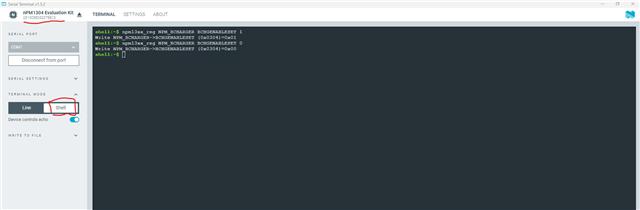
    The nPM PowerUP GUI may not be the suitable tool for triggering this fault recovery. Instead, you can use a Serial terminal app from nRF Connect for Desktop.

    See the attached image for reference for the correct settings.


    For example, on the nPM1304-EK, once a short-circuit fault occurs and the PCM enters a latched state (battery disconnected), you can connect USB (i.e VBUS powers VSYS + the host MCU power rail) and run the following commands to set the charger registers.

    # Enable charger
    shell:~$ npm13xx_reg NPM_BCHARGER BCHGENABLESET 1

    ( Optional setting : Set  BCHGVBATLOWCHARGE to enable charging at low battery voltage.
    shell:~$ npm13xx_reg NPM_BCHARGER BCHGVBATLOWCHARGE 1   )

    # Disable charger
    shell:~$ npm13xx_reg NPM_BCHARGER BCHGENABLESET 0

    This sequence will allow the battery to recover from the PCM locked state.

    Also note that the nPM1304 reacts faster and at lower current thresholds (IBATLIM) than the PCM for overcurrent events involving current flow from VBAT to VSYS.


    Regards 

    Tharaka

Reply
  • Hi Bill

    Connecting USB does not automatically activate the charger; it must be explicitly enabled via I²C.

    To exit this state, the host MCU must participate in the recovery process. In any PCM, if the OD (discharge) MOSFET is turned off, the only way to unlock it is by initiating a charge. ( Some PCMs, after an overcurrent event, require the VBAT pin to be raised to the battery cell voltage to unlock from the latched state also).

    So the practical approach is to momentarily enable the charger when USB is connected. Nordic’s default charger settings are safe and conservative typically 4 mA constant current and 4 V termination voltage—which is often sufficient to trigger a PCM reset.

    You can enable the charger by setting the BCHGENABLESET bit in the charger control register.

    The nPM PowerUP GUI may not be the suitable tool for triggering this fault recovery. Instead, you can use a Serial terminal app from nRF Connect for Desktop.

    See the attached image for reference for the correct settings.


    For example, on the nPM1304-EK, once a short-circuit fault occurs and the PCM enters a latched state (battery disconnected), you can connect USB (i.e VBUS powers VSYS + the host MCU power rail) and run the following commands to set the charger registers.

    # Enable charger
    shell:~$ npm13xx_reg NPM_BCHARGER BCHGENABLESET 1

    ( Optional setting : Set  BCHGVBATLOWCHARGE to enable charging at low battery voltage.
    shell:~$ npm13xx_reg NPM_BCHARGER BCHGVBATLOWCHARGE 1   )

    # Disable charger
    shell:~$ npm13xx_reg NPM_BCHARGER BCHGENABLESET 0

    This sequence will allow the battery to recover from the PCM locked state.

    Also note that the nPM1304 reacts faster and at lower current thresholds (IBATLIM) than the PCM for overcurrent events involving current flow from VBAT to VSYS.


    Regards 

    Tharaka

Children
No Data
Related