

Setup
-
Hardware: Nordic nRF7002DK as Wi-Fi STA (client).
-
AP & Receiver: a Linux PC creates a Wi-Fi Hotspot/SoftAP (NetworkManager/hostapd) and simultaneously runs the UDP receiver on the same machine.
-
Traffic: the STA streams the same JPEG image repeatedly over UDP; only the RF band changes (2.4 GHz vs 5 GHz).
-
Power: system powered at 3.3 V, measured with a precision current monitor (PPK-style).
-
Environment: near-water/underwater test; the transmitter is progressively submerged. Water depths: air, 0, −2, −4, −6, −8, −10 cm.
-
Controls: same AP, scripts, STA role, TX power, and payload across runs; only the band differs.
Observation
-
With increasing depth, 2.4 GHz shows higher average power and lower/more jittery throughput.
-
5 GHz remains lower and steadier in power with relatively stable throughput. (Plots attached.)
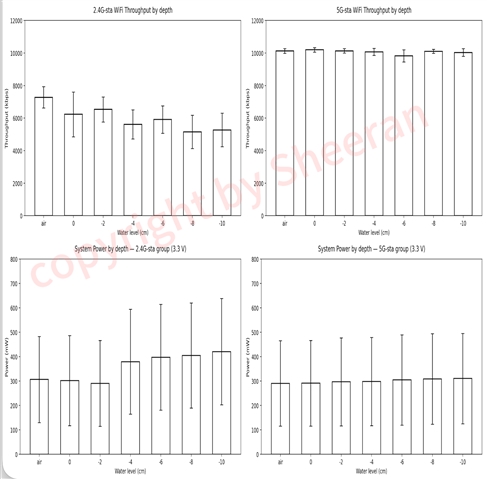
I expected 2.4 GHz not to be worse than 5 GHz near water due to the longer wavelength. Instead I see more power draw yet less throughput on 2.4 GHz.
-
Questions
-
What mechanisms could make 2.4 GHz draw more power than 5 GHz in STA mode under these conditions?
-
Why would throughput on 2.4 GHz fall as average power rises? Any band-specific rate control/fallback behaviors that explain this?
Thanks!
-
