nPM1300 Setup Guidance

Hey Nordic Team

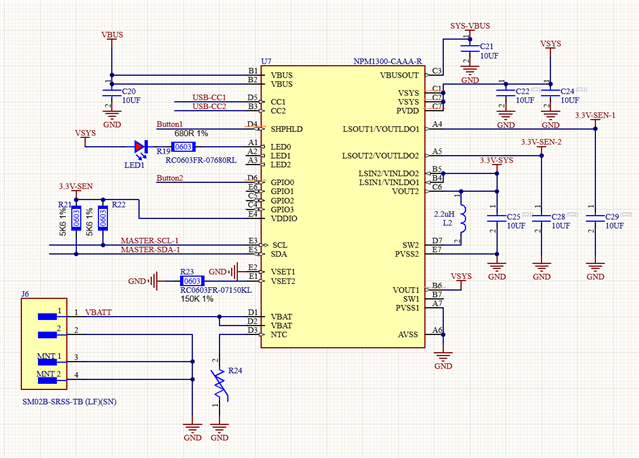
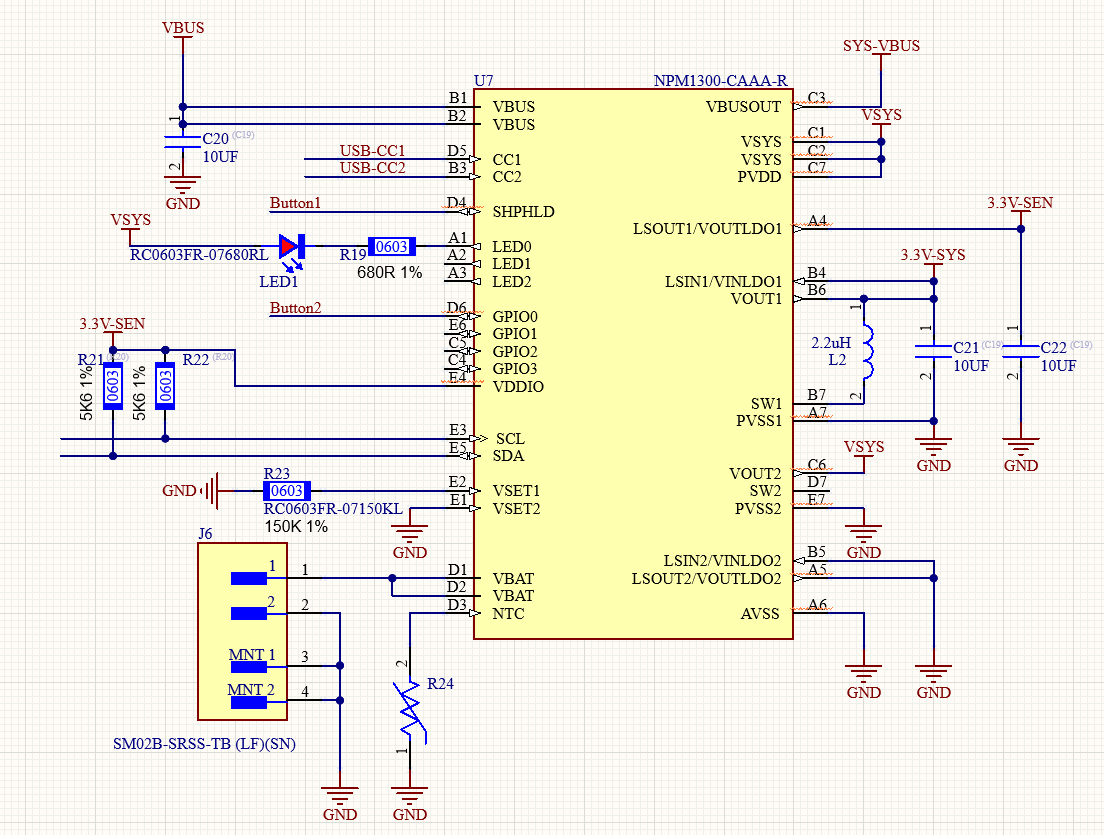
Just looking for guidance and clarification on the nPM1300 setup. couple of questions on the sample setup below. 

Project Overview

Project is a consumer grade hand held device that charges with USB C or USB 2 connection with a 3.7v Li ion battery and couple of buttons, the current requirements is well within the specifications of the LDO of the nPm1300 chip so that's fine, Im unclear of the output setup to the rest of the system. 

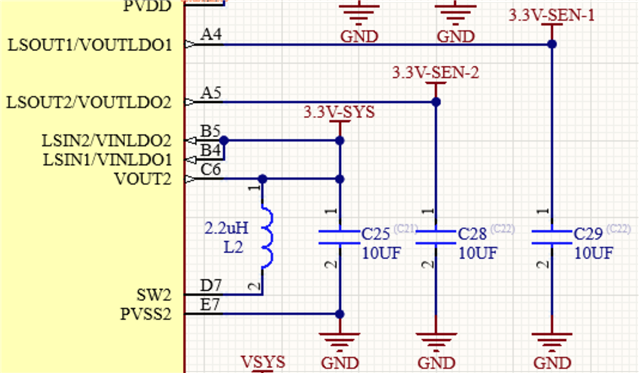
I am using a nrf5340 as the Soc and couple of analog and i2c sensors, My plan is to power the Soc off the "3.3V-SYS" rail and the rest of the sensors on the "3.3V-SEN rail" the idea is to be able to turn the sensors on and off via the LDO switch in software when powered down. 

1) Does this make sense for best shutdown setup and current consumption monitoring ? My initial thought was that the VSYS output would be regulated and the LDO 1 and 2 could be used independently but it does not seem like that's the case. 

2) I know the LDO outputs can be setup via the registers but since the SOC will be powered on boot by LDO1 how do I set the boot up voltage to 3v3? The datasheet notes the max as 2.7V for LDO1 ? 

3) If the above is correct do I just leave VSYS and SYS-VBUS unconnected/used ?
Parents
  • Hi, Johann.

    1) Does this make sense for best shutdown setup and current consumption monitoring ? My initial thought was that the VSYS output would be regulated and the LDO 1 and 2 could be used independently but it does not seem like that's the case.

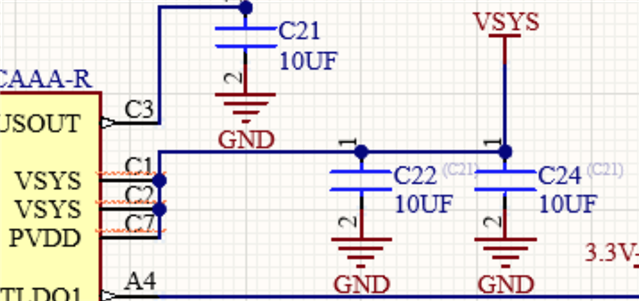
    By "VSYS" here, do you mean the VOUT1 output called "3.3V-SYS" in your schematic, or do you mean the VSYS output? The relationship between VSYS and VBUS is shown in these graphs in the datasheet. Do you mean using LDOs 1 and 2 independently from each other, or independently from the rest of the nPM1300? In your schematic, you're powering LDO from the VOUT1 buck output, which again is powered by VSYS through PVDD, as shown in the block diagram.

    2) I know the LDO outputs can be setup via the registers but since the SOC will be powered on boot by LDO1 how do I set the boot up voltage to 3v3? The datasheet notes the max as 2.7V for LDO1 ?

    The maximum LDO output voltage is 3.3V, as shown in the LDO electrical specification. As seen in the register overview, the LDO output voltages are set in the LDSW1VOUTSEL and LDSW2VOUTSEL registers.

    3) If the above is correct do I just leave VSYS and SYS-VBUS unconnected/used ?

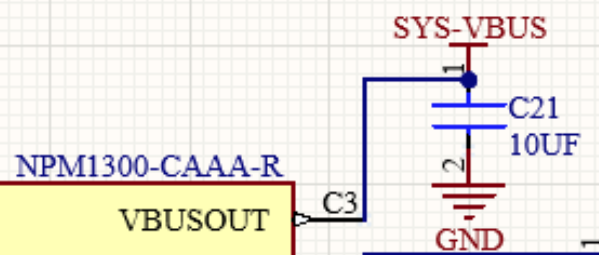
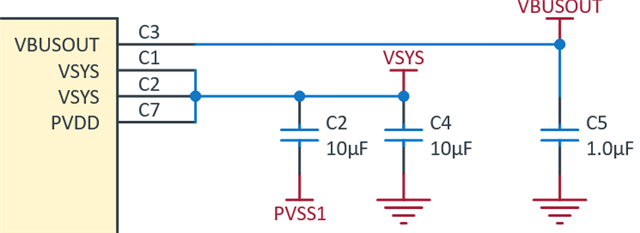
    The reference circuitry has to be followed even if not connecting VSYS or VBUSOUT to any external circuitry. The configurations can be combined to match your design. E.g., in configuration 3, VBUSOUT isn't used.

    Best regards,
    Mathias

  • Hi Mathias, Let me clarify as it seems you are not understanding what I'm asking. The net labels are miss leading so let me ask questions differently. 

    1. ) I know the VBUS and VSYS outputs require the external Capacitors as per reference design. I have those added in this design. My question here was, I assumed VSYS was a regulated voltage ( my case 3v3) and I could power my MCU and memory off this rail permanently. Looking at the graphs the VSYS voltage out that output requires additional regulation hence why they are fed into the Buck inputs to allow regulation. So the next approach is to power the MCU and Memory off the buck1 output. and all sensors off the LDO1 and or LDO 2 outputs to allow power savings and rail control. I'm asking if this makes sense an approach, and secondly if I will be able to still monitor total system current consumption in this setup with the battery column counter when running on battery. 
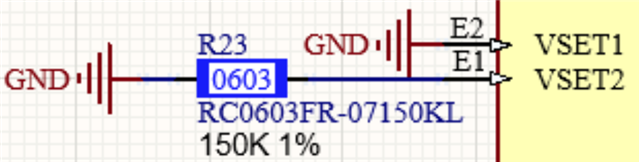
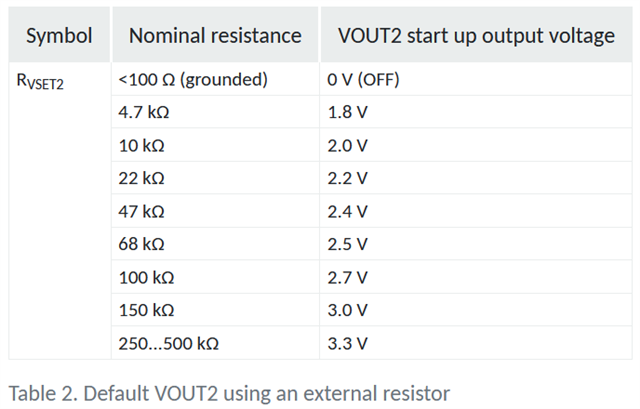
    2. ) if you look at the example provided R23 is used to set the buck1 output voltage on startup. if the voltage level for either buck 1 or buck 2 is set in registers, does these settings remain even after reboot? and if so what is the use/point of external VSEL resistors ? if the settings does not persist across reboots and the external resistors are needed for VSEL does the 150K make sense on BUck1 output as the datasheet shows up to 2.7v and not 3.3 like buck 2. page 47 table 18 and tablet 19 of the datasheet. Long stroy short how do I set VSET1 to 3.3V on boot if the table shows it can only go to 2.7v
Reply
  • Hi Mathias, Let me clarify as it seems you are not understanding what I'm asking. The net labels are miss leading so let me ask questions differently. 

    1. ) I know the VBUS and VSYS outputs require the external Capacitors as per reference design. I have those added in this design. My question here was, I assumed VSYS was a regulated voltage ( my case 3v3) and I could power my MCU and memory off this rail permanently. Looking at the graphs the VSYS voltage out that output requires additional regulation hence why they are fed into the Buck inputs to allow regulation. So the next approach is to power the MCU and Memory off the buck1 output. and all sensors off the LDO1 and or LDO 2 outputs to allow power savings and rail control. I'm asking if this makes sense an approach, and secondly if I will be able to still monitor total system current consumption in this setup with the battery column counter when running on battery. 
    2. ) if you look at the example provided R23 is used to set the buck1 output voltage on startup. if the voltage level for either buck 1 or buck 2 is set in registers, does these settings remain even after reboot? and if so what is the use/point of external VSEL resistors ? if the settings does not persist across reboots and the external resistors are needed for VSEL does the 150K make sense on BUck1 output as the datasheet shows up to 2.7v and not 3.3 like buck 2. page 47 table 18 and tablet 19 of the datasheet. Long stroy short how do I set VSET1 to 3.3V on boot if the table shows it can only go to 2.7v
Children
  • Johann said:
    So the next approach is to power the MCU and Memory off the buck1 output. and all sensors off the LDO1 and or LDO 2 outputs to allow power savings and rail control. I'm asking if this makes sense an approach,

    I can't immediately see any problems with this, as long as the voltages are the same.

    Johann said:
    secondly if I will be able to still monitor total system current consumption in this setup with the battery column counter when running on battery.

    I'm sorry, but is it a battery coulomb counter you're referring to?

    Johann said:
    if you look at the example provided R23 is used to set the buck1 output voltage on startup. if the voltage level for either buck 1 or buck 2 is set in registers, does these settings remain even after reboot? and if so what is the use/point of external VSEL resistors ?

    As seen in the answer to this ticket, there's no non-volatile memory on the nPM1300. Thus, the VSET resistors will determine the output voltage at start-up.

    Johann said:
    if the settings does not persist across reboots and the external resistors are needed for VSEL does the 150K make sense on BUck1 output as the datasheet shows up to 2.7v and not 3.3 like buck 2. page 47 table 18 and tablet 19 of the datasheet. Long stroy short how do I set VSET1 to 3.3V on boot if the table shows it can only go to 2.7v

    As you've already seen in the VSET table, BUCK1 may only be set to voltages up to 2.7V at start-up by using the resistors and the BUCK1NORMVOUT register must be written to in order to set it to 3.3V.

    Is there a reason why you can't just use BUCK2 instead?

  • That's the next best option yes, SO will need to setup the MCU on BUCK 2 to make sure 3v3 is correct at startup. and yes I'm asking if all current is measured by the coulomb counter for accurate reporting 

  • Updated. setup. so MCU can stay powered via Buck 2 and the two load switches turn on and off independently for sensors.


  • Johann said:
    and yes I'm asking if all current is measured by the coulomb counter for accurate reporting

    It should then be the fuel gauging functionality you're looking for. There's also a page about this in the documentation.

    If you want to have a default output voltage on VOUT2 of 3.3V, a resistor in the 250...500kΩ range should be used on the VSET2 pin.
        

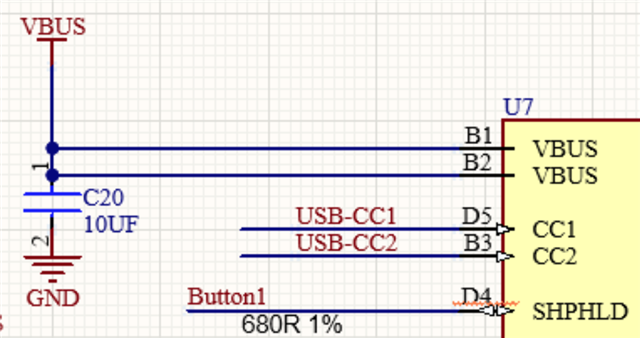
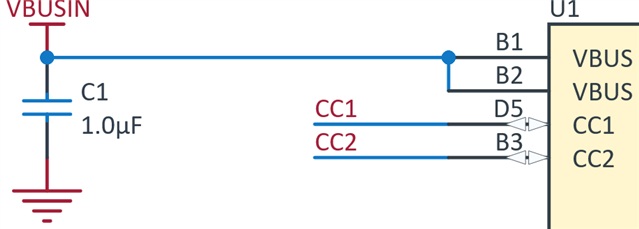
    As described in the hardware design guidelines, there should be a 1µF decoupling cap on the VBUS pin.
        

    How is the SHPHLD button connected?
      

    The VBUSOUT pin should have a 1µF decoupling cap.
        

    It might be a good idea to evaluate whether should add a smaller cap in the 10 to 100nF range as well to the VSYS output/PVDD input or not.
      

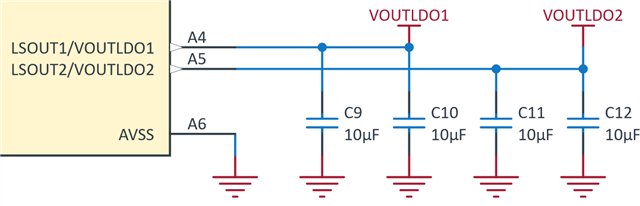
    In LDO mode, it's recommended to have two 10µF caps in parallel on each of the LDO outputs.
        

  • Thank you for the reply, Yes the Cap recommendations will be followed this was a snippet out of a larger design as example. so not all net connection are terminated/ shown. wanted to clarify that the buck1 could not be set by default to 3v3 and that all current downstream of the chip was measurable by the fuel gauge 

Related