Question About RTC Interface and Back-Feeding Protection for RV-8263-C7 with nRF52832

Hello,

I’m designing a wearable device based on the nRF52832. To maintain time and date when the MCU and other sensors are completely disconnected from the 3.3 V supply, I plan to include an external RTC — the RV-8263-C7.

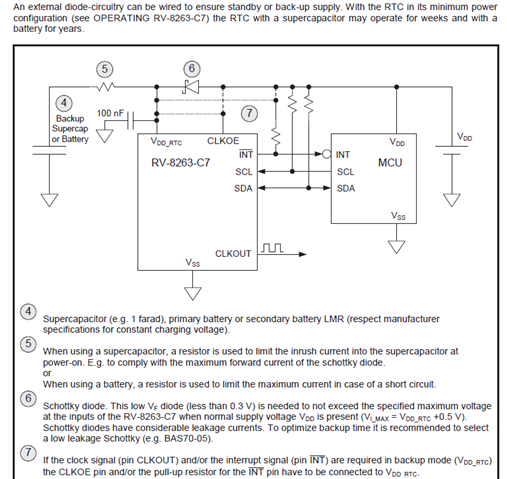
Please see the attached document. Instead of using the Backup Supercap or Battery LMR (Note 4), I intend to use a standard rechargeable battery that may have a voltage of up to 4.2 V.

My question is: do I need to include an interface component — for example, an analog bus switch such as the TMUX1511 — to prevent possible back-feeding from the SDA/SCL lines to the MCU?

Best regards,
Hossein
Parents Reply Children
  • Allowing any phantom power (aka back-drive or back-feed) into a port pin on the nRF52 is a design flaw. The external source raises the internal VDD in the absence of normal VDD power and often prevents correct operation of the internal reset circuitry; this leads to random and unpredictable cases when disconnecting and reconnecting the 3.3V which can only be recovered by removing all power sources including the source of the back-drive. Simply repeating 3.3V disconnect-connect in this scenario does not fix the hangup.

    The correct fix is usually to use a single level-shifter which is powered from the nRF52 3.3V; this allows higher battery voltages as well as removing back-drive. Without this design flaw fix, at some future date sensors in the field will require an expensive site visit to recover. Search for phantom power on the dev zone; I responded to multiple posts with more details. Finally if your bench test doesn’t exhibit this behavior, rest assured that some sensors in the field will :-)

Related