Really low range improvements with the nRF21540DK compared to the nRF52840

Hello,

I am currently evaluating the use of the nRF21540 FEM to boost our radio transmission range and resilience. Currently we are using an nRF52840. For my tests I used the nRF21540DK.

The problem is that I don't get even close to the advertised 7.1x range improvement for an nRF52840. The absolute best I could manage was a 1.65x range improvement.
I performed all of my tests with a rough line-of-sight between the DevKits. The only obstructions were a small tree and a slight curvature of the road. (see attached image). I oriented the DevKits so that the power USB port was facing down (I read that this is the optimal position).
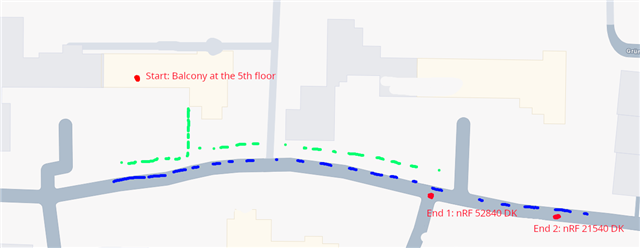
The distance between Start and End 1 is 170m and the distance between Start and End 2 is 270 m.
The green dots symbolize trees (which don't have any leaves anymore) and the blue dots are parked cars on the street.
Around the street are a fair number of houses, which should reflect radio waves nicely.

I am using OpenThread for communication and I have measured the maximum connection distance by checking when I don't receive periodic heartbeat messages anymore.
For configuration I have enabled these KConfigs for the nRF21540DK:

CONFIG_MPSL=y
CONFIG_MPSL_FEM=y
CONFIG_MPSL_FEM_NRF21540_GPIO=y
CONFIG_MPSL_FEM_LOG_LEVEL_DBG=y
CONFIG_MPSL_FEM_NRF21540_TX_GAIN_DB=20
CONFIG_MPSL_FEM_NRF21540_RX_GAIN_DB=13
I am building for the nrf21540dk_nrf52840 overlay.
I have set the default OpenThread TX power to +20 dBm using the CONFIG_OPENTHREAD_DEFAULT_TX_POWER KConfig for both boards.
 
I am not sure if I have missed a crucial configuration step, because the additional range I get is super low (compared to what was said in the documentation).

Many Greetings
Arne
  • Hello Arne,
    Q1: Just for my own sake, during the nRF52840 test, you had one of those without FEM in both ends of the link and for the nRF21540 you had boards with nRF21540 in both ends of the link?
    Q2: What data rate are you using, 1M?
    Anyways, I think you've been fortunate and unfortunate in this test of yours. Fortunate to achieve 170m range with the nRF52840 (if that's what you had in both ends of the link). Assuming you used 1M on air data rate that is quite impressive range. Normally we would say 30-50 meter range is what you should expect. So you've been fortunate with your initial range test, but that means your end result once added FEM because a bit unfortunate. I don't think you've done anything wrong, I think what you saw is the proper range and what I would expect. The theoretical gain from extra TX and RX with the FEM is only theoretical and I'd say the "Key features" list here: https://www.nordicsemi.com/Products/nRF21540 is a bit misleading. 
    This would be a better statement with regard to accuracy.
    The RX gain will also amplify "noise" from the surroundings, like other 2.4GHz products. The 13dB RX gain is best possible scenario.
    The result you describe I think is the real result. You might improve the result for the FEM if it was used in an even more open space and possibly also if it was added to a product based on a smaller PCB than the devkit. 
    Best regards
    Asbjørn
  • Hello Asbjørn,
    thanks for the detailed explanation.

    Regarding Q1:
    For my tests I always used similar DevKits on both sides with the same firmware and settings. For non-FEM tests I used normal nRF52840 DKs.

    Regarding Q2:
    With 1M datarate, do you mean 1M bits (or bytes?) of data, which my application transfers per seconds.

    I haven't done these tests in relation to data rate yet. I will do more tests focusing on data rates next.

    If the datarate / range might not be enough: Does nordic have some other tricks to boost data rate over a larger distance?

Related
