

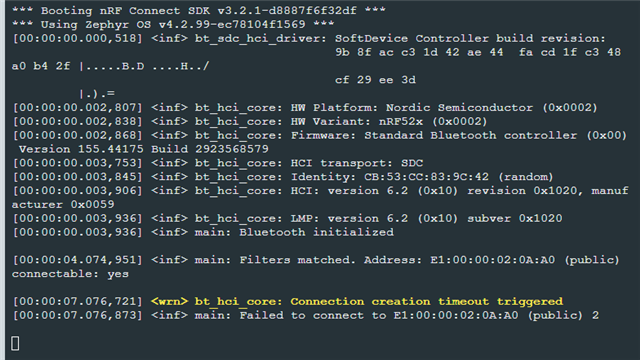
While running scan & connection tests with NCS 3.2.1, I encountered frequent connection timeouts (
bt_hci_core: Connection creation timeout triggered) when using the Nordic protocol stack. The issue disappeared immediately after switching to the Zephyr protocol stack.What could be the root cause of this discrepancy?
This is the master side code I used during the testing.
This is the master side code I used during the testing.
/* main.c - Application main entry point */

/*
 * Copyright (c) 2015-2016 Intel Corporation
 *
 * SPDX-License-Identifier: Apache-2.0
 */

#include <bluetooth/scan.h>
#include <errno.h>
#include <stddef.h>
#include <zephyr/bluetooth/bluetooth.h>
#include <zephyr/bluetooth/conn.h>
#include <zephyr/bluetooth/gatt.h>
#include <zephyr/bluetooth/hci.h>
#include <zephyr/bluetooth/uuid.h>
#include <zephyr/kernel.h>
#include <zephyr/sys/byteorder.h>
#include <zephyr/types.h>

#include <zephyr/logging/log.h>
LOG_MODULE_REGISTER(main, CONFIG_MAIN_LOG_LEVEL);

static struct bt_conn *default_conn;

static void connected(struct bt_conn *conn, uint8_t err) {
  char addr[BT_ADDR_LE_STR_LEN];

  bt_addr_le_to_str(bt_conn_get_dst(conn), addr, sizeof(addr));

  if (err) {
    LOG_INF("Failed to connect to %s %u %s\n", addr, err,
            bt_hci_err_to_str(err));

    bt_conn_unref(default_conn);
    default_conn = NULL;
    return;
  }

  if (conn != default_conn) {
    return;
  }

  LOG_INF("Connected: %s\n", addr);

}

static void disconnected(struct bt_conn *conn, uint8_t reason) {
  char addr[BT_ADDR_LE_STR_LEN];

  if (conn != default_conn) {
    return;
  }

  bt_addr_le_to_str(bt_conn_get_dst(conn), addr, sizeof(addr));

  LOG_INF("Disconnected: %s, reason 0x%02x %s\n", addr, reason,
          bt_hci_err_to_str(reason));

  bt_conn_unref(default_conn);
  default_conn = NULL;

}

BT_CONN_CB_DEFINE(conn_callbacks) = {
    .connected = connected,
    .disconnected = disconnected,
};

static void scan_filter_match(struct bt_scan_device_info *device_info,
                              struct bt_scan_filter_match *filter_match,
                              bool connectable) {
  char addr[BT_ADDR_LE_STR_LEN];

  bt_addr_le_to_str(device_info->recv_info->addr, addr, sizeof(addr));

  LOG_INF("Filters matched. Address: %s connectable: %s\n", addr,
          connectable ? "yes" : "no");

  int err = bt_scan_stop();
  if (err) {
    LOG_INF("Stop LE scan failed (err %d)\n", err);
  }
}

static void scan_connecting_error(struct bt_scan_device_info *device_info) {
  LOG_ERR("Connecting failed\n");
}

static void scan_connecting(struct bt_scan_device_info *device_info,
                            struct bt_conn *conn) {
  default_conn = bt_conn_ref(conn);
}

static void scan_filter_no_match(struct bt_scan_device_info *device_info,
                                 bool connectable) {

  // LOG_INF("no matched");
}

BT_SCAN_CB_INIT(scan_cb, scan_filter_match, scan_filter_no_match,
                scan_connecting_error, scan_connecting);

int main(void) {
  int err;

  err = bt_enable(NULL);
  if (err) {
    LOG_INF("Bluetooth init failed (err %d)\n", err);
    return 0;
  }

  LOG_INF("Bluetooth initialized\n");

  struct bt_scan_init_param scan_init = {
      .connect_if_match = 1,
      .scan_param = BT_LE_SCAN_PARAM(
          BT_LE_SCAN_TYPE_PASSIVE, BT_LE_SCAN_OPT_NONE,
          3200, 3200),
  };

  bt_scan_init(&scan_init);
  bt_scan_cb_register(&scan_cb);

  bt_addr_le_t addr;
  err = bt_addr_le_from_str("e1:00:00:02:0a:a0", "public", &addr);
  if (err) {
    LOG_INF("bt_addr_le_from_str (err %d)\n", err);
    return 0;
  }

  /* 例如按 UUID 过滤 */
  err = bt_scan_filter_add(BT_SCAN_FILTER_TYPE_ADDR, &addr);
  if (err) {
    LOG_INF("Scanning filters cannot be set (err %d)\n", err);
    return 0;
  }

  err = bt_scan_filter_enable(BT_SCAN_ADDR_FILTER, false);
  if (err) {
    LOG_INF("Filters cannot be turned on (err %d)\n", err);
    return 0;
  }

  err = bt_scan_start(BT_SCAN_TYPE_SCAN_PASSIVE);
  if (err) {
    LOG_INF("Scanning failed to start (err %d)\n", err);
  }

  return 0;
}
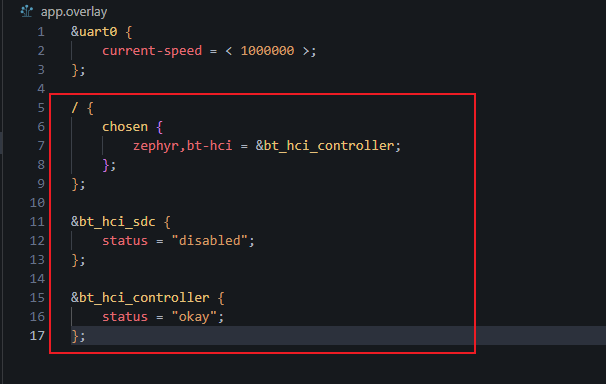
When I added the following configuration to the app.overlay file, the timeout issue no longer occurred when using the Zephyr protocol stack.
Oddly enough, no connection timeouts occurred when I tested with nrf5-sdk. Are the Nordic protocol stacks in nrf5-sdk and NCS different? How should I resolve this issue?

