SSD1306 OLED display fails for nRF52840 boards using nRF Connect SDK 3.2.1

Hello,

I’ve been using SSD1306 128x64 OLED displays with nRF52840 boards for several years without any issues, building with nRF Connect SDK 2.5.x to 3.1.0. Recently, I've been attempting to move existing NCS 3.1.0 projects over to NCS 3.2.1. However, I’m unable to successfully get the SSD1306 OLED display to work with any of the nRF52840 boards using the latest nRF Connect SDK 3.2.1.

All the nRF52840 boards with SSD1306 display work fine when built with vanilla Zephyr 4.1.x and 4.2.x.

Also, the target for thingy53/nrf5340/cpuapp/ns failed to run successfully with both NCS 3.1.0 and NCS 3.2.1. The target thingy53/nrf5340/cpuapp ran fine with the SSD1306 OLED.

To try to isolate the issue, I’ve taken the Zephyr sample, “/opt/nordic/ncs/v3.2.1/zephyr/samples/subsys/display/cfb_custom_font” and built it for a couple of different nRF52840 boards (e.g. particle_xenon_nrf52840, promicro_nrf52840) plus thingy/nrf5340/cpuapp.

Built exactly the same sample "cfb_custom_font" main.c (modified to display board target and Zephyr version) & used the same devicetree overlays. All the builds compiled and linked without any issues.  However, only particle_xenon/nrf52840 using NCS 3.1.0 and thingy53/nrf5340/cpuapp using NCS 3.2.1 ran successfully with the SSD1306 displays.

I used the below board configuration and the overlays with the ssd1306 devicetree included in the I2C sections of the overlays. Default sysbuild option used from with the nRF Connect SDKs.

I don't see anything that is obvious that may be wrong. I would appreciate if you could determine the cause of the issue with the nRF52840 boards with SSD1306 when using  nRF Connect SDK 3.2.1.

Also, Is there any reason as to why the target for thingy53/nrf5340/ns doesn’t run successfully with the I2C SSD1306 display?

Thank you.

particle_xenon_nrf52840.overlay:

/ {
	chosen {
		zephyr,display = &ssd1306;
		zephyr,console = &uart0;
		zephyr,shell-uart = &uart0;
	};
};

&uart0 {
	compatible = "nordic,nrf-uarte";
	status = "okay";
	current-speed = <115200>;
	pinctrl-0 = <&uart0_default>;
	pinctrl-1 = <&uart0_sleep>;
	pinctrl-names = "default", "sleep";
};

&gpio0{
	status = "okay";
};

&i2c0 {
	compatible = "nordic,nrf-twi";
	status = "okay";
	pinctrl-0 = <&i2c0_default>;
	pinctrl-1 = <&i2c0_sleep>;
    pinctrl-names = "default", "sleep";
	ssd1306: ssd1306@3c {
		compatible = "solomon,ssd1306fb";
		reg = <0x3c>;
		width = <128>;
		height = <64>;
		segment-offset = <0>;
		page-offset = <0>;
		display-offset = <0>;
		multiplex-ratio = <63>;
		segment-remap;
		com-invdir;
		prechargep = <0x22>;
	};
};

thingy53_nrf5340_cpuapp.overlay

/ {
	chosen {
		zephyr,display = &ssd1306;
	};
};

&pinctrl {
	i2c0_default: i2c0_default {
		group1 {
			psels = <NRF_PSEL(TWIM_SDA, 0, 5)>,
				<NRF_PSEL(TWIM_SCL, 0, 4)>;
		};
	};

	i2c0_sleep: i2c0_sleep {
		group1 {
			psels = <NRF_PSEL(TWIM_SDA, 0, 5)>,
				<NRF_PSEL(TWIM_SCL, 0, 4)>;
		};
	};
};

&i2c0 {
	compatible = "nordic,nrf-twim";
	status = "okay";
	clock-frequency = <I2C_BITRATE_FAST>;
	zephyr,concat-buf-size = <4096>;
	pinctrl-0 = <&i2c0_default>;
	pinctrl-1 = <&i2c0_sleep>;
    pinctrl-names = "default", "sleep";
	ssd1306: ssd1306@3c {
		compatible = "solomon,ssd1306fb";
		reg = <0x3c>;
		width = <128>;
		height = <64>;
		segment-offset = <0>;
		page-offset = <0>;
		display-offset = <0>;
		multiplex-ratio = <63>;
		segment-remap;
		com-invdir;
		prechargep = <0x22>;
	};
};

prj.conf:

CONFIG_HEAP_MEM_POOL_SIZE=16384

CONFIG_DISPLAY=y
CONFIG_SSD1306=y

CONFIG_CHARACTER_FRAMEBUFFER=y
CONFIG_CHARACTER_FRAMEBUFFER_USE_DEFAULT_FONTS=n

CONFIG_LOG=y

# Preferred SHELL options
CONFIG_SHELL=y
CONFIG_DEVICE_SHELL=y
CONFIG_INIT_STACKS=y
CONFIG_KERNEL_SHELL=y
CONFIG_SHELL_STATS=n
CONFIG_I2C_SHELL=y

# Enable RTT to replace UART
CONFIG_UART_CONSOLE=y
CONFIG_USE_SEGGER_RTT=n
CONFIG_SHELL_BACKEND_RTT=n

CONFIG_LOG_BACKEND_UART=y
CONFIG_SHELL_LOG_BACKEND=y

Console Output 

NCS 3.2.1 build  - particle_xenon_nrf52840 with  SSD1306 (particle_xenon/nrf52840):

*** Booting nRF Connect SDK v3.2.1-d8887f6f32df ***
*** Using Zephyr OS v4.2.99-ec78104f1569 ***

Display device not ready

Failed to turn off display blanking

NCS 3.1.0 build  - particle_xenon_nrf52840 with  SSD1306 (particle_xenon/nrf52840):

*** Booting nRF Connect SDK v3.1.0-6c6e5b32496e ***
*** Using Zephyr OS v4.1.99-1612683d4010 ***
Zephyr v4.1.99
Board target: particle_xenon/nrf52840
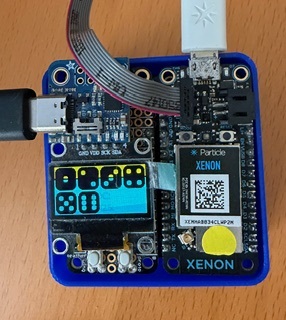
NCS 3.2.1 build  - thingy53_nrf5340_cpuapp with  SSD1306:

*** Booting nRF Connect SDK v3.2.1-d8887f6f32df ***
*** Using Zephyr OS v4.2.99-ec78104f1569 ***
[00:00:00.035,614] <inf> udc_nrf: Initialized
Zephyr v4.2.99
Board target: thingy53/nrf5340/cpuapp
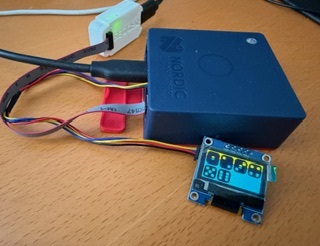
NCS 3.1.0 build  - thingy53_nrf5340_cpuapp with  SSD1306:

[Disconnected]
[Connected]
*** Booting nRF Connect SDK v3.1.0-6c6e5b32496e ***
*** Using Zephyr OS v4.1.99-1612683d4010 ***
Zephyr v4.1.99
Board target: thingy53/nrf5340/cpuapp

Vanilla Zephyr 4.2.x from terminal command line: SSD1306 displays works fine.

*** Booting Zephyr OS build v4.2.0-717-g85e135362445 ***
Zephyr v4.2.99
Board target: particle_xenon/nrf52840
uart:~$ 

Parents
  • Hello,

    There was a major update to the nrfx layer in SDK v3.2.0, which included a switch to standard POSIX error codes. Unfortunately, for the legacy TWI driver, we missed updating the Zephyr integration to handle the new return codes. This was later fixed in Zephyr, and we also added tests to improve the driver’s test coverage, see https://github.com/nrfconnect/sdk-zephyr/pull/3624/changes/1a8ca7c52da4e7b8083a2fe09b61bcd5f819f557

    You could cherry pick this commit, but the best solution is to switch from using TWI to TWIM by selecting "nordic,nrf-twim" binding in your overlay instead of "nordic,nrf-twi". 

    Best regards,

    Vidar

  • Hi Vidar,

    Thank you for your quick response. It's much appreciated.

    After posting the ticket yesterday, I noticed that the Thingy53 device overlay was using TWIM, so I did switch from TWI to TWIM for the nRF52840 boards. This has resolved the SSD1306 issue with Particle Xenon nRF52840 when building the application with NCS 3.2.1.

    However, I'm still having problems with a promicro_nrf52840 board when hooked up to a SSD1306 display.

    When building promicro/nrf52840/uf2 with the default build setting (i.e. sysbuild), the SD1306 doesn't show anything and the USB-C serial console doesn't come up. A no-sysbuild with NCS 3.2.1 works fine with the SSD1306.

    Any thoughts on why the sysbuild doesn't bring up the display & serial console? Thanks.

    Also, the build for target thingy53/nrf5340/ns fails to start successfully. Thanks.


    Best Regards,
    Ravi

  • zpm1066 said:
    For the thing53/nrf5340/cpuapp target, I'm using I2C0, as below, TF_M logging shouldn't be affected.

    I assume you are using this for the thingy53/nrf5340/cpuapp/ns.  Given the same pins and driver works fine with the non-NS target, I suspect either the driver or app is trying to access secure RAM and trigger an access violation from the app leading to a secure fault. Do you have an external debugger you can connect to the thingy to debug this further?

    Best regards,

    Vidar

  • Hi Vidar,

    Yes, I've been attempting to get a successful run for the thingy53/nrf5340/cpuapp/ns target with the same pins and driver.

    I've tried to debug with Segger's Edu Mini probe and also the nrf54l15dk debug with Thingy53, with debug info to RTT. In both cases, I never get to a point where there is any output to RTT. Weird! 

    I'll dig further tomorrow.

    The same application for nrf54l15dk/nrf54l15/ns works fine. It seems Nordic is deprecating thingy53/nrf5340/cpuapp/ns. I've had TFM overflows by 200%! with Thing53 on another project (still debugging)  although it has 64MB external RAM and I've used successfully used the Thingy53 external FLASH before quite a few times.


    Best Regards,
    Ravi

  • Hi Ravi,

    zpm1066 said:
    I've tried to debug with Segger's Edu Mini probe and also the nrf54l15dk debug with Thingy53, with debug info to RTT. In both cases, I never get to a point where there is any output to RTT. Weird! 

    This suggests that there may be an error occurring during startup before the logger is available. To troubleshoot this further I would disable the CONFIG_RESET_ON_FATAL_ERROR symbol in the project configuration and attach the debugger to see if the program entered the error handler.

    zpm1066 said:
    It seems Nordic is deprecating thingy53/nrf5340/cpuapp/ns

    The Zephyr Bluetooth Host switched to using PSA Crypto instead having crypto support from tinycrypt built into the stack. For /ns targets  this requires building TF-M with these crypto services enabled, which significantly increases its memory footprint compared to the minimal TF-M builds used previously. The Thingy53 board uses static memory partitions that do not allocate sufficient memory to the secure region. For this reason, we have removed this board target from the BLE samples.

    Best regards,

    Vidar

  • Hi Vidar,

    I'll try your suggestion of disabling CONFIG_RESET_ON_FATAL_ERROR for the Thingy53 debugging. I'll sync up with you on the findings.

    For thingy53/nrf5340/ns targets where the TF-M overflows FLASH significantly, can we not use the external FLASH?


    Best Regards,
    Ravi

  • Hi Vidar,

    I tried the following.

    • Added CONFIG_RESET_ON_FATAL_ERROR=n to prj.conf
    • Built a debug version of  thingy53/nrf5340/cpuapp/ns target

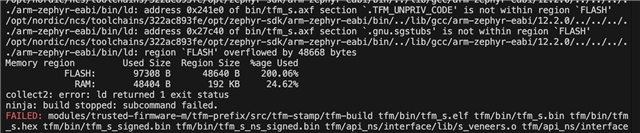
    • Got build errors with TFM FLASH overflow


    /nordic/ncs/v3.2.1/nrfxlib/crypto/nrf_oberon/lib/cortex-m33/soft-float/liboberon_3.0.17.a && :
    /opt/nordic/ncs/toolchains/322ac893fe/opt/zephyr-sdk/arm-zephyr-eabi/bin/../lib/gcc/arm-zephyr-eabi/12.2.0/../../../../arm-zephyr-eabi/bin/ld: address 0x1c300 of bin/tfm_s.axf section `.TFM_UNPRIV_CODE' is not within region `FLASH'
    /opt/nordic/ncs/toolchains/322ac893fe/opt/zephyr-sdk/arm-zephyr-eabi/bin/../lib/gcc/arm-zephyr-eabi/12.2.0/../../../../arm-zephyr-eabi/bin/ld: address 0x1fc40 of bin/tfm_s.axf section `.gnu.sgstubs' is not within region `FLASH'
    /opt/nordic/ncs/toolchains/322ac893fe/opt/zephyr-sdk/arm-zephyr-eabi/bin/../lib/gcc/arm-zephyr-eabi/12.2.0/../../../../arm-zephyr-eabi/bin/ld: bin/tfm_s.axf section `.TFM_DATA' will not fit in region `FLASH'
    /opt/nordic/ncs/toolchains/322ac893fe/opt/zephyr-sdk/arm-zephyr-eabi/bin/../lib/gcc/arm-zephyr-eabi/12.2.0/../../../../arm-zephyr-eabi/bin/ld: address 0x1c300 of bin/tfm_s.axf section `.TFM_UNPRIV_CODE' is not within region `FLASH'
    /opt/nordic/ncs/toolchains/322ac893fe/opt/zephyr-sdk/arm-zephyr-eabi/bin/../lib/gcc/arm-zephyr-eabi/12.2.0/../../../../arm-zephyr-eabi/bin/ld: address 0x1fc40 of bin/tfm_s.axf section `.gnu.sgstubs' is not within region `FLASH'
    /opt/nordic/ncs/toolchains/322ac893fe/opt/zephyr-sdk/arm-zephyr-eabi/bin/../lib/gcc/arm-zephyr-eabi/12.2.0/../../../../arm-zephyr-eabi/bin/ld: region `FLASH' overflowed by 15856 bytes
    Memory region         Used Size  Region Size  %age Used
               FLASH:       64496 B      48640 B    132.60%
                 RAM:       14560 B        32 KB     44.43%
    collect2: error: ld returned 1 exit status
    ninja: build stopped: subcommand failed.

    CONFIG_PM_PARTITION_SIZE_TFM suggests TFM FLASH size can be increased.

    • Resolved TFM overflow by disabling TFM logging and increased TFM partition size to 256kB (0x40000)

    CONFIG_TFM_PROFILE_TYPE_MINIMAL=n
    CONFIG_TFM_LOG_LEVEL_SILENCE=y
    CONFIG_PM_PARTITION_SIZE_TFM=0x40000


    • Build was successful. 
    • Disabling TFM logging was enough to prevent TFM FLASH overflow in this "cfb" sample
    • However, the TFM partition size remained the same.
    • Why hasn’t the FLASH region size changed to 320KB (0x40000) as per link above? Thanks.


    RTT output:

    SEGGER J-Link V8.96 - Real time terminal output
    SEGGER J-Link (unknown) V1.0, SN=<xxxxxxxxxxxx>
    Process: JLinkExe
    
    rtt:~$ Initialized ssd1306@3c
    font width 10, font height 16
    font width 15, font height 24
    font width 20, font height 32
    x_res 128, y_res 64, ppt 8, rows 8, cols 128
    [00:00:00.001,617] <inf> udc_nrf: Preinit
    *** Booting nRF Connect SDK v3.2.1-d8887f6f32df ***
    *** Using Zephyr OS v4.2.99-ec78104f1569 ***
    [00:00:00.012,725] <inf> udc_nrf: Initialized
    Zephyr v4.2.99
    Board target: thingy53/nrf5340/cpuapp/ns
    [00:00:00.013,153] <dbg> cfb: cfb_framebuffer_init: number of fonts 3
    [00:00:00.016,937] <inf> udc_nrf: SUSPEND state detected
    [00:00:00.115,203] <inf> udc_nrf: Reset
    [00:00:00.115,264] <inf> udc: ep 0x80 is not halted|disabled
    [00:00:00.115,295] <inf> udc_nrf: RESUMING from suspend

    The sample "cfb" for NS build runs successfully.  However, for a typical NS application with BT, the TFM size would be greater than the default ~47.5KB.

    How do I configure CONFIG_PM_PARTITION_SIZE_TFM correctly? Thank you.


    Best Regards,
    Ravi

Reply
  • Hi Vidar,

    I tried the following.

    • Added CONFIG_RESET_ON_FATAL_ERROR=n to prj.conf
    • Built a debug version of  thingy53/nrf5340/cpuapp/ns target

    • Got build errors with TFM FLASH overflow


    /nordic/ncs/v3.2.1/nrfxlib/crypto/nrf_oberon/lib/cortex-m33/soft-float/liboberon_3.0.17.a && :
    /opt/nordic/ncs/toolchains/322ac893fe/opt/zephyr-sdk/arm-zephyr-eabi/bin/../lib/gcc/arm-zephyr-eabi/12.2.0/../../../../arm-zephyr-eabi/bin/ld: address 0x1c300 of bin/tfm_s.axf section `.TFM_UNPRIV_CODE' is not within region `FLASH'
    /opt/nordic/ncs/toolchains/322ac893fe/opt/zephyr-sdk/arm-zephyr-eabi/bin/../lib/gcc/arm-zephyr-eabi/12.2.0/../../../../arm-zephyr-eabi/bin/ld: address 0x1fc40 of bin/tfm_s.axf section `.gnu.sgstubs' is not within region `FLASH'
    /opt/nordic/ncs/toolchains/322ac893fe/opt/zephyr-sdk/arm-zephyr-eabi/bin/../lib/gcc/arm-zephyr-eabi/12.2.0/../../../../arm-zephyr-eabi/bin/ld: bin/tfm_s.axf section `.TFM_DATA' will not fit in region `FLASH'
    /opt/nordic/ncs/toolchains/322ac893fe/opt/zephyr-sdk/arm-zephyr-eabi/bin/../lib/gcc/arm-zephyr-eabi/12.2.0/../../../../arm-zephyr-eabi/bin/ld: address 0x1c300 of bin/tfm_s.axf section `.TFM_UNPRIV_CODE' is not within region `FLASH'
    /opt/nordic/ncs/toolchains/322ac893fe/opt/zephyr-sdk/arm-zephyr-eabi/bin/../lib/gcc/arm-zephyr-eabi/12.2.0/../../../../arm-zephyr-eabi/bin/ld: address 0x1fc40 of bin/tfm_s.axf section `.gnu.sgstubs' is not within region `FLASH'
    /opt/nordic/ncs/toolchains/322ac893fe/opt/zephyr-sdk/arm-zephyr-eabi/bin/../lib/gcc/arm-zephyr-eabi/12.2.0/../../../../arm-zephyr-eabi/bin/ld: region `FLASH' overflowed by 15856 bytes
    Memory region         Used Size  Region Size  %age Used
               FLASH:       64496 B      48640 B    132.60%
                 RAM:       14560 B        32 KB     44.43%
    collect2: error: ld returned 1 exit status
    ninja: build stopped: subcommand failed.

    CONFIG_PM_PARTITION_SIZE_TFM suggests TFM FLASH size can be increased.

    • Resolved TFM overflow by disabling TFM logging and increased TFM partition size to 256kB (0x40000)

    CONFIG_TFM_PROFILE_TYPE_MINIMAL=n
    CONFIG_TFM_LOG_LEVEL_SILENCE=y
    CONFIG_PM_PARTITION_SIZE_TFM=0x40000


    • Build was successful. 
    • Disabling TFM logging was enough to prevent TFM FLASH overflow in this "cfb" sample
    • However, the TFM partition size remained the same.
    • Why hasn’t the FLASH region size changed to 320KB (0x40000) as per link above? Thanks.


    RTT output:

    SEGGER J-Link V8.96 - Real time terminal output
    SEGGER J-Link (unknown) V1.0, SN=<xxxxxxxxxxxx>
    Process: JLinkExe
    
    rtt:~$ Initialized ssd1306@3c
    font width 10, font height 16
    font width 15, font height 24
    font width 20, font height 32
    x_res 128, y_res 64, ppt 8, rows 8, cols 128
    [00:00:00.001,617] <inf> udc_nrf: Preinit
    *** Booting nRF Connect SDK v3.2.1-d8887f6f32df ***
    *** Using Zephyr OS v4.2.99-ec78104f1569 ***
    [00:00:00.012,725] <inf> udc_nrf: Initialized
    Zephyr v4.2.99
    Board target: thingy53/nrf5340/cpuapp/ns
    [00:00:00.013,153] <dbg> cfb: cfb_framebuffer_init: number of fonts 3
    [00:00:00.016,937] <inf> udc_nrf: SUSPEND state detected
    [00:00:00.115,203] <inf> udc_nrf: Reset
    [00:00:00.115,264] <inf> udc: ep 0x80 is not halted|disabled
    [00:00:00.115,295] <inf> udc_nrf: RESUMING from suspend

    The sample "cfb" for NS build runs successfully.  However, for a typical NS application with BT, the TFM size would be greater than the default ~47.5KB.

    How do I configure CONFIG_PM_PARTITION_SIZE_TFM correctly? Thank you.


    Best Regards,
    Ravi

Children
  • Hi Ravi,

    The thingy53 board includes a static memory partition file to ensure consistent memory layout for all samples built for this board and keep compatibility with the version of the bootloader that comes pre-programmed on the board. But when you have an external debugger you can safely change the memory layout without worrying about bricking the device.

    zpm1066 said:
    How do I configure CONFIG_PM_PARTITION_SIZE_TFM correctly? Thank you.

    The static partitioning file takes precedence. If you want to allow dynamic allocation, you need to remove this partitioning file from the board directory: https://github.com/nrfconnect/sdk-zephyr/blob/ncs-v3.2.1/boards/nordic/thingy53/pm_static_thingy53_nrf5340_cpuapp_ns.yml 

    Best regards,

    Vidar

  • Hi Vidar,

    For both the Thingy53 and nRF5340-DK, when building BLE applications, I've extended the TF-M size to get successful non-secure builds. A “pm_static_thingy53_nrf5340_cpuapp_ns.yml” in the local project folder with TF_M size extended to 96kB was used.

    These applications (peripheral_lbs sample and a few migrated BLE applications) run fine provided if I silence (CONFIG_TFM_LOG_LEVEL_SILENCE=y) the TF-M logs. Otherwise, I get   “<err> flash_nrf: invalid address: 0x100feff8:8”. 

    Clearly this address is outside the 1MB address range for Thingy53 internal FLASH. I'm not sure what TF-M logging generates the error. Any suggestions on how to debug the TF-M logs? Thanks.

    I need to debug further and also us the addr2line utility to isolate the cause of the issue. 

    Have you seen this type of error before?


    Best Regards,
    Ravi

  • Hi Ravi,

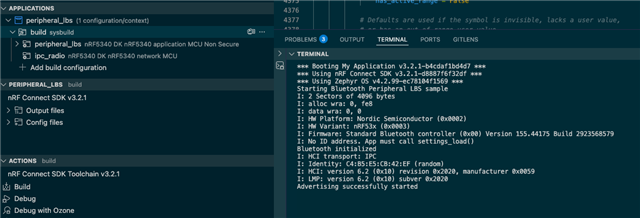
    Have you made any other changes modifications to the peripheral_lbs sample? I do not get any build errors if I build the original version from from SDK v3.2.1 for nrf5340dk/nrf5340/cpuapp/ns. It also seems to run without issues.

    Best regards,

    Vidar 

  • Hi Vidar,

    No modification to the original peripheral_lbs sample was made when building for thingy53/nrf5340/cpuapp/ns. Building the sample for nrf5340dk/nrf5340/cpuapp/ns works, and it runs fine. The issue is with the Thingy53 NS.

    I have just taken another copy of peripheral_lbs from the NCS 3.2.1 samples and attempted to build for thingy53/nrf5340/cpuapp/ns.

    Again, I get the FLASH overflow error, as below.


    Can you please try to build peripheral_lbs for  thingy53/nrf5340/cpuapp/ns? Thank you.

    On Github nrfconnect sdk, for the peripheral_lbs, I noticed that there was a change in the Kconfig.sysbuild last week. PM was disabled for the Thingy53.

    config PARTITION_MANAGER
    	default n if !BOARD_THINGY53 && !BOARD_IS_NON_SECURE
    
    config NRF_DEFAULT_IPC_RADIO
    	default y
    
    config NETCORE_IPC_RADIO_BT_HCI_IPC
    	default y
    
    source "share/sysbuild/Kconfig"


    I haven't updated NCS 3.2.1 to the latest but will later today.

    Also, from the sample.yml history, the Thingy53 non secure target got removed because of BT_CRYPTO support.

    Anyway, I've ended up the path of modifying TF_M size for the Thingy53 NS applications because of the additional space required to support BT_CRYPTO.

    As mentioned before, if I silence (CONFIG_TFM_LOG_LEVEL_SILENCE=y) the TF-M logs, the Thingy NS applications run fine.

    I like to know what's causing TFM Log bus faults and if here is a way to have TFM logs enabled for Thing NS builds.. Thank you.


    Best Regards,
    Ravi

  • Hi Ravi,

    I thought you were getting the same warning on nrf5340DK. Have now tried to build for the thingy53 as well after making the following changes in the board directory:

    diff --git a/boards/nordic/thingy53/pm_static_thingy53_nrf5340_cpuapp_ns.yml b/boards/nordic/thingy53/pm_static_thingy53_nrf5340_cpuapp_ns.yml
    index 70ffe6d9c12..b05346273bd 100644
    --- a/boards/nordic/thingy53/pm_static_thingy53_nrf5340_cpuapp_ns.yml
    +++ b/boards/nordic/thingy53/pm_static_thingy53_nrf5340_cpuapp_ns.yml
    @@ -8,20 +8,20 @@ mcuboot_pad:
       size: 0x200
     tfm_secure:
       address: 0x10000
    -  size: 0xc000
    +  size: 0x18000 
       span: [mcuboot_pad, tfm]
     tfm_nonsecure:
    -  address: 0x1c000
    -  size: 0xd4000
    +  address: 0x28000
    +  size: 0xc8000
       span: [app]
     tfm:
       address: 0x10200
       region: flash_primary
    -  size: 0xbe00
    +  size: 0x17e00
     app:
    -  address: 0x1c000
    +  address: 0x28000
       region: flash_primary
    -  size: 0xd4000
    +  size: 0xc8000
     mcuboot_primary:
       address: 0x10000
       orig_span: &id001
    diff --git a/boards/nordic/thingy53/thingy53_nrf5340_cpuapp_ns_defconfig b/boards/nordic/thingy53/thingy53_nrf5340_cpuapp_ns_defconfig
    index f831ec5148e..aeb0691df9d 100644
    --- a/boards/nordic/thingy53/thingy53_nrf5340_cpuapp_ns_defconfig
    +++ b/boards/nordic/thingy53/thingy53_nrf5340_cpuapp_ns_defconfig
    @@ -6,6 +6,17 @@ CONFIG_ARM_MPU=y
     # Enable TrustZone-M
     CONFIG_ARM_TRUSTZONE_M=y
     
    +# TF-M profile has to be properly configured to be able to run
    +# the Bluetooth stack which uses PSA crypto API.
    +# The following configuration is a minimal set of options required.
    +CONFIG_TFM_PROFILE_TYPE_NOT_SET=y
    +
    +CONFIG_TFM_PARTITION_PLATFORM=y
    +CONFIG_TFM_PARTITION_CRYPTO=y
    +CONFIG_TFM_PARTITION_INTERNAL_TRUSTED_STORAGE=y
    +CONFIG_TFM_PARTITION_PROTECTED_STORAGE=n
    +CONFIG_TFM_PARTITION_INITIAL_ATTESTATION=n
    +
     # This Board implies building Non-Secure firmware
     CONFIG_TRUSTED_EXECUTION_NONSECURE=y


    I did not see any warnings or errors in the log.

    Best regards,

    Vidar

Related