Current consumption increase when using SPI on lower power domain

Hi,

I'm developing an application with an nRF54L15 on a custom PCB and I'm looking to minimize the current consumption. The application is very simple, just a sensor that is connected over SPI and read out every X ms when data is available. In my previous revision of the PCB, I wasn't fully aware of the constraints of the nRF54L15 compared to the nRF52 series (I routed an interrupt pin to a GPIO from P2, which doesn't have GPIOTE) and I didn't specifically design around power domains. That's how I ended up using SPI00 with pins on P2 (following nRF54L15DK). Thinking that I could save on current consumption by using SPI22 with P1 instead, I had a new revision of the PCB made with the interrupt pin correctly routed to a P1 pin. 

Upon testing, though, I noticed a higher current consumption using SPI22 compared to SPI00. Is this to be expected?

Current consumption with SPI00
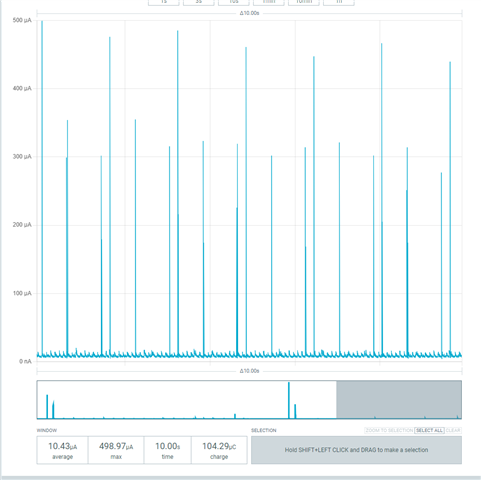
Current consumption with SPI00

Current consumption with SPI22:
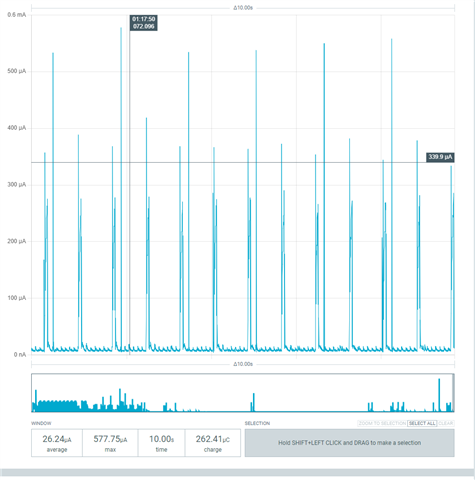
Current consumption with SPI22

It seems that with SPI22 something is powering on for some short time, consuming more current than is the case with SPI00. 

Parents
  • Hello,

    Are both of the SPIs running at the same speed?

    My guess is that the SPI00 is using a higher speed/frequency than SPI22. The spikes do look a bit thinner. If this is the case, then the reason is probably that the SPI00 is using a higher SPI frequency, and hence it uses less time to actually do the transfers, and in total uses less current (more sleep for the CPU and less time toggling SPI GPIOs).

    Best regards,

    Edvin

Reply
  • Hello,

    Are both of the SPIs running at the same speed?

    My guess is that the SPI00 is using a higher speed/frequency than SPI22. The spikes do look a bit thinner. If this is the case, then the reason is probably that the SPI00 is using a higher SPI frequency, and hence it uses less time to actually do the transfers, and in total uses less current (more sleep for the CPU and less time toggling SPI GPIOs).

    Best regards,

    Edvin

Children
Related