Channel sounding tips & tricks? Do i need a second antenna?

Hi,

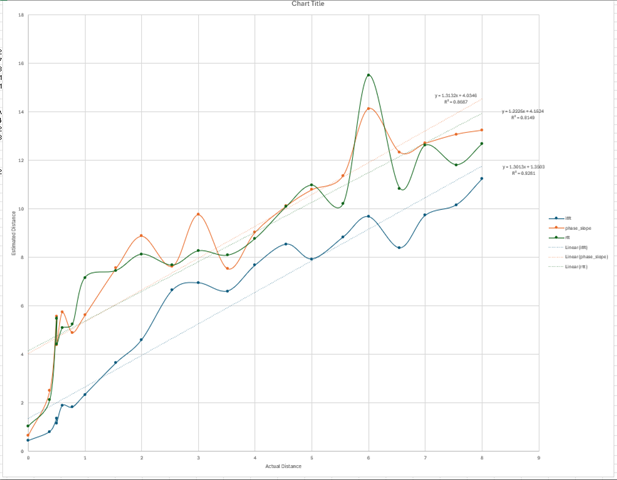
I am working on a project with channel sounding requirements and I have collected some test data. I am using the example codes Bluetooth: Channel Sounding Initiator with Ranging Requestor and Requestor one. However data is not accurate or precise. I have also tried outside and accuracy still isn't perfect. The data also fluctuates a lot. I heard adding a second antenna might help.

We are using nrf54l15-dk. 

So my questions are:

1. What are the data analysis tips & tricks people are using? Is median better than calculating mean? Or what are the cs parameters i can change to get more accurate results? Ifft is tway better than the other data. Why is that?

2. How can i add a second antenna? Datasheet and documentation for the board wasnt super explaining.
Parents
  • For my own Channel Sounding evaluation I created a simple Channel Sounding AT Command Set with nRF Connect SDK for setting up ranging sessions between two devices. It supports one or two antennas (four antenna paths) and I used the dual-antenna channel sounding kit by Ezurio but it also works with the regular single-antenna BL54L15(µ) kits (pre-compiled images for these kits under releases). It outputs raw RTT and IQ data over UART. I also added a Python script which reads the raw IQ data and does the computation for distance estimation and prints all results (RTT, IFFT, slope).

    Might be a good basis for quick testing and further tweaking of the algorithms.

Reply
  • For my own Channel Sounding evaluation I created a simple Channel Sounding AT Command Set with nRF Connect SDK for setting up ranging sessions between two devices. It supports one or two antennas (four antenna paths) and I used the dual-antenna channel sounding kit by Ezurio but it also works with the regular single-antenna BL54L15(µ) kits (pre-compiled images for these kits under releases). It outputs raw RTT and IQ data over UART. I also added a Python script which reads the raw IQ data and does the computation for distance estimation and prints all results (RTT, IFFT, slope).

    Might be a good basis for quick testing and further tweaking of the algorithms.

Children
No Data
Related