Hello together!
I am trying to reproduce the ultra low power connection as described in this whitepaper: /cfs-file/__key/communityserver-discussions-components-files/4/3482.Ultra-low-power-PPP-connection-using-nRF9151.pdf
Therefore, I am using the same hardware, i.e. the nRF9151-DK and the nRF54L15-DK. I downloaded the ncs-serial-modem v1.0.0 and compiled the firmware for both DKs using the description from https://docs.nordicsemi.com/bundle/addon-serial_modem-latest/page/samples/sm_ppp_shell.html and added the required overlays to both the serial modem app and the PPP shell sample. As described, I also disabled VCOM0 on the nRF54L15-DK. I used the exact same wiring as described and a PPK2 in source meter mode at 3.7 V to measure the current of the nRF9151-DK.
Everything works fine and I can connect to a network through the UART shell on the nRF54L15-DK, achieving IP connectivity.
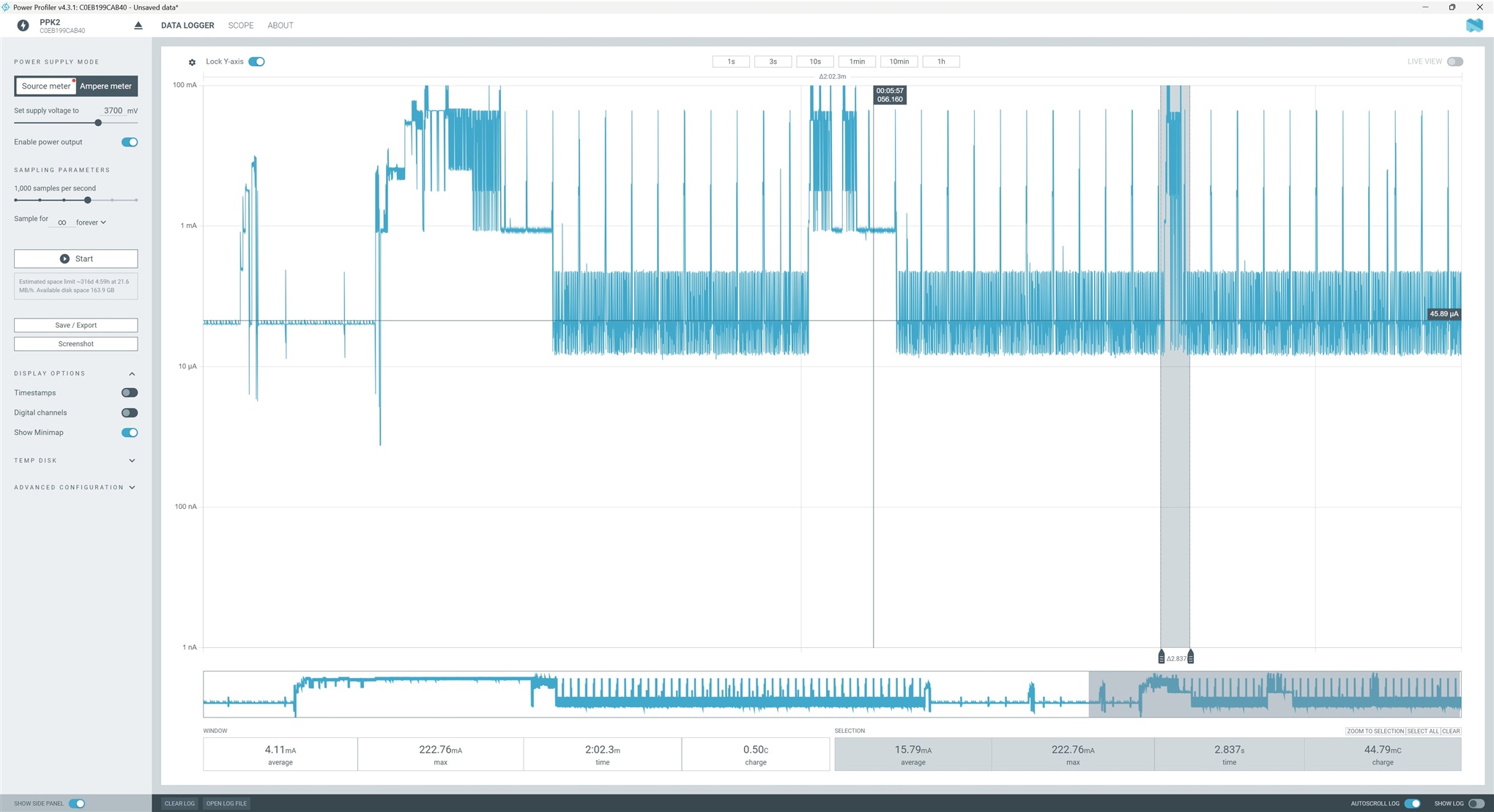
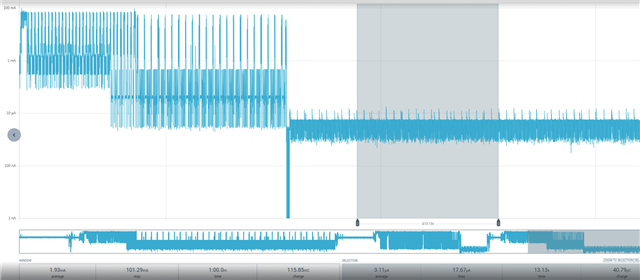
But unfortunately, I am not able to achieve the floor current of 2 uA as described in the whitepaper, instead it is around 40 uA. Even after reset (without sending anything over the UART) the current does not drop below those 40 uA.
When trying the AT client shell sample from https://docs.nordicsemi.com/bundle/addon-serial_modem-latest/page/samples/sm_at_client_shell.html with the exact same setup I am able to achieve a floor/idle current of around 3 uA, which I would accept to be close enough to the "ideal" 2 uA from the whitepaper.
After all, I found a temporary way to reduce the current to 3 uA using the PPP shell sample too, which is:
- bring up IP connectivity
- reset the nRF9151-DK (push button)
- reset the nRF54L15-DK (push button)
I guess, through that procedure I probably break some CMUX or PPP state machine and it's not the intended way how it should work. Doing another reset on the nRF9151-DK the current goes back up to 40 uA.
Is there any additional configuration required to reproduce the setup from the whitepaper? Alternatively, would it be possible to share the source code and test procedure that were used for the measurements in the whitepaper?
Best regards
Bernhard