nRF54L15 BLE RX current comsumption

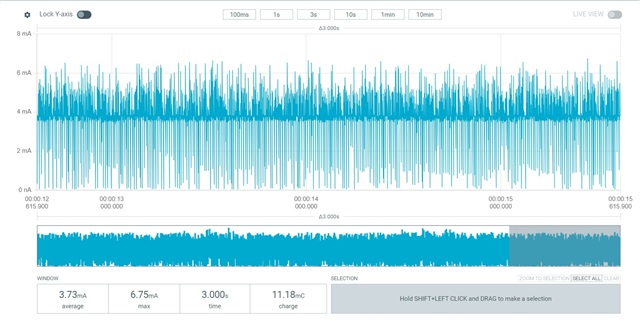
I measured the power consumption of the BLE RX using the nRF54L15.(nRF54L15-DK v1.0.0)
3.0V operation
apps: scan_adv (delete advertising)
west build -b nrf54l15dk/nrf54l15/cpuapp
proj.conf
CONFIG_BT=y
CONFIG_BT_BROADCASTER=y
CONFIG_BT_OBSERVER=y
CONFIG_LOG=n
CONFIG_SERIAL=n

Result: The average current consumption was 3.73mA.
This is 330uA higher than the 3.4mA stated in the datasheet.
Is this correct behavior? Is further processing required to reduce it to 3.4mA?
Parents
  • Hi

    To be clear. With just the radio running in RX, the current consumption is indeed drawing 3.4mA.

    However, the SoftDevice controller, which is what controls the radio peripheral, enables constant latency mode when running, which draws the additional 3.7mA.

    So, the datasheet is correct, but the datasheet doesn't cover how the SoftDevice controller operates, which is where you're confused I believe. 

    The last snippet you added is an example of the system in idle mode (no radio or any other peripherals running), with the constant latency mode enabled.

    Best regards,

    Simon

Reply
  • Hi

    To be clear. With just the radio running in RX, the current consumption is indeed drawing 3.4mA.

    However, the SoftDevice controller, which is what controls the radio peripheral, enables constant latency mode when running, which draws the additional 3.7mA.

    So, the datasheet is correct, but the datasheet doesn't cover how the SoftDevice controller operates, which is where you're confused I believe. 

    The last snippet you added is an example of the system in idle mode (no radio or any other peripherals running), with the constant latency mode enabled.

    Best regards,

    Simon

Children
  • In my opinion it is kind of "false advertising" or whatever you call it to say 3.4 mA in RX mode for the full system consumption (compared to only the radio current usage isolated as in docs.nordicsemi.com/.../parameters.radio_rx_current.html) because such an operation is practically useless without having the MCU domain turned on (e.g. by activating constant latency or having TIMER00 running) while reception is ongoing; otherwise you might receive corrupt packets.

    Please see my post here: https://devzone.nordicsemi.com/f/nordic-q-a/117339/radio-tx-doesn-t-work-unless-mcu-domain-is-active-during-ramp-up/520046 where I came to those conclusions. I am still awaiting feedback in that thread regarding if the errata should be updated to state this fact (i.e. the workaround is necessary for not only TX but also for RX).

  • We prioritize power consumption when selecting devices.
    We have been using the nRF52832, but later discovered a significant discrepancy between the RF power consumption listed in its datasheet and the actual measured values ​​(the measured values ​​were higher than the listed values).
    This time, the measured values ​​are also considerably higher than those listed in the datasheet.
    We have used several devices from other companies in the past, and have never encountered this kind of error.
    We hope that accurate information will be provided in the future.
    The nRF54LM20 likely has a similar problem.

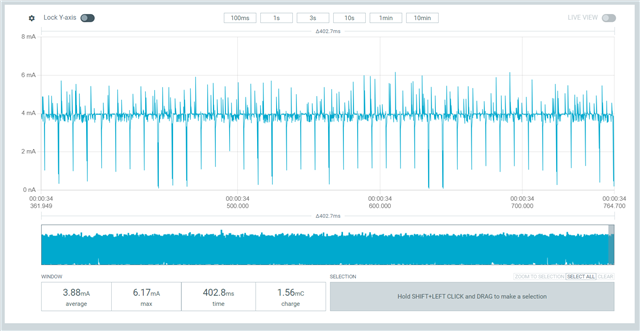
  • These are the results for the nRF54LM20-DK (0.5.4).
    The SoC is the nRF54LM20B.
    The datasheet specifies 3.0V/3.3mA, but the result is 3.88mA, which is 0.58mA (!) higher.
    This may be due to an older revision of the SoC, but it's still a significant problem.

    As an additional note, the real current consumption during reception with the nRF54L15 is 3.0V/3.8mA. During scanning, channel switching and other factors cause the average current consumption to be slightly lower.

    This is an important point to note when checking with an online power profiler.

Related