
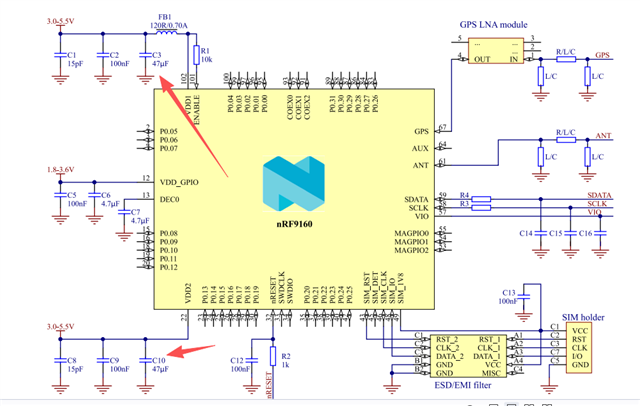
 I noticed from the design guide that the voltage tolerance of capacitors C3 and C10 is 10V. Can I choose 6.3V for the voltage tolerance of these two capacitors? Will this have any impact on the chip?

I noticed from the design guide that the voltage tolerance of capacitors C3 and C10 is 10V. Can I choose 6.3V for the voltage tolerance of these two capacitors? Will this have any impact on the chip?
Hello,
It is strongly advisable to use capacitors with at least a 10 V voltage rating as specified in Nordic's reference design for C3 and C10. Substituting 6.3 V rated capacitors risks insufficient effective capacitance, potential supply voltage drops, and degraded RF and EMI performance.
Looking at the nRF9160 reference circuitry and design recommendations, the capacitors specified in the Bill of Materials (BOM) are predominantly rated at 10 V (X5R type). For example:
[nRF9160 ref circuitry] [nRF9160 design overview]
The nRF9160 operates at a voltage range of 3.0 V to 5.5 V, with a minimum of 3.3 V required for full RF performance. [nRF9160 voltage range]
Regarding using a 6.3 V rated capacitor instead of a 10 V rated one, the key concern is that:
In summary: While the knowledge sources do not explicitly prohibit a 6.3 V rated capacitor for every position, the recommended parts are 10 V (or higher) rated, and using a 6.3 V rated capacitor on supply rails that can reach up to 5.5 V leaves insufficient voltage margin and will likely result in significant capacitance degradation due to DC bias effects. It is strongly advisable to follow Nordic's reference design and use capacitors with at least a 10 V rating for the nRF9160.
Kind regards,
Øyvind
Hello,
It is strongly advisable to use capacitors with at least a 10 V voltage rating as specified in Nordic's reference design for C3 and C10. Substituting 6.3 V rated capacitors risks insufficient effective capacitance, potential supply voltage drops, and degraded RF and EMI performance.
Looking at the nRF9160 reference circuitry and design recommendations, the capacitors specified in the Bill of Materials (BOM) are predominantly rated at 10 V (X5R type). For example:
[nRF9160 ref circuitry] [nRF9160 design overview]
The nRF9160 operates at a voltage range of 3.0 V to 5.5 V, with a minimum of 3.3 V required for full RF performance. [nRF9160 voltage range]
Regarding using a 6.3 V rated capacitor instead of a 10 V rated one, the key concern is that:
In summary: While the knowledge sources do not explicitly prohibit a 6.3 V rated capacitor for every position, the recommended parts are 10 V (or higher) rated, and using a 6.3 V rated capacitor on supply rails that can reach up to 5.5 V leaves insufficient voltage margin and will likely result in significant capacitance degradation due to DC bias effects. It is strongly advisable to follow Nordic's reference design and use capacitors with at least a 10 V rating for the nRF9160.
Kind regards,
Øyvind
