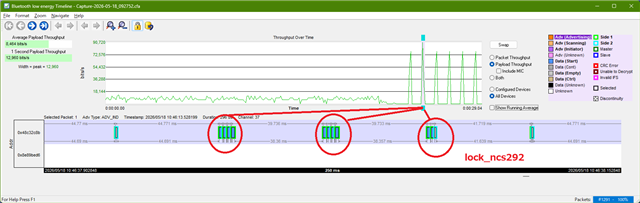
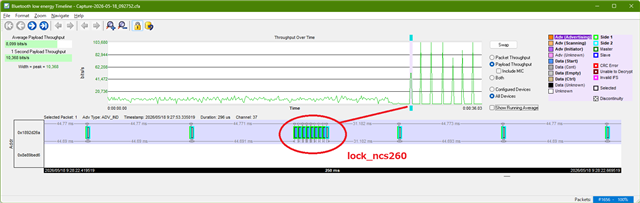
BLE throughput differs between NCS v2.6.0 and v2.9.2.

Hi,

BLE throughput differs between NCS v2.6.0 and v2.9.2.
v2.9.2 appears to have fewer MoreData packets.
(Both have CONFIG_BT_CTLR_SDC_MAX_CONN_EVENT_LEN_DEFAULT set to 7500)
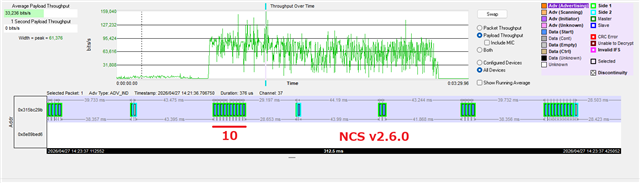
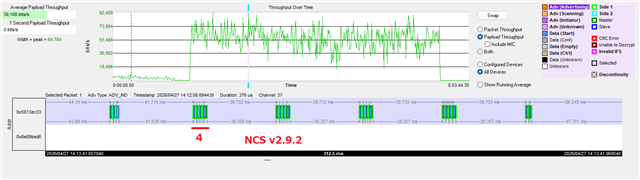
In v2.9.2, I confirmed that setting `CONFIG_BT_CTLR_SDC_MAX_CONN_EVENT_LEN_DEFAULT=15000` changes the number of more data packets.
Is there a difference in how `CONFIG_BT_CTLR_SDC_MAX_CONN_EVENT_LEN_DEFAULT` is handled between v2.6.0 and v2.9.2?

- Using the nrf5340
- Configured for multi-protocol communication with Matter (At the time of this test, commissioning had not been performed, and no Matter communication was taking place)

Parents
  • Hello,

    Can you please upload your whole application in v2.9.2?

    Best Regards,

    Samruddhi

  • HI, I've created a project so you can reproduce it on a DK board.

    Overview

    Packets are periodically transmitted from the Central to the Peripheral.
    Once both devices are powered on, they connect automatically and transmit packets at 1-second intervals.

    Project Details

    • central_52840dk
      - Description: Central-side project for the nRF52840 DK.
      - Base: ncs292/zephyr/samples/bluetooth/central
    • lock_5340dk_ncs260
      - Description: Peripheral-side project for the nRF5340 DK (NCS 2.6.0).
      - Base: ncs260/nrf/samples/matter/lock
    • lock_5340dk_ncs292
      - Description: Peripheral-side project for the nRF5340 DK (NCS 2.9.2).
      - Base: ncs292/nrf/samples/matter/lock

    8055.lock_5340dk_ncs292.zip

    7624.lock_5340dk_ncs260.zip

    1856.central_52840dk.zip

  • Hi,

    Both ncs2.6.0 and ncs2.9.2 are being operated on the same DK board. I have sent the project files, so could you please perform a packet capture on the Nordic side as well?

    Here is the background regarding this issue:

    1. We discovered that the throughput differs between ncs2.6.0 and ncs2.9.2 in a certain product, with ncs2.9.2 being slower. After capturing the BLE packets, we confirmed that the number of "More Data" packets differs between ncs2.6.0 and ncs2.9.2. This was the starting point of the DevZone topic.

    2. Samruddhi Jadhav requested that we provide the project.

    3. I have created and provided a test project for the DK board so that the issue can be reproduced on your end.

  • Hello,

    Yes. Samruddhi asked if I could have a look at your ticket. 

    Can you please clarify for me where you are sending the packets? The reason I ask is that most of us who are familiar with Bluetooth are not that familiar with the Matter stack, and since this is all written in C++, I need some help navigating. So can you please point me to where you are sending/queuing the packets, so that I can speed up the investigation to help you solve your issues quicker?

    Best regards,

    Edvin

  • Hi,

    This project is based on a Matter sample project, but it concerns Bluetooth communication.
    Matter is not running, and commissioning has not been performed.
    Additionally, the project I provided is a modified version of the sample project provided by NCS, but the changes are minimal.
    Please compare it with the original NCS sample code.

    Project Details (Repeat)

    central_52840dk
    - Description: Central-side project for the nRF52840 DK.
    - Base: ncs292/zephyr/samples/bluetooth/central
    lock_5340dk_ncs260
    - Description: Peripheral-side project for the nRF5340 DK (NCS 2.6.0).
    - Base: ncs260/nrf/samples/matter/lock
    lock_5340dk_ncs292
    - Description: Peripheral-side project for the nRF5340 DK (NCS 2.9.2).
    - Base: ncs292/nrf/samples/matter/lock


    [central_52840dk]---ble_packet--->[lock_5340dk_ncs260]

    [central_52840dk]---ble_packet--->[lock_5340dk_ncs290]

  • I am struggling to find where you are sending the large arrays containing 0x00's. Perhaps you can help me locate them.

    BR,

    Edvin

  • Hi,

    > sending the large arrays containing 0x00's'

    I believe this is the code on the central_52840dk side.

    static void timeout_handler( struct k_timer *timer )
    {
        static uint8_t data[155] ={0};
        static uint16_t count=0;
    	
        if (fts_rx_handle) {
            printk("send sequence %d\n", count);
            data[0] = count++;
            bt_fts_client_send(data, sizeof(data));
            bt_fts_client_send(data, sizeof(data));
            bt_fts_client_send(data, sizeof(data));
            bt_fts_client_send(data, sizeof(data));
            bt_fts_client_send(data, sizeof(data));
            bt_fts_client_send(data, sizeof(data));
            bt_fts_client_send(data, sizeof(data));
            bt_fts_client_send(data, sizeof(data));
        } else {
            printk("Waiting for handle discovery...\n");
        }
    }
    
    ```


    This packet is received by either lock_5340dk_ncs260 or lock_5340dk_ncs292.

    [central_52840dk]---ble_packet--->[lock_5340dk_ncs260]

    [central_52840dk]---ble_packet--->[lock_5340dk_ncs292]

    The sender is central_52840dk.
    The receiver is either lock_5340dk_ncs260 or lock_5340dk_ncs292.
    lock_5340dk_ncs292 has fewer MD packets.

    It appears that lock_5340dk_ncs292 is not returning an ACK.

Reply
  • Hi,

    > sending the large arrays containing 0x00's'

    I believe this is the code on the central_52840dk side.

    static void timeout_handler( struct k_timer *timer )
    {
        static uint8_t data[155] ={0};
        static uint16_t count=0;
    	
        if (fts_rx_handle) {
            printk("send sequence %d\n", count);
            data[0] = count++;
            bt_fts_client_send(data, sizeof(data));
            bt_fts_client_send(data, sizeof(data));
            bt_fts_client_send(data, sizeof(data));
            bt_fts_client_send(data, sizeof(data));
            bt_fts_client_send(data, sizeof(data));
            bt_fts_client_send(data, sizeof(data));
            bt_fts_client_send(data, sizeof(data));
            bt_fts_client_send(data, sizeof(data));
        } else {
            printk("Waiting for handle discovery...\n");
        }
    }
    
    ```


    This packet is received by either lock_5340dk_ncs260 or lock_5340dk_ncs292.

    [central_52840dk]---ble_packet--->[lock_5340dk_ncs260]

    [central_52840dk]---ble_packet--->[lock_5340dk_ncs292]

    The sender is central_52840dk.
    The receiver is either lock_5340dk_ncs260 or lock_5340dk_ncs292.
    lock_5340dk_ncs292 has fewer MD packets.

    It appears that lock_5340dk_ncs292 is not returning an ACK.

Children
  • Hello,

    So I looked at your applications, and captured a sniffer trace between the lock_5340_ncs292 and the central_52840dk applications, and this is what I got in my office environment:

    new_trace_292.pcapng

    From what I can tell, there is no degrade in performance. From your ...292.pcapng trace I saw that there wass a lot of packet loss, but the traces themselves can't tell why the central didn't try to send more packets. 

    If you do have a certain amount of data that you need to send, you need to check the return value of your bt_fts_client_send_data(), which does indeed return a value:

    /* Function to send data to the discovered FTS RX handle */
    int bt_fts_client_send(const uint8_t *data, uint16_t len)
    {
    	if (!btconn || !fts_rx_handle) {
    		printk("FTS RX handle not discovered or not connected\n");
    		return -EIO;
    	}
    
    	int err = bt_gatt_write_without_response(btconn, fts_rx_handle, data, len, false);
    	printk("bt_gatt_write_without_response len:%d 0x%04x: %d\n", len, fts_rx_handle, err);
    
    	return err;
    }

    So if it returns 0, it means that the packet was successfully queued, and will be transmitted (when the link has capacity). 

    If it returns anything other than 0, it means that the packet was not queued, and will not be sent. In those cases, you need to look at the return value to see why these were not able to be queued.

    I see from your 262 trace that it always sent 5 packets, so I suspect that you did change the central application after capturing this trace, before sending the central application, since the central application always sends 8 packets once every second.

    Best regards,

    Edvin

Related