Question about ESB Power Consumption at Different PHY Data Rates

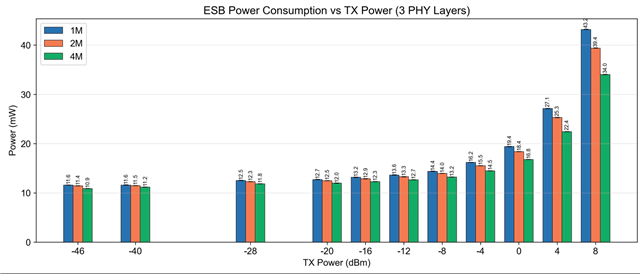
I have observed that when using the ESB protocol at maximum throughput, the measured power consumption decreases as the PHY data rate increases: 4 Mbps consumes less power than 2 Mbps, and 2 Mbps consumes less power than 1 Mbps.

Could you help explain the reason behind this behavior?
  • Hi Zhou, 
    When you do 2 Mbps or 4 Mbps, the current when the radio is active remain the same but the time it take to transmit the same data is reduced by half or 1/4 of what you would need in 1Mbps. This might explain what you observed, you consume less power when doing 4Mbps and 2Mbps compare to 1Mbps.

    The trade off here is the range. You have reduced range when doing 2Mbps and 4Mbps.  

  • Hi

    I thought that when each PHY operates at its maximum throughput, the percentage of radio-active time over the total time would be the same. Under this assumption, the energy consumption of the three PHYs should also be similar.

    However, the measured power consumption is different, and the 4M PHY shows lower energy consumption. Does this imply that, at a higher PHY rate, the actual radio utilization becomes lower?

    This also seems to be reflected in the maximum throughput results: the throughput is 767 kbps for 1M, 1404 kbps for 2M, and 2284 kbps for 4M. When the PHY rate doubles, the achieved throughput does not double accordingly, which indicates that the utilization efficiency decreases at higher PHY rates.

    ...

  • Hi Zhou, 

    Ok, so the power measurement was measured under continuous max throughput text I assume ? 
    In that case you may need to measure the radio active time. You can do this by profiling the power consumption. This way you can find much time the radio is utilized and see if you have optimized the application or not. 
    You can use a PPK2 for this purpose. 

    My suspicion is that the buffer was not filled quick enough, so on 4Mbps it has some idle time that reduce the throughput and the power consumption. 

Related