Hello Nordic team,
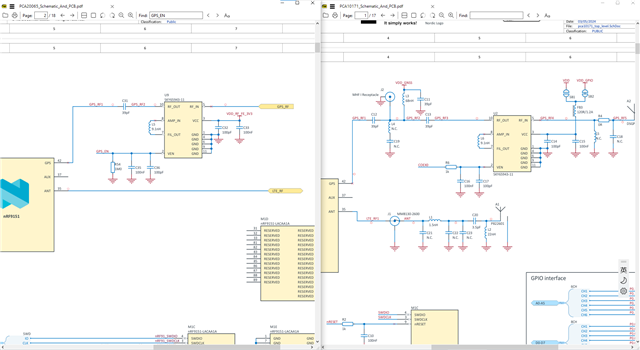
We are reviewing the GNSS LNA design for an nRF9151-based product and noticed a difference between the nRF9151 DK and Thingy:91 X implementations of the SKY65943-11.
### 1. nRF9151 DK implementation
According to the nRF9151 DK schematic:
- SKY65943-11 VCC is supplied from VDD_GPIO.
- When VDD_GPIO is 1.8 V, the LNA VCC is approximately 1.8 V.
- VEN is driven by COEX0, whose high level is also approximately 1.8 V.
Therefore, when VCC is 1.8 V:
VCC ≈ 1.8 V
VEN high ≈ 1.8 V
Required VEN high ≥ VCC − 0.3 V = 1.5 V
This appears to meet the SKY65943-11 recommended operating conditions.
### 2. Thingy:91 X implementation
According to the Thingy:91 X PCA20065 schematic:
- SKY65943-11 VCC is supplied from the switched VDD_RF_FE_3V3 rail.
- The 3.3 V rail is enabled through load switch U13, controlled by COEX2 / RFFE_LTE_ENABLE.
- SKY65943-11 VEN is driven directly by COEX0 / GPS_EN.
- The nRF9151 VDD_GPIO supply is 1.8 V, so the COEX0 high level should also be approximately 1.8 V.
This results in:
VCC ≈ 3.3 V
VEN high ≈ 1.8 V
Required VEN high ≥ VCC − 0.3 V = 3.0 V
According to the SKY65943-11 Rev.H datasheet, the recommended VEN levels are:
Enable high: VCC − 0.3 V ≤ VEN ≤ VCC
Disable low: VEN ≤ 0.3 V
Therefore, a 1.8 V VEN signal appears to be outside the published recommended operating condition when VCC is 3.3 V.
### Questions
Could Nordic please clarify the following?
1. Is a 1.8 V VEN level guaranteed to enable the SKY65943-11 when VCC is 3.3 V?
2. Has the Thingy:91 X implementation been characterized across:
- SKY65943-11 process and production-lot variation
- VCC tolerance
- The full operating temperature range
- Power-up and power-down sequencing
3. Is there an unpublished minimum VIH specification, characterization result, or approval from Skyworks that allows VEN=1.8 V when VCC=3.3 V?
4. Is the VCC − 0.3 V requirement intended as a strict input-high requirement, or is it only a conservative test condition?
5. For a new mass-production nRF9151 design, which implementation does Nordic recommend?
- VCC=1.8 V and VEN=1.8 V, similar to the nRF9151 DK
- VCC=3.3 V with a 1.8-to-3.3 V level shifter on VEN
- The original Thingy:91 X implementation with VCC=3.3 V and VEN=1.8 V
6. If the Thingy:91 X implementation is recommended, can Nordic confirm that it is safe to copy without additional VEN level translation?
We understand that the Thingy:91 X has demonstrated good GNSS performance. Our concern is specifically about guaranteed VEN logic-level compatibility for a mass-production design, rather than typical GNSS performance
on a small number of boards.
We are currently using the modem COEX configuration below:
AT%XCOEX0=1,1,1565,1586
AT%XCOEX2=1
In the Thingy:91 X topology, we understand that COEX2 enables the switched 3.3 V RF frontend supply, while COEX0 controls the GNSS LNA VEN pin.
Thank you for helping us confirm the recommended production design.
Best regards,