This post is older than 2 years and might not be relevant anymore
More Info: Consider searching for newer posts

Current or voltage problem

Hello everyone,

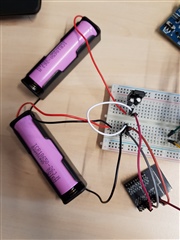
I am having a problem with powering my nrf51822, I have 2 Li ion batteries to power my nrf51822 and a stepper motor, I put the batteries in series to have more power, this way I reache 8.4V in total, that is good, I also know that I can't give 8.4V to my nrf51822, I would destroy it, that is why I use a voltage regulator (https://nl.farnell.com/rohm/ba33dd0t/ldo-fixed-3-3v-2a-to-220fp-3/dp/2342847?ost=BA33DD0T&scope=partnumberlookahead&searchref=searchlookahead&krypto=B%2Bw6trfVJ2dPy0i%2BfgvVpPNNDjQ5GUbVOE1577D2pXPRdc4fYMoJeZKoLSZUPfZwVkhKpDTJ7mPe25JpWIoTic%2FWd7836MhN03vOmRUguobXFuQsMvX3w4zBC8hWIAB3sK6pN%2FMA7mEfbo0W4Jcyv5Z%2F9tdqzOYKtPt2Iz2VLnUSxL%2B1xTNAYEE1LZUAaQAfzx4URrYIaCIk7qjr4X9oiVaSYdP%2BS57MvCc%2BIJwv76zpiYDGMa22SjlyQRFnwWnOcc%2FNZl2IBGNfNItoMcY4fXbMqtomq%2B2%2BeU0Y2hd0dn1i7Dr65HsK6guRm5REUma%2BKFbvAdLYE%2FxublbPrn1qZ78Xey0WeNr%2FriAtK8F5DEl1qz%2F33ynSAUZDRah3N4cgjSalaIgC2AJzFImZj%2BGy36aAJkiEVdOOx2F6iax2R5Exd%2FB1XyT55VOGd0tPe1SeRxSeD96MOkLK7Dql40pqPHkTsOMhjWDeI62nUSTXcM4Nj1BGDCSBu%2FpIxxBj1wUNLHnztLMqHHcznJ%2FdLu%2Bc%2FPG%2Bt%2FT5chCxGkQCULzmqhhLm54hqfqXOO7YOVNwHy3HEL0EITqYdcGZ7yPnkgAc4ckmUCIzUuIIM97TKAzCd1U%3D&ddkey=https%3Anl-NL%2FElement14_Netherlands%2Fw%2Fsearch) I am using this one.

In output i have a stable 3.3V (I measured it with my multimeter) and I have 1.4Amp of current, when I plug the nrf51822, it turns on, it is visible as a peripheral in nrfToolbox and when I try to connect I can't, I have "Error on connection state change (133), I tried to power the nrf51822 with only one batterie that has 3.6V and 2.6Amp of output current and with this I can connect to the nrf51822, I even tried to power it with 2 AAA batteries that have 3.0V and 1Amp of output current and it works.

So I think the problem comes from the voltage regulator, I tried with a different one, even changing the capacitors, but still doesn't work. If someone has an idea of what could be the problem, it would be really helpfull, because I have no idea at this point.

Thank you very much.

Best regards.
Parents
  • According to the BA33DD0T datasheet the thermal dissipation of the LDO is ~1200mW. You need to dissipate (8.4V - 3.3V) * 1.4A = 7.14W. If the LDO has a thermal shutdown then that might reset the nRF51 module continuously. If that's the cause then you need to either add the required heatsink or reduce the current drawn from the LDO. 

    Another probable cause is supply noise from the stepper motor, if that's the case you need to filter the nRF51 module's supply. 

    Either way you need to scope your power supply and see what's going on. 

  • But I Don't understand because the LDO is supposed to support up to 25V Input voltage, why would 8.4V would be a problem? also it is absolutely not hot when I touch it.

    How am I suppose to reduce the current drawn from the LDO if this is the problem?

    I am sure that it is not due to the stepper motor, because the stepper motor is not on the circuit at this moment.

  • "But I Don't understand because the LDO is supposed to support up to 25V Input voltage, why would 8.4V would be a problem?"

    The LDO is not a good solution when you need to supply a large amount of current and step down a large amount of voltage because the LDO removes an amount of power equal to (Vin - Vout) * I from the supply. The power removed is converted to heat, and this is a fundamental limitation of any LDO. 

    "How am I suppose to reduce the current drawn from the LDO if this is the problem?"

    If you cannot reduce the current consumption from 1.4A to less than:

    I = Pd / (Vin-Vout) = 1200mW / (8.4V - 3.3V) = ~235mA

    Then you need to reduce the input voltage to the LDO to:

    Vin = Vout + (Pd / I) = 3.3V + (1200mW / 1.4A) = 4.157V.

    These calculations are only valid given that you're drawing 1.4A from the LDO as you previously stated. 

    If you cannot lower the current drawn from or the input voltage to the LDO then you need to either use a hefty heatsink, or use a Switch Mode Power Supply, commonly known as a Buck/Boost Regulator. 


    "In output i have a stable 3.3V (I measured it with my multimeter)"
    You need an oscilloscope. The supply can be very noisy and the multimeter will probably not capture it. 

Reply
  • "But I Don't understand because the LDO is supposed to support up to 25V Input voltage, why would 8.4V would be a problem?"

    The LDO is not a good solution when you need to supply a large amount of current and step down a large amount of voltage because the LDO removes an amount of power equal to (Vin - Vout) * I from the supply. The power removed is converted to heat, and this is a fundamental limitation of any LDO. 

    "How am I suppose to reduce the current drawn from the LDO if this is the problem?"

    If you cannot reduce the current consumption from 1.4A to less than:

    I = Pd / (Vin-Vout) = 1200mW / (8.4V - 3.3V) = ~235mA

    Then you need to reduce the input voltage to the LDO to:

    Vin = Vout + (Pd / I) = 3.3V + (1200mW / 1.4A) = 4.157V.

    These calculations are only valid given that you're drawing 1.4A from the LDO as you previously stated. 

    If you cannot lower the current drawn from or the input voltage to the LDO then you need to either use a hefty heatsink, or use a Switch Mode Power Supply, commonly known as a Buck/Boost Regulator. 


    "In output i have a stable 3.3V (I measured it with my multimeter)"
    You need an oscilloscope. The supply can be very noisy and the multimeter will probably not capture it. 

Children
Related