

Development Software:
nRF5 SDK for Mesh v3.1.0
SEGGER Embedded Studio for ARM v3.50
SoftDevice S140 v6.1.0
Computer Platform:
Windows 10 Professional
Hardware:
Two nRF52840 DK's
What I'm trying to do:
I've read this part of the Mesh documentation:
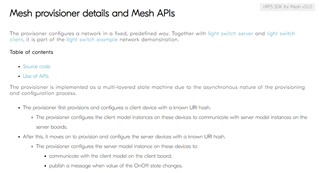
and it seems that the provisioner connects to a client via a URI. I've traced the m_nw_state variable all throughout main.c in the light_switch_provisioner_nrf52840_xxAA_s140_6.1.0 example, as it seems that m_nw_state.p_client_uri is the URI passed to the following function:
static const char * server_uri_index_select(const char * p_client_uri)
{
    if (strcmp(p_client_uri, EX_URI_LS_CLIENT) == 0 || strcmp(p_client_uri, EX_URI_ENOCEAN) == 0)
    {
        return EX_URI_LS_SERVER;
    }
    else if (strcmp(p_client_uri, EX_URI_DM_CLIENT) == 0)
    {
        return EX_URI_DM_SERVER;
    }
    // RengTech RGB URI's
    else if (strcmp(p_client_uri, RGB_CLIENT_URI) == 0)
    {
        return RGB_SERVER_URI;
    }

    __LOG(LOG_SRC_APP, LOG_LEVEL_ASSERT, "Invalid client URI index.\n");
    NRF_MESH_ASSERT(false);

    return NULL;
}
As you can see in the function below, m_nw_state.p_client_uri is passed to the above function, which generates the server URI:
static void app_config_successful_cb(void)
{
    __LOG(LOG_SRC_APP, LOG_LEVEL_INFO, "Configuration of device %u successful\n", m_nw_state.configured_devices);

    hal_led_pin_set(APP_CONFIGURATION_LED, 0);

    m_nw_state.configured_devices++;
    access_flash_config_store();
    ERROR_CHECK(store_app_data());

    if (m_nw_state.configured_devices < (SERVER_NODE_COUNT + CLIENT_NODE_COUNT))
    {
        static const char * uri_list[1];
        uri_list[0] = server_uri_index_select(m_nw_state.p_client_uri);
        prov_helper_provision_next_device(PROVISIONER_RETRY_COUNT, m_nw_state.next_device_address,
                                           uri_list, ARRAY_SIZE(uri_list));
        prov_helper_scan_start();

        hal_led_pin_set(APP_PROVISIONING_LED, 1);
    }
    else
    {
        __LOG(LOG_SRC_APP, LOG_LEVEL_INFO, "All servers provisioned\n");

        hal_led_blink_ms(LEDS_MASK, LED_BLINK_INTERVAL_MS, LED_BLINK_CNT_PROV);
    }
}
However, I'm not able to find where m_nw_state.p_client_uri is assigned. I've added my custom URI's, RGB_SERVER_URI and RGB_CLIENT_URI to example_common.h as follows:
#define EX_URI_BEACON       URI_SCHEME_EXAMPLE "URI for Beacon example"
#define EX_URI_DFU          URI_SCHEME_EXAMPLE "URI for DFU example"
#define EX_URI_ENOCEAN      URI_SCHEME_EXAMPLE "URI for Enocean example"
#define EX_URI_DM_CLIENT    URI_SCHEME_EXAMPLE "URI for Dimming Client example"
#define EX_URI_DM_SERVER    URI_SCHEME_EXAMPLE "URI for Dimming Server example"
#define EX_URI_LPN          URI_SCHEME_EXAMPLE "URI for LPN example"
#define EX_URI_LS_CLIENT    URI_SCHEME_EXAMPLE "URI for LS Client example"
#define EX_URI_LS_SERVER    URI_SCHEME_EXAMPLE "URI for LS Server example"
#define RGB_CLIENT_URI      URI_SCHEME_EXAMPLE "URI for RGB Client example"
#define RGB_SERVER_URI      URI_SCHEME_EXAMPLE "URI for RGB Server example"
#define EX_URI_PBR_CLIENT   URI_SCHEME_EXAMPLE "URI for PB Remote Client example"
#define EX_URI_PBR_SERVER   URI_SCHEME_EXAMPLE "URI for PB Remote Server example"
#define EX_URI_SERIAL       URI_SCHEME_EXAMPLE "URI for Serial example"
My question ultimately is, how does the client URI get set? And where in the code/example does this happen? I'd like to set it to my custom URI and have the provisioner provision my custom example.
