Hi,
Disclaimer - this is definitely a question where one picture worth a 1000 words... ;)
My app use timeslot api to get a free time period to do some hard real-time job (nRF52832, SDK15.2)
The needed timeslot duration is ~1000us and the interval is ~29000us.
- First I open a timeslot session - sd_radio_session_open(TS_RadioCallback)
- I request a timeslot using sd_radio_request(earliest possible) , duration ~2500us (1000 + 1500us margin) interval ~29000us).
If request fails, I pump up its priority (NRF_RADIO_PRIORITY_HIGH) and retry - Upon event NRF_RADIO_CALLBACK_SIGNAL_TYPE_START
- Initialize T0CC0 to 2000 (500us margin before timeslot expires)
- Call app's callback that sets some vars and starts T4
- returns with NRF_RADIO_SIGNAL_CALLBACK_ACTION_NONE
- Some realtime work happens for ~1000us and after 2000us, T0CC0 expires and sets event NRF_RADIO_CALLBACK_SIGNAL_TYPE_TIMER0.
Upon a global flag value (cleared after 9 timeslots) by the app I decide either to- request another timeslot in ~29000us with NORMAL priority (regardless of the prioirty that was used in stage 2 ) &
return NRF_RADIO_SIGNAL_CALLBACK_ACTION_REQUEST_AND_END
or - terminate the timeslots burst by returning NRF_RADIO_SIGNAL_CALLBACK_ACTION_END
- request another timeslot in ~29000us with NORMAL priority (regardless of the prioirty that was used in stage 2 ) &
- Occasionally, the next requested timeslot is blocked/cancelled NRF_EVT_RADIO_BLOCKED/NRF_EVT_RADIO_CANCELED.
In such case I re-request a timeslot (sd_radio_request()) with increasing steps (29100us, 29200us etc) - This is repeated periodically every few seconds
Now, I occasionally observe that the next timeslot, that is supposed to get triggered every 29000us (or longer in 100us steps) actually fires prematurely.
This is often accompanied by a hard-fault (not necessarily immediately)
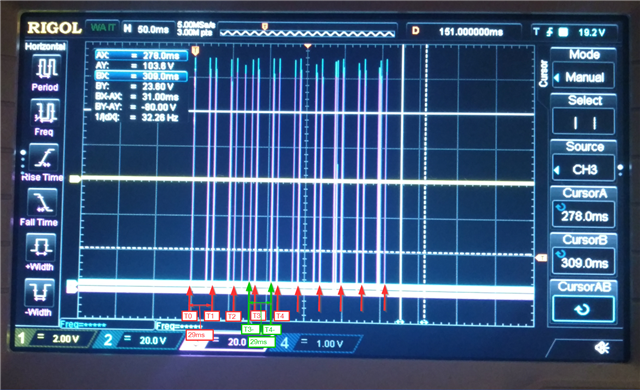
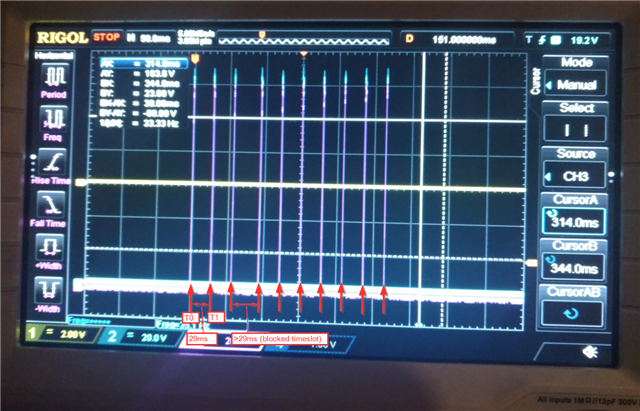
This long post can be summarized in the attached scope capture (using long persistence time) that depicts several 10 pulses bursts (normal capture and one with the phenomenon described)
The 'nominal' pulses that happen every 29ms are marked with red arrow and are evenly spaced
It can be also seen that there are premature pulses, marked with green arrow, that are triggered prematurely (but seem to retain the 29ms spacing)
Now my question are:
- What can be the cause for this observation ?
- If initial timeslot was granted using high priority, do all other timeslots should be requested with high priory as well? Can this explain the hard-faults ?
- Is it possible that after the callback returned NRF_RADIO_SIGNAL_CALLBACK_ACTION_END, another single timeslot shall be triggered (as also observed)
Many thanks for any advice.