Others have had similar problems with pointers for structures. So, I've tried several different methods including one that was suggested in another help ticket. I am writing a block structure so I tried using (uint8_t *) &fstorage pointers to no effect.
Here's my code:
/*****************************************************************************************
                     FStorage Flash EXAMPLE
******************************************************************************************/
static void fstorage_evt_handler(nrf_fstorage_evt_t * p_evt);

NRF_FSTORAGE_DEF(nrf_fstorage_t fstorage) =
{
    /* Set a handler for fstorage events. */
    .evt_handler = fstorage_evt_handler,

    /* These below are the boundaries of the flash space assigned to this instance of fstorage.
     * You must set these manually, even at runtime, before nrf_fstorage_init() is called.
     * The function nrf5_flash_end_addr_get() can be used to retrieve the last address on the
     * last page of flash available to write data. */

    .start_addr = 0x3e000,
    .end_addr   = 0x3ffff,
};

/* Dummy data to write to flash. */

static uint32_t m_data          = 0xBADC0FFE;
static char     m_hello_world[] = "hello world";
#define FLASH_ADDR  0x3e000

/**@brief   Helper function to obtain the last address on the last page of the on-chip flash that
 *          can be used to write user data. */

static uint32_t nrf5_flash_end_addr_get()
{
    uint32_t const bootloader_addr = NRF_UICR->NRFFW[0];
    uint32_t const page_sz         = NRF_FICR->CODEPAGESIZE;
    uint32_t const code_sz         = NRF_FICR->CODESIZE;

    return (bootloader_addr != 0xFFFFFFFF ?
            bootloader_addr : (code_sz * page_sz));
}

// *@brief   Sleep until an event is received.
static void power_manage(void)
{
    (void) sd_app_evt_wait();
}


static void fstorage_evt_handler(nrf_fstorage_evt_t * p_evt)
{
    if (p_evt->result != NRF_SUCCESS)
    {
        NRF_LOG_INFO("--> Event received: ERROR while executing an fstorage operation.");
        return;
    }

    switch (p_evt->id)
    {
        case NRF_FSTORAGE_EVT_WRITE_RESULT:
        {
            NRF_LOG_INFO("--> Event received: wrote %d bytes at address 0x%x.",
                         p_evt->len, p_evt->addr);
        } break;

        case NRF_FSTORAGE_EVT_ERASE_RESULT:
        {
            NRF_LOG_INFO("--> Event received: erased %d page from address 0x%x.",
                         p_evt->len, p_evt->addr);
        } break;

        default:
            break;
    }
}

static void print_flash_info(nrf_fstorage_t * p_fstorage)
{
    NRF_LOG_INFO("========| flash info |========");
    NRF_LOG_INFO("erase unit: \t%d bytes",      p_fstorage->p_flash_info->erase_unit);
    NRF_LOG_INFO("program unit: \t%d bytes",    p_fstorage->p_flash_info->program_unit);
    NRF_LOG_INFO("==============================");
}

void wait_for_flash_ready(nrf_fstorage_t const * p_fstorage)
{
    // While fstorage is busy, sleep and wait for an event.
    while (nrf_fstorage_is_busy(p_fstorage))
    {
        power_manage();
    }
}

/****************** Erase Flash ***************************/
/* This is the address in flash page to be erased.
   The address below is presented as an example to illustrate the API. */

void erase_flash_block(void)
{
  ret_code_t rc;
  static uint32_t pages_to_erase = 1;
  // #define FLASH_ADDR  0x3e000        // defined in global area. Shown here clarity

    rc = nrf_fstorage_erase(
    &fstorage,      // The instance to use.
    FLASH_ADDR,     // The address of the flash pages to erase.
    pages_to_erase, // The number of pages to erase.
    NULL            // Optional parameter, backend-dependent.
    );
  if (rc == NRF_SUCCESS)
  {
    // The operation was accepted.
    // Upon completion, the NRF_FSTORAGE_ERASE_RESULT event
    // is sent to the callback function registered by the instance.
  }
  else
  {
    // Handle error.
  }
}

//int main(void)
int flash_init(void)
{
//typedef enum { FALSE = 0, TRUE = 1, } BOOL; // copy of global section shown here for clarity

/*
struct blockstruct // block to write into flash.
{
  int desired_temp;                       // Last water temperature requested by user.
  int desired_flow;                       // same
  int user_max_temp;
  int absolute_max_temp;
  bool startup_done;
  bool install_mode;
  bool initialization_done;
  bool clockwise_heat;
  int shower_timer;
  bool temp_scale;
  int user_last_preset;
  int user_last_temp;
} flashblock, readflashblock;
*/

//  Fill flash structure with known data to test flash writes and reads
    flashblock.desired_temp = 75;   // Last water temperature requested by user.
    flashblock.desired_flow = 2;    // same
    flashblock.user_max_temp = 103;
    flashblock.absolute_max_temp = 115;
    flashblock.startup_done = 0;
    flashblock.install_mode = 0;
    flashblock.initialization_done = 1;
    flashblock.clockwise_heat = 1;
    flashblock.shower_timer = 13;
    flashblock.temp_scale = 0;

    erase_flash_block();

    wait_for_flash_ready(&fstorage);
    NRF_LOG_INFO("Done Erasing.");

    ret_code_t rc;
    NRF_LOG_INFO("fstorage example started.");
    nrf_fstorage_api_t * p_fs_api;

    NRF_LOG_INFO("Initializing nrf_fstorage_sd implementation...");
    /* Initialize an fstorage instance using the nrf_fstorage_sd backend.
     * nrf_fstorage_sd uses the SoftDevice to write to flash. This implementation can safely be
     * used whenever there is a SoftDevice, regardless of its status (enabled/disabled). */

    p_fs_api = &nrf_fstorage_sd;

    rc = nrf_fstorage_init(&fstorage, p_fs_api, NULL);
    APP_ERROR_CHECK(rc);

    // Print out the flash structure to the debug window
    print_flash_info(&fstorage);

    /* It is possible to set the start and end addresses of an fstorage instance at runtime.
     * They can be set multiple times, should it be needed. The helper function below can
     * be used to determine the last address on the last page of flash memory available to
     * store data. */

    (void) nrf5_flash_end_addr_get();

    // Let's write to flash.
//    NRF_LOG_INFO("Writing \"%x\" to flash.", m_data);
    NRF_LOG_INFO("Writing \"%d\" to flash.", flashblock.desired_temp);
    NRF_LOG_INFO("Writing \"%x\" to flash.", flashblock.desired_flow);
    NRF_LOG_INFO("Writing \"%d\" to flash.", flashblock.user_max_temp);
    NRF_LOG_INFO("Writing \"%d\" to flash.", flashblock.absolute_max_temp);
    NRF_LOG_INFO("Writing \"%h\" to flash.", flashblock.startup_done);
    NRF_LOG_INFO("Writing \"%h\" to flash.", flashblock.install_mode);
    NRF_LOG_INFO("Writing \"%h\" to flash.", flashblock.initialization_done);
    NRF_LOG_INFO("Writing \"%h\" to flash.", flashblock.clockwise_heat);
    NRF_LOG_INFO("Writing \"%d\" to flash.", flashblock.shower_timer);
    NRF_LOG_INFO("Writing \"%h\" to flash.", flashblock.temp_scale);
//    rc = nrf_fstorage_write(&fstorage, 0x3e000, &m_data, sizeof(m_data), NULL);
    rc = nrf_fstorage_write(&fstorage, 0x3e000, (uint8_t*) &flashblock, sizeof(flashblock), NULL);
//    rc = nrf_fstorage_write(&fstorage, 0x3e000, &flashblock, sizeof(flashblock), NULL);
    APP_ERROR_CHECK(rc);

    wait_for_flash_ready(&fstorage);
    NRF_LOG_INFO("Done Writing.");

// Read the information back and put into new structure
/****************** Read Flash ***************************/
/* This is the address in flash where data will be read.
   The address below is presented as an example to illustrate the API.
*/
//#define FLASH_ADDR  0x3e000   // defined in global area. Shown here for clarity

    rc = nrf_fstorage_read(
    &fstorage,              // The instance to use.
    FLASH_ADDR,             // The address in flash where to read data from.
    (uint8_t*) &readflashblock,        // A buffer to copy the data into.
    sizeof(readflashblock)  // Lenght of the data, in bytes.
    );
    if (rc == NRF_SUCCESS)
    {
    // The operation was accepted.
    }
    else
    {
    // Handle error.
    }

    wait_for_flash_ready(&fstorage);
    NRF_LOG_INFO("Done Reading.");

// Now read back the data
    NRF_LOG_INFO("Read back data \"%d\" from flash.", readflashblock.desired_temp);
    NRF_LOG_INFO("Read back data \"%x\" from flash.", readflashblock.desired_flow);
    NRF_LOG_INFO("Read back data \"%d\" from flash.", readflashblock.user_max_temp);
    NRF_LOG_INFO("Read back data \"%d\" from flash.", readflashblock.absolute_max_temp);
    NRF_LOG_INFO("Read back data \"%h\" from flash.", readflashblock.startup_done);
    NRF_LOG_INFO("Read back data \"%h\" from flash.", readflashblock.install_mode);
    NRF_LOG_INFO("Read back data \"%h\" from flash.", readflashblock.initialization_done);
    NRF_LOG_INFO("Read back data \"%h\" from flash.", readflashblock.clockwise_heat);
    NRF_LOG_INFO("Read back data \"%d\" from flash.", readflashblock.shower_timer);
    NRF_LOG_INFO("Read back data \"%h\" from flash.", readflashblock.temp_scale);

    m_data = 0xDEADBEEF;

    NRF_LOG_INFO("Writing \"%x\" to flash.", m_data);
    rc = nrf_fstorage_write(&fstorage, 0x3e100, &m_data, sizeof(m_data), NULL);
    APP_ERROR_CHECK(rc);

    wait_for_flash_ready(&fstorage);
    NRF_LOG_INFO("Done.");

    NRF_LOG_INFO("Writing \"%s\" to flash.", m_hello_world);
    rc = nrf_fstorage_write(&fstorage, 0x3f000, m_hello_world, sizeof(m_hello_world), NULL);
    APP_ERROR_CHECK(rc);

    wait_for_flash_ready(&fstorage);
    NRF_LOG_INFO("Done.");
}
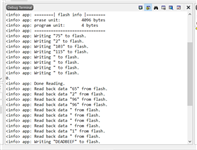
I copied the block structures from the global area into this flash routine for clarity so you can see what I am trying to write. Here's my debug info: