Hello,
I am trying to follow the tutorial SDK UART coexistence example, but it seems like the last step cannot be completed. As you can see, that .hex file does not exist in the folder. Do you have any suggestion?
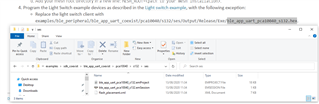
Thanks.
Hello,
I am trying to follow the tutorial SDK UART coexistence example, but it seems like the last step cannot be completed. As you can see, that .hex file does not exist in the folder. Do you have any suggestion?
Thanks.
Hi Marry,
Marry said:What do you mean by this?
BLE and Bluetooth Mesh work differently, so things like how the network is set up (BLE is one-to-one communication, different provisioning, etc.), the services (mesh models vs. GATT Services), and the stacks are different. You can check out this case which discuss this a bit.
Marry said:Do you think this is a good idea? Do you have other suggestions of what I should take care of?
As I stated, it's a lot of work to do combine BLE and mesh. However, it's a case of "you shouldn't do it if you don't have to" and not "you shouldn't do it at all", so it's possible to do so. It just requires some work and you need to know what you're doing and be aware that you risk degrading the mesh traffic.
If you only wanted to turn on/off the light, I would recommend using the mesh light switch example directly, but you can also see if it's possible to implement what you can do in that example. I recommend you read about mesh models. Models define the behavior and communication formats of all data that is transmitted across the mesh. There are several different models in the SDK, for instance the generic OnOff model, which is used to set the OnOff value. I don't know what characteristic you want to implement in the Blinky example, but it could be that you find something to use for it in one of the models. You can read about mesh models here, and you can find the API for mesh models here.
Best regards,
Marte