This post is older than 2 years and might not be relevant anymore
More Info: Consider searching for newer posts

Butonless secure DFU with bonds- limitation on client devices

Hello!

Reading the following segment regarding Buttonless DFU with bonds from the documentation, I'm not clear as to the meaning of these paragraphs. It looks like two contradicting designs are held simultaneously, so I was hoping someone could make this clearer.

Below is a snippet where I point out what I found confusing. I can't understand if the buttonless DFU with bonds process must always be requested by the same client, as indicated in the last marked portion, or if it may be requested by any bonded client, but once a client has requested the device to enter buttonless DFU mode, it must be the same client which completes the DFU process with the same peripheral.

Should a DFU process timeout or fail for any reason, other bonded clients will be able to start a buttonless dfu process with the same peripheral, but again, the same bonded client must be the one to complete the DFU process with this peripheral.
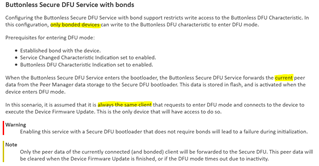


Any clarification will be appreciated.
Thanks!

Parents
  • I am going with the assumption that the bootloader is a 'separate application in itself' from the 'Buttonless DFU service/application'.
    Is that correct?

    If the answer to the above is YES, then are the changes suggested in the file "components\ble\ble_services\ble_dfu\ble_dfu_unbonded.c" for the bootloader application build or for the Buttonless DFU application build?

    Cheers
    RMV

Reply
  • I am going with the assumption that the bootloader is a 'separate application in itself' from the 'Buttonless DFU service/application'.
    Is that correct?

    If the answer to the above is YES, then are the changes suggested in the file "components\ble\ble_services\ble_dfu\ble_dfu_unbonded.c" for the bootloader application build or for the Buttonless DFU application build?

    Cheers
    RMV

Children
Related