

I'm using nRF52 DK (PCA10040) <TWI sensor> example.
On line 139, printed result = NRF_SUCCESS
However, the program doesn't print line 142. Instead, the code jumps to twi_handler()
And then, the code doesn't print line 191. It prints line 206: Case 22: NRF_DRV_TWI_EVT_ADDRESS_NACK
A screenshot of PuTTY is given below
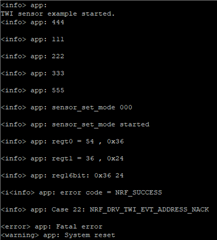
My code is here:
/**
 * Copyright (c) 2015 - 2020, Nordic Semiconductor ASA
 *
 * All rights reserved.
 *
 * Redistribution and use in source and binary forms, with or without modification,
 * are permitted provided that the following conditions are met:
 *
 * 1. Redistributions of source code must retain the above copyright notice, this
 *    list of conditions and the following disclaimer.
 *
 * 2. Redistributions in binary form, except as embedded into a Nordic
 *    Semiconductor ASA integrated circuit in a product or a software update for
 *    such product, must reproduce the above copyright notice, this list of
 *    conditions and the following disclaimer in the documentation and/or other
 *    materials provided with the distribution.
 *
 * 3. Neither the name of Nordic Semiconductor ASA nor the names of its
 *    contributors may be used to endorse or promote products derived from this
 *    software without specific prior written permission.
 *
 * 4. This software, with or without modification, must only be used with a
 *    Nordic Semiconductor ASA integrated circuit.
 *
 * 5. Any software provided in binary form under this license must not be reverse
 *    engineered, decompiled, modified and/or disassembled.
 *
 * THIS SOFTWARE IS PROVIDED BY NORDIC SEMICONDUCTOR ASA "AS IS" AND ANY EXPRESS
 * OR IMPLIED WARRANTIES, INCLUDING, BUT NOT LIMITED TO, THE IMPLIED WARRANTIES
 * OF MERCHANTABILITY, NONINFRINGEMENT, AND FITNESS FOR A PARTICULAR PURPOSE ARE
 * DISCLAIMED. IN NO EVENT SHALL NORDIC SEMICONDUCTOR ASA OR CONTRIBUTORS BE
 * LIABLE FOR ANY DIRECT, INDIRECT, INCIDENTAL, SPECIAL, EXEMPLARY, OR
 * CONSEQUENTIAL DAMAGES (INCLUDING, BUT NOT LIMITED TO, PROCUREMENT OF SUBSTITUTE
 * GOODS OR SERVICES; LOSS OF USE, DATA, OR PROFITS; OR BUSINESS INTERRUPTION)
 * HOWEVER CAUSED AND ON ANY THEORY OF LIABILITY, WHETHER IN CONTRACT, STRICT
 * LIABILITY, OR TORT (INCLUDING NEGLIGENCE OR OTHERWISE) ARISING IN ANY WAY OUT
 * OF THE USE OF THIS SOFTWARE, EVEN IF ADVISED OF THE POSSIBILITY OF SUCH DAMAGE.
 *
 */
/** @file
 * @defgroup tw_sensor_example main.c
 * @{
 * @ingroup nrf_twi_example
 * @brief TWI Sensor Example main file.
 *
 * This file contains the source code for a sample application using TWI.
 *
 */

#include <math.h>
#include <stdio.h>
#include "boards.h"
#include "app_util_platform.h"
#include "app_error.h"
#include "nrf_drv_twi.h"
#include "nrf_delay.h"


#include "nrf_log.h"
#include "nrf_log_ctrl.h"
#include "nrf_log_default_backends.h"

/* TWI instance ID. */
#define TWI_INSTANCE_ID     0


//

/* Common addresses definition for temperature sensor.
 * 1) U means data type is "unsigned". Another example of data type is L, which means "long"
 * 2)  >> is the right shift operator, which means to shift the bit to the right by xxx positions.
 *     e.g. if a = 5 (0000 0101), (a<<1)=10 because (0000 1010)=10
 * 3) The prefix 0x means hexadecimal value
 *    0x21U in hex = 2*(16^1) + 1*(16^0) = 33 in decimal
 *    By seeing the datasheet of SDP3x sensor: address=0x22 when ADDR connects to 1.2K resistor
 *    That's why we define address = 0x22U here
 */
 // When ADDR connects to GND/1.2k resistor, it uses the default I2C address: 0x21/0x22 (Got this info from datasheet)
#define SENSOR_ADDR          (0x22 >> 1)

/* Chose mode for master and slave. Use 1 bit (LSB) to indicate that
   - If master reads data from slave, use 1
   - If master sends data to slave, use 0
   In order to set sensor as continuous mode, use register 0x3608
*/
#define continuous_mode_command1 0x36
#define continuous_mode_command2 0x24

uint16_t tempVal;
float tempC;


/* Indicates if operation on TWI has ended. */
static volatile bool m_xfer_done = false;


/* Creating a TWI master driver instance. */
static const nrf_drv_twi_t m_twi = NRF_DRV_TWI_INSTANCE(TWI_INSTANCE_ID);

/* Buffer for samples read from sensor.
   SDP3x digital sensor outputs a 16-bits data. Since m_sample is 8-bit, so we need to use m_smaple[2] for 16-bit.
*/
static uint8_t m_sample[2];


/**
 * @brief Function for setting mode on sensor
 */
void sensor_set_mode(void)
{
    NRF_LOG_INFO("sensor_set_mode 000\r\n");
    ret_code_t err_code;
    NRF_LOG_INFO("sensor_set_mode started\r\n");
    // Writing CONTINUOUS_MODE = 0x3608U into SDP3x configuration register. Set SDP3x sensor in continuous mode.
    uint8_t reg0 = continuous_mode_command1;
    uint8_t reg1 = continuous_mode_command2;
    NRF_LOG_INFO("regt0 = %d , 0x%x\r\n",reg0,reg0);
    NRF_LOG_INFO("regt1 = %d , 0x%x\r\n",reg1,reg1);
    //uint16_t reg = ((reg0 << 8) | reg1);
    uint8_t reg[2] = {reg0,reg1};
    NRF_LOG_INFO("reg16bit: 0x%x %x\r\n",reg[0],reg[1]);


    /* Function for sending data to a TWI slave.
        * @param[in] p_instance Pointer to the driver instance structure.
        * @param[in] address    Address of a specific slave device (only 7 LSB).
        * @param[in] p_data     Pointer to a transmit buffer.
        * @param[in] length     Number of bytes to send.
        * @param[in] no_stop    If set, the stop condition is not generated on the bus
        *                       after the transfer has completed successfully (allowing
        *                       for a repeated start in the next transfer).
        This function will return NRF_SUCCESS if the procedure was successful.
    */
    err_code = nrf_drv_twi_tx(&m_twi, SENSOR_ADDR, reg, sizeof(reg), false);
    APP_ERROR_CHECK(err_code);
    NRF_LOG_INFO("error code = %s\r\n",nrf_strerror_find(err_code));
    //NRF_LOG_INFO("sizeof reg = %d\r\n",sizeof(reg));

    NRF_LOG_INFO(" set i2c address\r\n");
    while (m_xfer_done == false);
    NRF_LOG_INFO("done1\r\n");

}


/**
 * @brief Function for handling data from temperature sensor.
 *
 * @param[in] temp          Pressure value read from sensor.
 */

__STATIC_INLINE void data_handler(uint16_t pressure_raw_data)
{
     float pressure;
     float pressure_scale = 60.0;
     pressure = pressure_raw_data / pressure_scale ;
     NRF_LOG_INFO("raw_data = %d , pressure = " NRF_LOG_FLOAT_MARKER "\r\n",pressure_raw_data,NRF_LOG_FLOAT(pressure));
}


/**
    @brief Structure for a TWI event.

    typedef struct
    {
        nrf_drv_twi_evt_type_t  type;      ///< 3 TWI master event types (enum): DONE, address_NACK, data_NACK
        nrf_drv_twi_xfer_desc_t xfer_desc; ///< Transfer details.
    } nrf_drv_twi_evt_t;
 */
/**
 * @brief TWI events handler.
 */
void twi_handler(nrf_drv_twi_evt_t const * p_event, void * p_context)
{

     // type: TWI master event types
     // foo->bar is equivalent to (*foo).bar, i.e. it gets the member called bar from the struct that foo points to.
     switch (p_event->type)
    {
        NRF_LOG_INFO("Test222\r\n");

        case NRF_DRV_TWI_EVT_DONE:            // Transfer completed event.
            // NRF_DRV_TWI_XFER_RX: is TWI master driver transfer types (Rx transfer)
            if (p_event->xfer_desc.type == NRF_DRV_TWI_XFER_RX)
            {
                NRF_LOG_INFO("Case 11: NRF_DRV_TWI_EVT_DONE\r\n");

                uint16_t pressure = ((m_sample[0] << 8) | m_sample[1]);
                data_handler(pressure);
            }
            m_xfer_done = true;
            break;
        case NRF_DRV_TWI_EVT_ADDRESS_NACK:
            ///< Error event: NACK received after sending the address.
            NRF_LOG_INFO("Case 22: NRF_DRV_TWI_EVT_ADDRESS_NACK\r\n");
            break;
        case NRF_DRV_TWI_EVT_DATA_NACK:
            ///< Error event: NACK received after sending a data byte.
            NRF_LOG_INFO("Case 33: NRF_DRV_TWI_EVT_DATA_NACK\r\n");
            break;
        default:
            NRF_LOG_INFO("1 Default");
            break;

    }
    NRF_LOG_INFO("Test 2\r\n");
}


/**
 * @brief UART initialization.
 */
void twi_init (void)
{
    ret_code_t err_code;


    // Structure for the TWI master driver instance configuration.
    const nrf_drv_twi_config_t twi_lm75b_config = {
       .scl                = ARDUINO_SCL_PIN,
       .sda                = ARDUINO_SDA_PIN,
       .frequency          = NRF_DRV_TWI_FREQ_100K,     // Options: 100K, 250K, 400K
       .interrupt_priority = APP_IRQ_PRIORITY_HIGH,
       .clear_bus_init     = false
    };
    NRF_LOG_INFO("111\r\n");


    err_code = nrf_drv_twi_init(&m_twi, &twi_lm75b_config, twi_handler, NULL);
    APP_ERROR_CHECK(err_code);
    NRF_LOG_INFO("222\r\n");


    nrf_drv_twi_enable(&m_twi);
    NRF_LOG_INFO("333\r\n");
}


/**
 * @brief Function for reading data from temperature sensor.
 */
static void read_sensor_data()
{
    m_xfer_done = false;
    NRF_LOG_INFO("read_sensor_data\r\n");

    /* Read 1 byte from the specified address - skip 3 bits dedicated for fractional part of temperature.

     * Function for reading data from a TWI slave.
     *
     * The transmission will be stopped when an error occurs. If a transfer is ongoing,
     * the function returns the error code @ref NRF_ERROR_BUSY.
     *
     * @param[in] p_instance Pointer to the driver instance structure.
     * @param[in] address    Address of a specific slave device (only 7 LSB).
     * @param[in] p_data     Pointer to a receive buffer.
     * @param[in] length     Number of bytes to be received.
     *
     * @retval NRF_SUCCESS                    If the procedure was successful.
     */
    ret_code_t err_code1 = nrf_drv_twi_rx(&m_twi, SENSOR_ADDR, &m_sample[0], sizeof(m_sample));
    ret_code_t err_code2 = nrf_drv_twi_rx(&m_twi, SENSOR_ADDR, &m_sample[1], sizeof(m_sample));
    APP_ERROR_CHECK(err_code1);
    APP_ERROR_CHECK(err_code2);
    uint16_t complete_data = ((uint16_t)m_sample[0] << 8) | m_sample[1];
    NRF_LOG_INFO("complete data = %d  \r\n",complete_data);
}


/**
 * @brief Function for main application entry.
 */
int main(void)
{
    NRF_LOG_INFO("aaa\r\n");
    APP_ERROR_CHECK(NRF_LOG_INIT(NULL));
    NRF_LOG_INFO("bbb\r\n");
    NRF_LOG_DEFAULT_BACKENDS_INIT();

    NRF_LOG_INFO("\r\nTWI sensor example started.");

    NRF_LOG_INFO("444\r\n");
    twi_init();
    NRF_LOG_INFO("555\r\n");

    sensor_set_mode();
    NRF_LOG_INFO("666\r\n");
    NRF_LOG_FLUSH();
    // NRF_LOG_INFO("Size = %d\r\n",sizeof(m_sample));
    while (true)
    {
        NRF_LOG_INFO("777\r\n");
        nrf_delay_ms(500);
        NRF_LOG_FLUSH();
        do
        {
            NRF_LOG_INFO("888\r\n");
            NRF_LOG_FLUSH();
            nrf_delay_ms(200);
            //  Wait For Event
            __WFE();
        }while (m_xfer_done == false);
        NRF_LOG_INFO("999\r\n");
        read_sensor_data();
        NRF_LOG_INFO("000\r\n");
        NRF_LOG_FLUSH();
    }
}

/** @} */
Question:
1) Do you know why it's not printing in sequence, please? Some printing sections seem to be skipped.
2) Do you know how to solve "NRF_DRV_TWI_EVT_ADDRESS_NACK", please?
