This post is older than 2 years and might not be relevant anymore
More Info: Consider searching for newer posts

Reducing current peaks

Hi!

We are trying to maximize the battery life of our product and have come across this white paper: High pulse drain impact on CR2032 coin cell battery capacity which suggest flattening the peak current draws should help.

To that end, we measured an nRF52833 current draw in 3 use cases:

1. No capacitors added to board.

2. a 47uF capacitor added in parallel to the battery.

3. 2x 47uF capacitors added in parallel to the battery.

here are the results, in graphs obtained from the PPK:

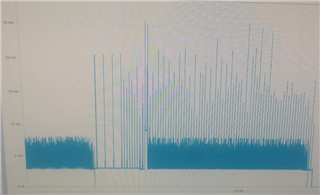
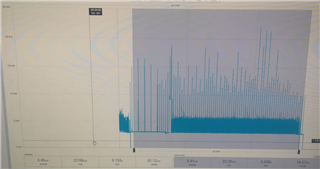
No capacitors added:

In system off- ~1uA average with ~12uA peaks.

While transmitting (There is some overhead of current because of a peripheral but its current draw is more or less constant, so it can be ignored):

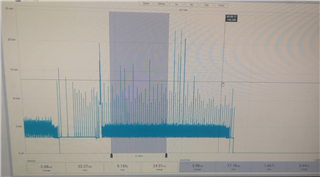
47uF capacitor added:
In system off- ~1uA average with ~4uA peaks.

While transmitting (There is some overhead of current because of a peripheral but its current draw is more or less constant, so it can be ignored):
2x47uF capacitor added:

In system off- ~1uA average with ~3.1uA peaks.

While transmitting (There is some overhead of current because of a peripheral but its current draw is more or less constant, so it can be ignored):

Conclusion:

Adding capacitors in parallel definitely reduces the current peaks in system off mode, and it looks like it also helps reduce the current peaks while transmitting.

Questions:
1. Is there a 'recommended' capacitor value to add in parallel to the battery which anyone has tested? If not, is there a way to calculate the capacitance needed for a given Tx, load size etc?
2. Is there a more 'accurate' way to measure the impact a capacitor has on current peaks than to roughly average the result given out by the PPK?
3. When selecting a capacitor, what are the values we must pay close attention to? We've selected for a low ESR and calculated the current draw an advertising event will require, and tried matching the capacitance after DC-bias to match the required charge.

Any insight will be helpful.
Thanks!

Parents
  • Item 1: I use 3x47uF on CR2032, not less than 6.3 volt but preferably 10 volt

    Item 2: PPK2 is better than PPK; not sure which you are using

    Item 3: The DC voltage applied to a ceramic capacitor causing a reduction in capacitance is well known, maybe see this FAQ link which shows a typical 50% reduction in capacitance using a 6.3volt rated capacitor at 6.3 volts; that requires a 2x increase in rated voltage for a given capacitance value or double the number of expected components fitted. My rule-of-thumb is 3x. See for example murata faqs

    TI also have a good white paper, though older: swra349.pdf (also swra347a.pdf and spreadsheet, not sure if any use swra347)

  • Hi hmolesworth!

    Thank you for the answers!
    I'm using the PPK, not PPK2. I'll consider acquiring a PPK2 as well.

    As far as the capacitance reduction due to DC bias, It seems I was misunderstanding a crucial point. I thought the voltage rating of a capacitor meant minimal DC bias loss while working within the given voltage rating, and that the DC bias loss becomes substantial only when approaching the rated voltage.

    Your link

    See for example murata faqs

    suggest otherwise, if I understood correctly. The bias, even at ~3V is roughly -20%, and at ~5V is roughly -40%. So the capacitance given for the capacitor is accurate only for 0V DC, and must be considered lower at any other DC voltage, even if the capacitor is rated for work in high voltages.
    Is my summary fair?

    Thank you for pointing that out!

    One last question, if my input will be no more than the 3.3V from a coin cell, why would I want the capacitors rated for 6.3V, or 10V, as you mentioned here?

    I use 3x47uF on CR2032, not less than 6.3 volt but preferably 10 volt
  • The PPK2 is much better, worth the cost. The bottom line on capacitors is that for ceramic types of the values you have in mind (say 47uF) at 6 volt operation a 47uF capacitor is only actually (47/2) = approx 24uF. At 3 volts a 6.3 volt capacitor is ok with more or less the 47uF actual capacitance as 3 volts is less than half of the capacitor rated voltage. However I would urge caution, and at 3 volts or 3.3 volts operation use a 10 volt capacitor (my 3x rule-of-thumb). At 10 volt rating and 3.3 volt operation, 47uF really is 47uF.

    Tantalum capacitors, on the other hand, do not have this issue; however Tantalum capacitors have increased leakage, maybe as much as 3uA, and can catch fire if fitted backwards.

Reply
  • The PPK2 is much better, worth the cost. The bottom line on capacitors is that for ceramic types of the values you have in mind (say 47uF) at 6 volt operation a 47uF capacitor is only actually (47/2) = approx 24uF. At 3 volts a 6.3 volt capacitor is ok with more or less the 47uF actual capacitance as 3 volts is less than half of the capacitor rated voltage. However I would urge caution, and at 3 volts or 3.3 volts operation use a 10 volt capacitor (my 3x rule-of-thumb). At 10 volt rating and 3.3 volt operation, 47uF really is 47uF.

    Tantalum capacitors, on the other hand, do not have this issue; however Tantalum capacitors have increased leakage, maybe as much as 3uA, and can catch fire if fitted backwards.

Children
No Data
Related