This post is older than 2 years and might not be relevant anymore
More Info: Consider searching for newer posts

lowest possible current consumption when system is running (nRF52810)

Chip - BT832AF (nRF52810 QFAA)

SDK- nRF5_SDK_17.0.2_d674dde

SD - s112_nrf52_7.2.0

2V- power supply

  My application need not to be very fast, but is extremely concerned about the power consumption. My application  sends beacon, communicates with sensor (SPI).

My device is drawing a current of 330nA during system OFF, 1 uA during system ON. are these the lowest figures I can get ?

Is it possible to reduce the clock frequency to save even more current during the controller is running/systemON/OFF ?

Parents
  • Hi,

    I'm not familiar with the STM32CubeMonitor-Power, and from its features I only see the expected accuracy for specific development kits. Can you confirm whether it is specified for measuring power consumption on custom devices as well?

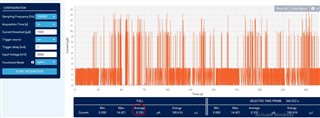
    From the graph this seems like noise/interference of some kind, and there could be quite a few things causing this. To exclude firmware for instance, you can try going to system OFF to see if there are any spikes when measuring there as well.

    It could also be that one or more of your GPIOs are floating. It could also be the equipment you're using. If you measure using an Ampere meter for instance you can confirm whether this is the case, as an ampere meter is generally better at showing the average current consumption over time.

    Best regards,

    Simon

Reply
  • Hi,

    I'm not familiar with the STM32CubeMonitor-Power, and from its features I only see the expected accuracy for specific development kits. Can you confirm whether it is specified for measuring power consumption on custom devices as well?

    From the graph this seems like noise/interference of some kind, and there could be quite a few things causing this. To exclude firmware for instance, you can try going to system OFF to see if there are any spikes when measuring there as well.

    It could also be that one or more of your GPIOs are floating. It could also be the equipment you're using. If you measure using an Ampere meter for instance you can confirm whether this is the case, as an ampere meter is generally better at showing the average current consumption over time.

    Best regards,

    Simon

Children
Related