Hi folks,
We have a project based on an nRF52833, on a custom board, running at 1.8V. There is no Bluetooth (so no SD usage), and the HF and LF clocks are running from the internal sources (i.e. no crystals). The dev environment is SES, no boot loaders (aside from the built-in vector table setup, etc). We're using v17.0.2 of the SDK.
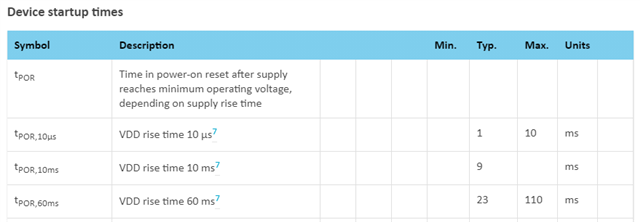
I'm seeing slow start-up times when running at 1.8V, of around 16ms - this is from power on to the first firmware action. This is measured by making the first actions in main() setting up and driving a GPIO high. We can use a 'scope to see the time between power rail rise and and the GPIO activating. I've also verified this using a (almost) stock blinky project as a starting point, with the same results.
When running the same code at 3.3V, the start-up time is more like 1.5ms. I've verified both measurements on a '833-DK board, with similar results. I have also used a high precision external power supply to ensure fast power rail rise, with minimal capacitance on the rails to make sure this isn't a problem of slow rail rises - the processor still takes around 16ms after the rail has comfortably hit 1.8V to start executing (user) code.
I'm not seeing anything that should be causing this in the documentation. This doesn't seem like a BOR issue, unless I've misunderstood how it works.
Can anyone suggest any other avenues to explore or reasons that could cause this behaviour?